“Global Electronic Cash Register Market to reach a market value of USD 16.87 Billion by 2032 growing at a CAGR of 12.1%”
The Global Electronic Cash Register Market size is expected to reach $16.87 billion by 2032, rising at a market growth of 12.1% CAGR during the forecast period.
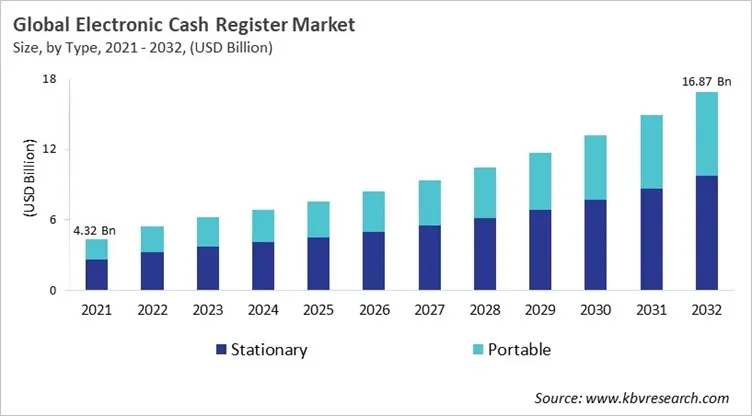
The electronic cash register market is growing swiftly and spans from simple systems for small retailers to advanced & complex, AI-enabled platforms for large vendors and stores, with features like cloud connectivity, centralized management, and integration with inventory. Advanced electronic cash registers facilitate multiple payment process – QR codes, NFC, digital wallets, and EMV cards – meanwhile achieving fiscal regulatory requirements in different regions secure, fraud-proof transaction. Also, point of sale (POS), solutions are propelling the growth of the market. Moreover, the retail industry is growing worldwide, and it has a huge impact on the electronic cash register market growth. For instance, as per the State Council of the Peoples Republic of China, in the first 6 months of 2025, China's total retail sales of consumer goods reached about 3.43 trillion U.S. dollars. Similarly, according to the United States Census Bureau, retail trade sales in USA were up 0.6% in June from May 2025, and up 3.5% from last year. This growth supports the high rates of electronic cash register installations.
In addition, the major trends propelling the market are the using cloud-based ECRs to manage multiple locations from one place, the growth of the handy POS solutions for small and mobile businesses, and the strict regulatory mandates, particularly across the European markets. The big key players like Verifone, Toshiba, NCR, and Casio – are using approaches like secure payment integration, product diversification, and affordable design supported by the increasing global digitalization. As per the World Bank, from April 2020 to December 2022, the percentage of firms investing in digital solutions doubled from 10% to 20% for micro firms and tripled from 20% to 60% for large. The rising investment in digital solutions by investors and proprietors worldwide is another key trend in the growth of the electronic cash register market. Moreover, ECRs are evolving into a major digital pillar of retail industry, transactions, and consumer engagement.
The COVID-19 pandemic had a big effect on the electronic cash register (ECR) market. Lockdowns, labor shortages, and factory shutdowns—especially in Asia—disrupted the supply chains for parts, which caused delays and backlogs in production. Core user industries like retail, hospitality, and food service saw big drops in revenue, which meant less money was available for investments and ECR installations were put off, especially in developing markets. Many businesses focused on cutting costs and went back to basic cash-handling systems. At the same time, the quick shift to contactless and mobile payment solutions made demand for traditional ECRs even lower. As a result, vendors saw their sales drop and had to change their strategies to fit a payment system that was becoming more favorable to digital and cloud-based solutions.

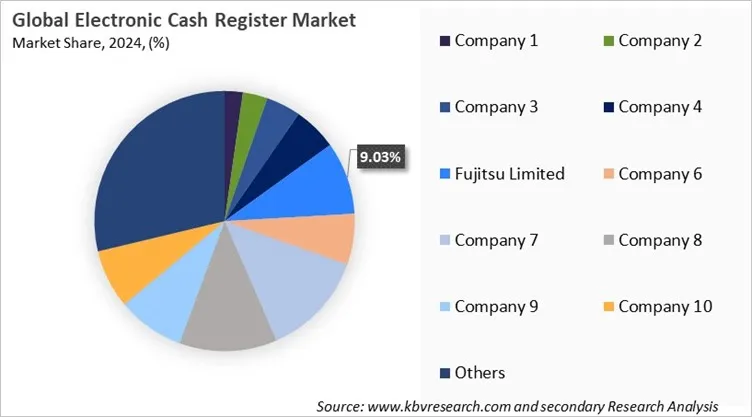
The leading players in the market are competing with diverse innovative offerings to remain competitive in the market. The above illustration shows the percentage of revenue shared by some of the leading companies in the market. The leading players of the market are adopting various strategies to cater to demand coming from the different industries. The key developmental strategies in the market are Acquisitions, and Partnerships & Collaborations.
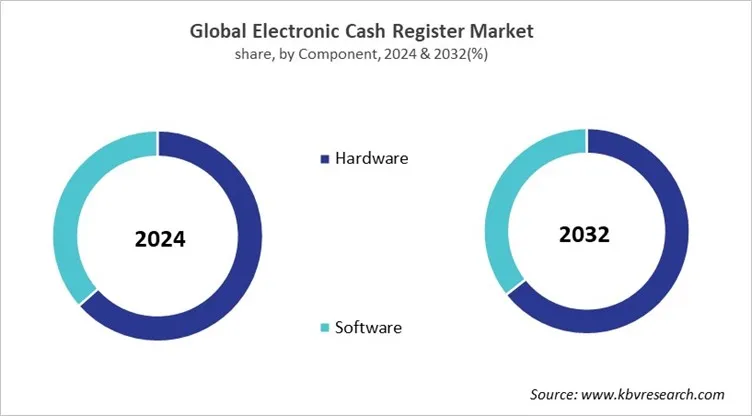
By component, the electronic cash register market is characterized into hardware and software. The hardware segment attained 63% revenue share in the electronic cash register market in 2024. The segment includes essential components such as cash drawers, receipt printers, barcode scanners, and input devices. Retailers and service providers consistently rely on durable hardware for daily operations, driving demand. With businesses upgrading their infrastructure for faster and more reliable transactions, investment in advanced electronic hardware remains a priority across industries like retail, hospitality, and convenience stores.
Based on end-use, the electronic cash register market is classified into retail, hospitality, healthcare, BFSI, and others. The retail segment acquired 47% revenue share in the electronic cash register market in 2024. Enhanced customer experience, faster billing operations, and integration with inventory management systems contributed to the widespread deployment of ECR systems. Retailers embraced these registers to streamline checkout processes and ensure accurate sales tracking. Technological upgrades like touch-screen interfaces and cloud connectivity further supported the sector’s transition to smarter point-of-sale systems, reinforcing the ECR’s role in modern retail environments.
Free Valuable Insights: Global Electronic Cash Register Market size to reach USD 16.87 Billion by 2032
Region-wise, the electronic cash register market is analyzed across North America, Europe, Asia Pacific, and LAMEA. The Asia Pacific segment attained 40% revenue share in the electronic cash register market in 2024. The North American electronic cash register market is mature and driven by technology. There is a big shift from old registers to cloud-based POS platforms that let you manage multiple locations, see real-time inventory, and analyze customer data. The U.S. and Canada are the best at combining contactless and mobile payments like Apple Pay and Google Pay while also following PCI-DSS and local data privacy rules. Companies of all sizes, from large corporations to small businesses, use subscription-based, scalable solutions from companies to improve payment security, omnichannel retail, and operational efficiency. In Europe, strict fiscalization in countries like Italy, Hungary, and Croatia, along with Western Europe's use of GDPR-compliant, cloud-based omnichannel systems, is driving the market.
Asia Pacific is growing quickly thanks to the integration of mobile wallets and QR code payments, government-led fiscalization, and low-cost cloud-based ECRs for small and medium-sized businesses. In contrast, developed markets are focusing on advanced omnichannel features. LAMEA is still diverse. Fiscal reforms in Brazil, Argentina, Kenya, and Uganda have led to more compliant ECR adoption, and mobile-first, offline-capable solutions are filling in infrastructure gaps.
| Report Attribute | Details |
|---|---|
| Market size value in 2024 | USD 6.84 Billion |
| Market size forecast in 2032 | USD 16.87 Billion |
| Base Year | 2024 |
| Historical Period | 2021 to 2023 |
| Forecast Period | 2025 to 2032 |
| Revenue Growth Rate | CAGR of 12.1% from 2025 to 2032 |
| Number of Pages | 541 |
| Number of Tables | 466 |
| Report coverage | Market Trends, Revenue Estimation and Forecast, Segmentation Analysis, Regional and Country Breakdown, Porter’s 5 Forces Analysis, Company Profiling, Companies Strategic Developments, SWOT Analysis, Winning Imperatives |
| Segments covered | Type, Component, Product Type, End-use, Region |
| Country scope |
|
| Companies Included | Square, Inc. (Block, Inc.), Sharp Corporation, Casio Computer Co., Ltd., Dell Technologies, Inc., Fujitsu Limited, HP, Inc., NCR Corporation, Diebold Nixdorf, Inc., Panasonic Holdings Corporation, Oracle Corporation |
By Type
By Component
By Product Type
By End-use
By Geography
This Market size is expected to reach $16.87 Billion by 2032.
Increasing Adoption of POS-Integrated ECRs Across Retail and Hospitality Sectors are driving the Market in coming years, however, Limited Integration Capabilities with Modern Retail Ecosystems restraints the growth of the Market.
Square, Inc. (Block, Inc.), Sharp Corporation, Casio Computer Co., Ltd., Dell Technologies, Inc., Fujitsu Limited, HP, Inc., NCR Corporation, Diebold Nixdorf, Inc., Panasonic Holdings Corporation, Oracle Corporation
The expected CAGR of this Market is 12.1% from 2023 to 2032.
The Stationary segment is leading the Market by Type in 2024; thereby, achieving a market value of $9.7 billion by 2032.
The Asia Pacific region dominated the Market by Region in 2024, and would continue to be a dominant market till 2032; thereby, achieving a market value of $6.9 billion by 2032.
Our team of dedicated experts can provide you with attractive expansion opportunities for your business.









 Unique Offerings