“Global Electric Vehicle Tires Market to reach a market value of USD 25.60 Billion by 2032 growing at a CAGR of 13.1%”
The Global Electric Vehicle Tires Market size is expected to reach $25.60 billion by 2032, rising at a market growth of 13.1% CAGR during the forecast period.
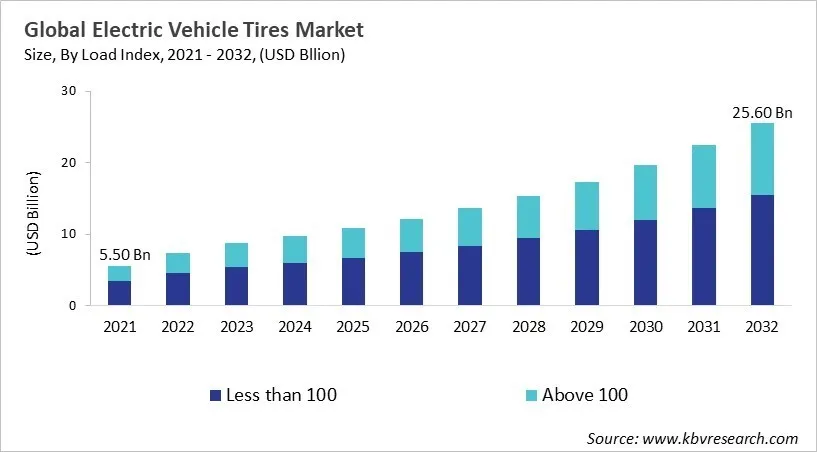
The electric vehicle tyres market has evolved from relying on standard ICE-vehicle tyres to designing specialised, EV-ready solutions developed for heavier battery loads, lower rolling resistance, reduced noise, and higher torque. Key manufacturers like Bridgestone and Michelin have redesigned their portfolios and R&D pipelines toward EV-specific performance elements-including enhanced wear resistance, range-extending compounds, acoustic-reduction technologies, and improved load-bearing structures. Increasing EV production, and government incentives for electrification in markets like Europe, India, and China, and OEM collaborations have surged the transition, supporting tyre makers to invest in sustainability initiatives, manufacturing adaptions, and new materials.
The electric vehicles tyres market is led by strong integration of sustainability and circular-economy principles, noise adaptations for EV dynamics, and energy-efficiency optimisation. Key market players pursue strategies centred on portfolio “EV-readiness”, material innovation, co-development with automakers, and technology leadership to secure both aftermarket demand and OEM fitments. The electric vehicle tyres market is witnessing intensive competition with established players advancing EV-specific technologies. As electrified mobility expands, the market growth majorly depends on sustainable materials, OEM integration, advanced performance features, and smart-tyre capabilities, transitioning the market to specialised EV-tyre solutions.
The major strategies followed by the market participants are Product Launches as the key developmental strategy to keep pace with the changing demands of end users. For instance, In April, 2025, Pirelli & C. S.p.A. unveiled the Scorpion XTM AT all-terrain tire in North America, available for gas-powered and electric vehicles. The Elect variant offers lower rolling resistance, boosting EV range by 5%. Designed for durability, off-road performance, and reduced noise, it comes in multiple sizes and features a 55,000-mile warranty. Moreover, In April, 2025, Pirelli & C. S.p.A. unveiled its fifth-generation P Zero tire, designed for premium and high-performance vehicles, including EVs. Featuring AI-driven development, improved handling, reduced rolling resistance, and Elect technology for extended EV range, it comes in 18–23-inch sizes with over 50 variants, serving luxury brands like Lamborghini, BMW, Lucid, and Polestar.
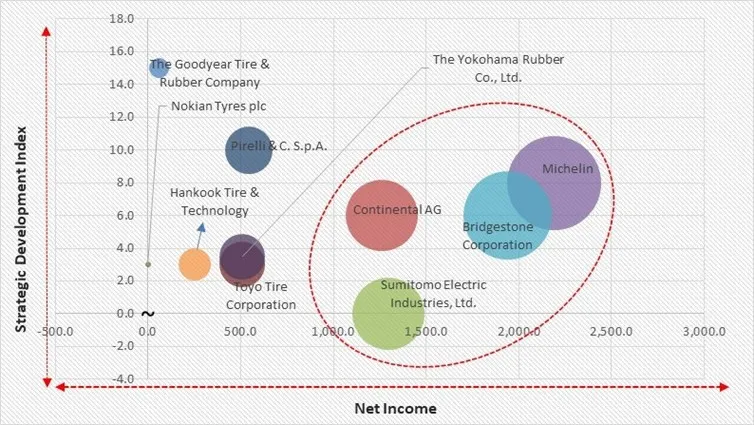
Based on the Analysis presented in the KBV Cardinal matrix; Michelin, Bridgestone Corporation, Sumitomo Electric Industries, Ltd., and Continental AG are the forerunners in the Electric Vehicle Tires Market. In May, 2025, Michelin unveiled the CrossClimate 3 and CrossClimate 3 Sport all-season tires, suitable for ICE, hybrid, and electric vehicles. Offering improved wet grip, longer lifespan, and advanced technologies like Dynamic Response and V-Shape tread, the range will be available in multiple sizes from July 2025, manufactured across several European plants. Companies such as Pirelli & C. S.p.A., The Yokohama Rubber Co., Ltd., and Toyo Tire Corporation are some of the key innovators in Electric Vehicle Tires Market.
The COVID-19 pandemic had a big effect on the global EV tires market. It stopped factories from making tires, made it harder for workers to move around, and caused major shortages of important raw materials, which made production slower and more expensive. The sharp drop in car sales, especially EVs, made the demand for specialized tires even lower, as many car companies put off releasing new models. Lockdowns and less travel also meant that people used their tires less, which caused a big drop in the aftermarket segment. Even though restrictions were lifted, recovery was still slow because prices for materials kept changing, there weren't enough workers, and there were problems with logistics. The pandemic had long-lasting effects on the EV tire industry's ability to produce goods quickly, its financial stability, and its customers' trust in the market. Thus, the COVID-19 had a negative impact on the market.

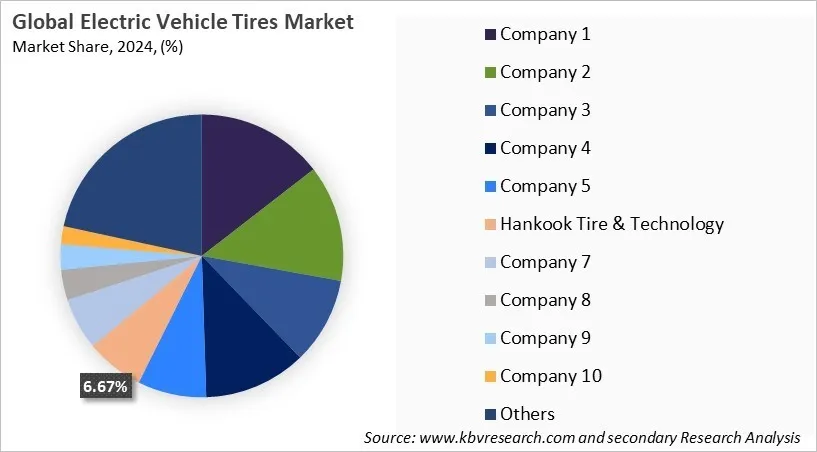
The leading players in the market are competing with diverse innovative offerings to remain competitive in the market. The above illustration shows the percentage of revenue shared by some of the leading companies in the market. The leading players of the market are adopting various strategies in order to cater demand coming from the different industries. The key developmental strategies in the market are Acquisitions, and Partnerships & Collaborations.
Free Valuable Insights: Electric Vehicle Tires Market size to reach USD 25.60 Billion by 2032
Based on Load Index, the market is segmented into Less than 100 and Above 100. The above 100 segment attained 38% revenue share in the electric vehicle tires market in 2024. The above 100 load index segment caters primarily to larger electric vehicles such as SUVs, trucks, and high-performance models that require tires capable of supporting heavier loads and higher torque. This category is characterized by tires with enhanced durability, reinforced sidewalls, and specialized tread patterns that improve traction and handling stability.
Based on Sales Channel, the market is segmented into OEM and Aftermarket. The aftermarket segment recorded 35% revenue share in the electric vehicle tires market in 2024. The aftermarket segment in the electric vehicle tires market focuses on the replacement and maintenance demand for tires once the vehicle is in use. This segment caters to individual consumers, fleet operators, and service centers that require tire replacements due to wear and tear, damage, or seasonal changes.
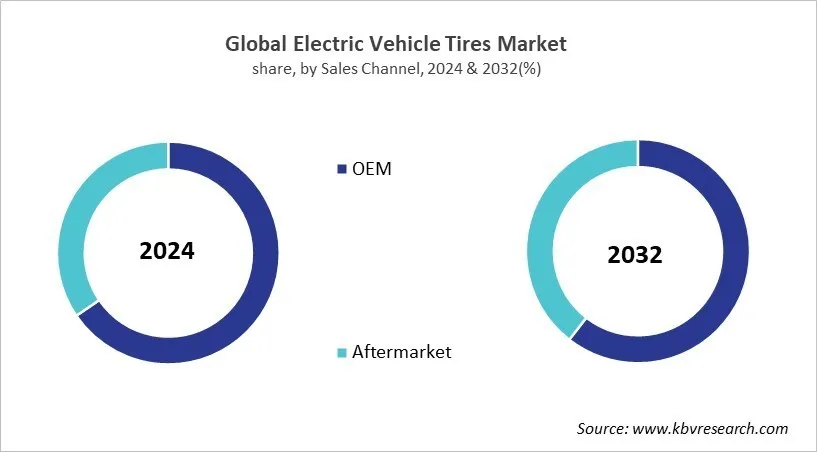
Region-wise, the Electric vehicle tires market is analyzed across North America, Europe, Asia Pacific, and LAMEA. The Asia Pacific segment gained 42% revenue share in the Electric vehicle tires market in 2024. The electric vehicles tires market is predicted to grow at a significant rate in the North America and Europe region. The market is growing significantly due to the accelerating adoption of EVs because of emissions-reduction targets, strong regulatory pressures, and supportive incentives. Both regions focus on premium EV-tyre performance-particularly low rolling resistance, improved wear life, and acoustic optimization-because customer expectations for range and comfort are high. Moreover, European market is growing rapidly by integrating sustainability into tyre manufacturing, with strict standards around noise labels, lifecycle emissions, and abrasion. North America region, backed by rapid growth in EV fleets from GM, Ford, Tesla, and developing startups, is witnessing increasing demand for EV-specific tyres, with key tyre makers rising their “EV-ready” portfolios to secure long-term contracts.
The electric vehicle tire market is anticipated to expand at a substantial rate in the Asia Pacific and LAMEA. The market is driven by expanding EV production hubs, especially in India, Japan, South Korea, and China, and large-scale electrification. The Asia Pacific region is driven by regional innovation, high-volume manufacturing, and competitive regional tyre brands investing in stronger load-bearing designs, EV-optimized compounds, and noise-reduction features. Further, large EV sales in China drives the demand for cost-effective and durable EV tyres across the mass-market and premium segment. In addition, the LAMEA region is also experiencing significant growth in the electric vehicle tire market. The market is led by government-supported EV initiatives in the Middle East and electrification in Latin America. Also, the region is serving with developing opportunities for global players to introduce EV suitable tyres as electrified mobility gains traction.
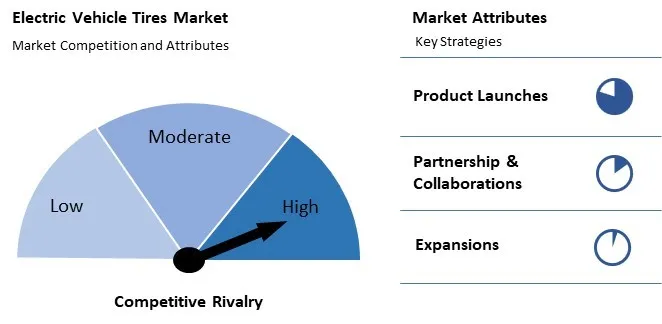
As manufacturers work on specialized designs that balance efficiency, durability, and low rolling resistance, competition in the electric vehicle tire market is getting stronger. Companies compete by making better materials, noise-reduction technologies, and tread patterns that can handle more torque. The market is also affected by more money going into eco-friendly production and recycling methods. As more and more people buy electric vehicles (EVs), companies are trying to stand out by coming up with new ideas, testing their products' performance, and teaming up with automakers. This makes the competition very dynamic and fast-changing.
| Report Attribute | Details |
|---|---|
| Market size value in 2025 | USD 10.82 Billion |
| Market size forecast in 2032 | USD 25.60 Billion |
| Base Year | 2024 |
| Historical Period | 2021 to 2023 |
| Forecast Period | 2025 to 2032 |
| Revenue Growth Rate | CAGR of 13.1% from 2025 to 2032 |
| Number of Pages | 659 |
| Number of Tables | 624 |
| Report coverage | Market Trends, Revenue Estimation and Forecast, Segmentation Analysis, Regional and Country Breakdown, Competitive Landscape, Market Share Analysis, Porter’s 5 Forces Analysis, Company Profiling, Companies Strategic Developments, SWOT Analysis, Winning Imperatives |
| Segments covered | Load Index, Sales Channel, Application, Vehicle Type, Propulsion Type, Rim Size, Region |
| Country scope |
|
| Companies Included | Michelin, Bridgestone Corporation, The Goodyear Tire & Rubber Company, Continental AG, Pirelli & C. S.p.A., Hankook Tire & Technology, The Yokohama Rubber Co., Ltd., Toyo Tire Corporation, Sumitomo Electric Industries, Ltd., and Nokian Tyres plc |
By Load Index
By Sales Channel
By Application
By Vehicle Type
By Propulsion Type
By Rim Size
By Geography
This Market size is expected to reach USD 25.60 billion by 2032.
The electric vehicle tires market is projected to grow at a CAGR of 13.1% between 2025 and 2032.
Rapid adoption of electric vehicles, combined with their unique performance requirements such as weight, torque, and rolling resistance, is reshaping tire innovation and demand.
Michelin, Bridgestone Corporation, The Goodyear Tire & Rubber Company, Continental AG, Pirelli & C. S.p.A., Hankook Tire & Technology, The Yokohama Rubber Co., Ltd., Toyo Tire Corporation, Sumitomo Electric Industries, Ltd., and Nokian Tyres plc
The On-road segment captured the maximum revenue in the Global Electric Vehicle Tires Market by Application in 2024, thereby, achieving a market value of $21.7 billion by 2032.
The Asia Pacific region dominated the Global Electric Vehicle Tires Market by Region in 2024, and would continue to be a dominant market till 2032; thereby, achieving a market value of $10.9 billion by 2032.
Our team of dedicated experts can provide you with attractive expansion opportunities for your business.







 Unique Offerings