“Global Digital Trust Market to reach a market value of USD 299.14 Billion by 2032 growing at a CAGR of 12.9%”
The Global Digital Trust Market size is expected to reach USD 299.14 billion by 2032, rising at a market growth of 12.9% CAGR during the forecast period.
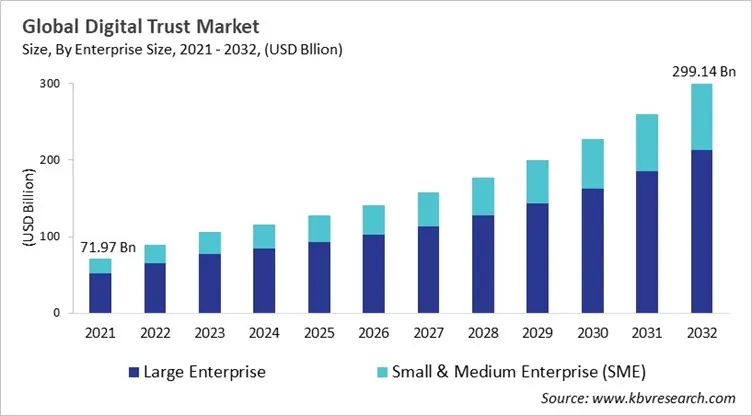
The digital trust market has recently developed into a comprehensive ecosystem that supports transparent, ethical, and secure digital interactions. Earlier developed for defense and government sectors through initiatives like digital identity frameworks and public key infrastructures (PKI), digital trust now is witnessing expanded application across various sectors as a strategic enabler of accountability and reliability in online ecosystems. Advanced digital trust now integrates privacy, cybersecurity, governance, and auditability, backed by developing technologies such as blockchain, IoT, AI, and zero trust architectures. Furthermore, enterprises and governments alike recognize that consumer and citizen trust in digital platforms mainly depends on continuous assurance that systems safeguard data, predictably, behave predictably, and provide transparency in automated decision making.
The digital trust market is witnessing intensive competition among security vendors, technology OEMs, cloud firms, and identity providers seeking to embed trust capabilities directly into services, software, and hardware. Key market players differentiate themselves through trust by ecosystem partnerships, design approaches, acquisitions, real-time trust analytics, and compliance with global frameworks. The growth of self-sovereign identity and decentralized models is transitioning control dynamics, enabling users with greater data autonomy along with demanding interoperability across systems. As a conclusion, digital trust has transformed from a security function to a competitive differentiator and core-business value, which requires transparent governance, continuous validation, and partnership across private and public domains to position themselves in the digital economy.
The major strategies followed by the market participants are Partnerships as the key developmental strategy to keep pace with the changing demands of end users. For instance, In July, 2025, Accenture PLC teamed up with Microsoft, an IT company to co-develop AI-driven cybersecurity solutions leveraging generative AI. This collaboration highlights growing industry efforts to integrate AI into security tools, aiming to enhance resilience, threat detection, and digital protection. The initiative underscores how advanced AI is shaping the future of cybersecurity and digital trust. Additionally, In July, 2025, Palo Alto Networks, Inc. teamed up with Okta to unify AI-driven security, tackling identity threats with integrated solutions. Their joint offerings secure application access on any device, automate threat response, and provide unified visibility across attack surfaces. This collaboration helps enterprises enhance digital trust, streamline security, and strengthen defenses against sophisticated breaches.
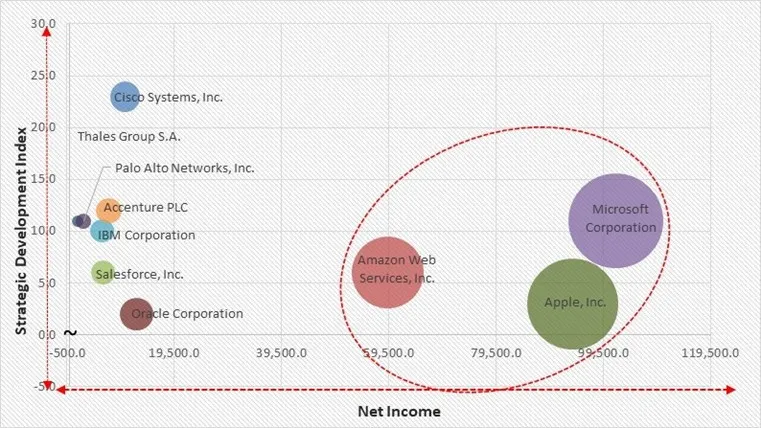
Based on the Analysis presented in the KBV Cardinal matrix; Microsoft Corporation, Apple, Inc., and Amazon Web Services, Inc. are the forerunners in the Digital Trust Market. Companies such as Oracle Corporation, Cisco Systems, Inc., and Accenture PLC are some of the key innovators in Digital Trust Market. In July, 2025, Amazon Web Services, Inc. teamed up with Saviynt, a Software company to integrate its Identity Cloud with Amazon Q Business, enhancing AI-driven identity security and governance. This collaboration strengthens Identity Security Posture Management (ISPM), enabling real-time identity insights, risk reduction, faster compliance checks, and Zero Trust adoption, particularly benefiting regulated industries like finance, healthcare, and manufacturing.
The COVID-19 pandemic had a big effect on the digital trust market. Because the economy was so uncertain around the world, many businesses, especially small and medium-sized ones, had to cut back on their operations and put off spending money on cybersecurity and identity management. Budget cuts and delayed digital transformation projects made it harder for people to use secure frameworks like blockchain and digital identity systems. Remote work sped up digital interactions, but not being ready for it led to more cyberattacks, data breaches, and a loss of consumer trust. Disruptions in the supply chain made it harder to set up secure infrastructure, and the focus of regulators moved away from data protection, which caused uncertainty. In general, these things slowed down innovation, investment, and growth in the digital trust ecosystem for a short time. Thus, the COVID-19 pandemic had a negative impact on the market.

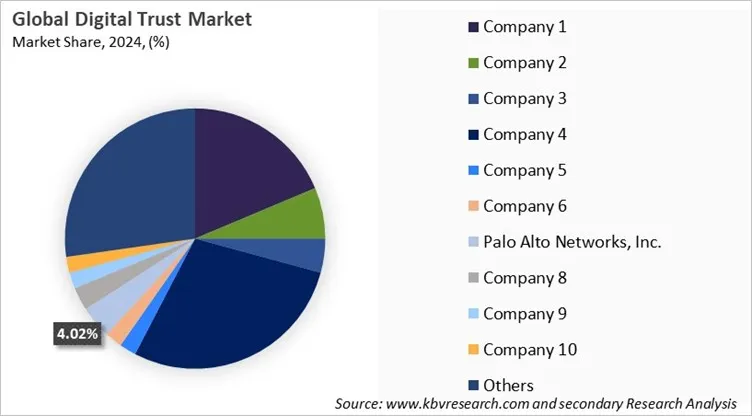
The leading players in the market are competing with diverse innovative offerings to remain competitive in the market. The above illustration shows the percentage of revenue shared by some of the leading companies in the market. The leading players of the market are adopting various strategies in order to cater demand coming from the different industries. The key developmental strategies in the market are Acquisitions, and Partnerships & Collaborations.
Free Valuable Insights: Digital Trust Market size to reach USD 127.59 Billion by 2032
Based on enterprise size, the digital trust market is characterized into large enterprise and small & medium enterprise (SME). The small & medium enterprise (SME) segment attained 27% revenue share in the digital trust market in 2024. As SMEs expand their digital presence through e-commerce platforms, cloud services, and mobile applications, the need for accessible, scalable, and cost-effective digital trust solutions becomes increasingly important. These enterprises often seek turnkey solutions and managed services that can provide secure authentication, data privacy, and compliance support without requiring extensive in-house security teams.
On the basis of technology, the digital trust market is classified into technology, AI & ML, cloud computing, privacy enhancing technologies (PETs) multi-factor authentication (MFA), and others. The cloud computing segment recorded 26% revenue share in the digital trust market in 2024. As organizations shift to cloud-based environments for scalability and agility, the need for secure and trusted cloud frameworks becomes increasingly vital. Cloud platforms offer built-in security features, encryption protocols, and access controls, all of which contribute to maintaining trust in data handling and system availability.
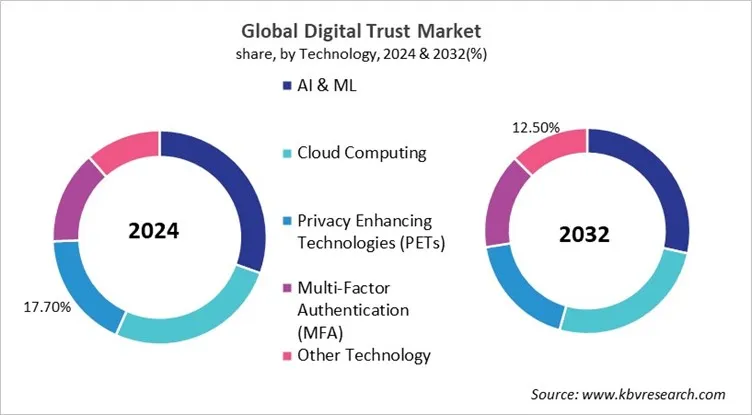
Region-wise, the Digital Trust Market is analyzed across North America, Europe, Asia Pacific, and LAMEA. The North America segment recorded 39% revenue share in the digital trust market in 2024. The digital trust market is anticipated to grow at a significant rate in North America and Europe. This is due to advanced digital infrastructures, stringent regulatory frameworks, and widespread acceptance of cybersecurity and identity management technologies. In North American nations, especially in the US, federal initiatives like the Department of Homeland Security and the National Cybersecurity Strategy’s zero trust mandates have surged the investments in trusted digital identity systems, secure data exchange frameworks, and AI governance. Enterprises across various industries-from healthcare to finance-are deploying trust frameworks to fulfil compliance and improve customer confidence. Furthermore, Europe’s market is growing with a policy-first approach through the regulatory frameworks such as GDPR, eIDAS regulations, and the upcoming AI Act, focusing on ethical AI, interoperability, and privacy. The region’s emphasis on cross-border digital identity, trust certification schemes, and transparency positions the digital trust market as a benchmark for standardization and governance.
In the Asia Pacific and LAMEA regions, the digital trust market is expected to grow at a prominent rate in the upcoming years. This expansion is supported by surging digital transformation alongside e-government initiatives. In the Asia Pacific, nations like Japan, Singapore, Australia, and South Korea are implementing zero trust frameworks and national digital identity programs to secure their rising digital economies, while developing nations such as Indonesia and India are deploying digital trust for citizen services and financial inclusion. Moreover, the Middle East region is prioritizing trust frameworks with the aim of supporting national digital strategies and smart city, with governments in Saudi Arabia and the UAE leading large-scale trust infrastructure integration. Also, Latin America and Africa are witnessing cross-border data initiatives, and growing cybersecurity regulations are accelerating expansion. The increasing cloud adoption, public-private collaboration, and IoT expansion are some of the other elements leading to the expansion of the digital trust market in both the Asia Pacific and LAMEA regions.
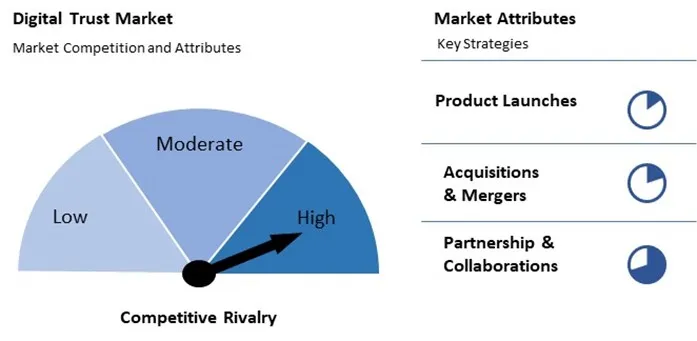
Competition in the digital trust market is intensifying as organizations across industries prioritize secure identity management, data integrity, and regulatory compliance in an increasingly digital environment. Providers compete on technology innovation, scalability, interoperability, and adherence to privacy standards. The market is shaped by rapid adoption of digital identity verification, blockchain-based authentication, and zero-trust frameworks. Growing cyber threats and stricter data-protection regulations are pushing vendors to offer integrated, end-to-end trust solutions covering identity, security, and governance. With rising enterprise and government demand, competition is shifting toward platforms that deliver transparency, automation, and verifiable digital interactions across global ecosystems.
| Report Attribute | Details |
|---|---|
| Market size value in 2025 | USD 127.59 Billion |
| Market size forecast in 2032 | USD 299.14 Billion |
| Base Year | 2024 |
| Historical Period | 2021 to 2023 |
| Forecast Period | 2025 to 2032 |
| Revenue Growth Rate | CAGR of 12.9% from 2025 to 2032 |
| Number of Pages | 587 |
| Number of Tables | 474 |
| Report coverage | Market Trends, Revenue Estimation and Forecast, Segmentation Analysis, Regional and Country Breakdown, Competitive Landscape, Market Share Analysis, Porter’s 5 Forces Analysis, Company Profiling, Companies Strategic Developments, SWOT Analysis, Winning Imperatives |
| Segments covered | Enterprise Size, Technology, Component, End Use, Region |
| Country scope |
|
| Companies Included | Microsoft Corporation, IBM Corporation, Cisco Systems, Inc., Amazon Web Services, Inc. (Amazon.com, Inc.), Thales Group S.A., Accenture PLC, Palo Alto Networks, Inc., Oracle Corporation, Salesforce, Inc., Apple, Inc. |
By Enterprise Size
By Technology
By Component
By End Use
By Geography
The market size is projected to reach USD 299.14 billion by 2032.
The digital trust market is projected to grow at a CAGR of 12.9% between 2025 and 2032.
Global shift toward digital-first economies is amplifying exposure to sophisticated cyber threats and digital fraud.
Microsoft Corporation, IBM Corporation, Cisco Systems, Inc., Amazon Web Services, Inc. (Amazon.com, Inc.), Thales Group S.A., Accenture PLC, Palo Alto Networks, Inc., Oracle Corporation, Salesforce, Inc., Apple, Inc.
The Solution segment is leading the Global Digital Trust Market by Component in 2024, thereby, achieving a market value of $166.72 billion by 2032.
The North America region dominated the Global Digital Trust Market by Region in 2024, and would continue to be a dominant market till 2032; thereby, achieving a market value of $112.36 billion by 2032.
Our team of dedicated experts can provide you with attractive expansion opportunities for your business.







 Unique Offerings