“Global Digital Thread Market to reach a market value of USD 49.68 Billion by 2032 growing at a CAGR of 20.1%”
The Global Digital Thread Market size is expected to reach USD 49.68 billion by 2032, rising at a market growth of 20.1% CAGR during the forecast period.
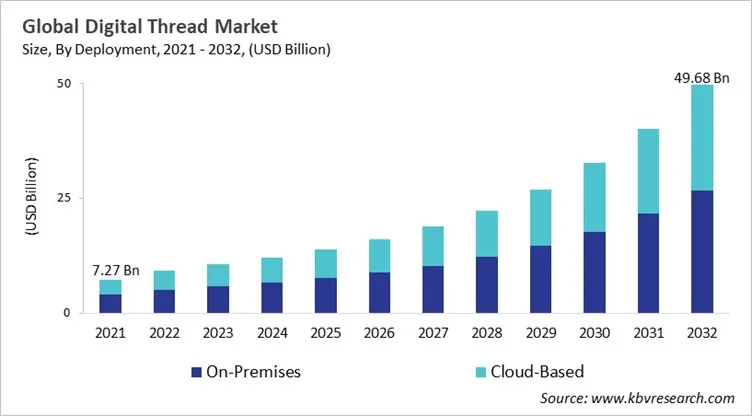
The digital thread market has transformed from a foundational framework that provides continued, end-to-end data flow across every stage of the product lifecycle-from engineering and design to engineering, supply-chain operations, field service, and maintenance. Initially rooted in complex manufacturing environments, the concept gained significant traction as companies recognized the limitations of siloed systems and the increasing need for connected workflows, supported by Industry 4.0. Nowadays, the digital thread acts as the data backbone for digital twins, agile production, advanced analytics, and lifecycle optimisation. Standards bodies and governments, including NIST, are driving the deployment to improve supply chain resilience, interoperability, and data consistency. With supply chains growing more complex and manufacturing shifting toward more data-driven and flexible models, digital thread platforms have evolved from isolated tools into integrated enterprise systems.
The digital thread market is becoming more strategically oriented and competitive, with key players focusing on platform unification, lifecycle integration, and ecosystem collaborations that combine MES, PLM, ERP, IoT data, and field-service systems. Trends like digital twin enablement, end-to-end data connectivity, and standards adoption are encouraging enterprises to invest in cross-disciplinary, scalable digital-thread architectures. Competition now spans major industrial software providers, system integrators, and specialized solution firms, each competing on technology, data governance, implementation expertise, supply-chain reach, and industry templates. With digital thread adoption shifting into large-scale enterprise deployment, competitive advantage largely depends on the ability to deliver measurable outcomes in agility, quality, lifecycle cost reduction, and manufacturing resilience.
The major strategies followed by the market participants are (Strategy name) as the key developmental strategy to keep pace with the changing demands of end users. For instance, In 2025, February, Dassault Systemes SE announced the partnership with KUKA, a robotics company to enhance robotics and automation efficiency. Through KUKA’s mosaixx digital ecosystem, customers can access Dassault’s 3DEXPERIENCE platform for virtual twin technology, enabling real-time simulation, improved collaboration, and innovation across industries like automotive, aerospace, electronics, and healthcare. Additionally, In 2024, September, PTC, Inc. announced the partnership with AWS, a cloud computing company to enhance its Onshape cloud-native CAD and PDM solutions. The collaboration focuses on product improvements, AI-driven design assistance, data migration tools, and compliance for government users. This partnership aims to accelerate adoption, innovation, and cloud-based product development globally.
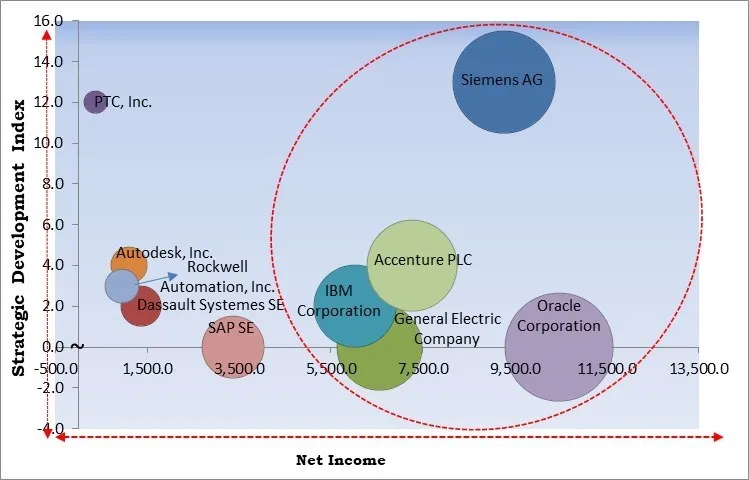
Based on the Analysis presented in the KBV Cardinal matrix; Oracle Corporation, Siemens AG, Accenture PLC, General Electric Company, and IBM Corporation are the forerunners in the Digital Thread Market. Companies such as SAP SE, Dassault Systemes SE, and Autodesk, Inc. are some of the key innovators in Digital Thread Market. In February, 2025, Siemens AG teamed up with SAP, a software company to deliver seamless, end-to-end digital threads by integrating Siemens Teamcenter with SAP Business Suite. This collaboration enables streamlined product lifecycle processes—from design to operation, helping companies innovate faster, adopt cloud solutions, and meet evolving market demands with improved efficiency and sustainability.
COVID-19 negatively impacted the Digital Thread Market by disrupting global supply chains, halting manufacturing operations, and delaying technology investments. Budget priorities shifted toward essential business continuity rather than digitalization, causing planned deployments to be postponed. Remote working limitations and reduced staff also slowed on-site integration and collaboration. Industries are most affected by the pandemic, such as aerospace and automotive, reduced spending, contributing to a market decline. Although awareness of digital transformation increased, resource constraints and uncertainty temporarily weakened adoption momentum. Thus, the COVID-19 pandemic had a negative impact on the market.

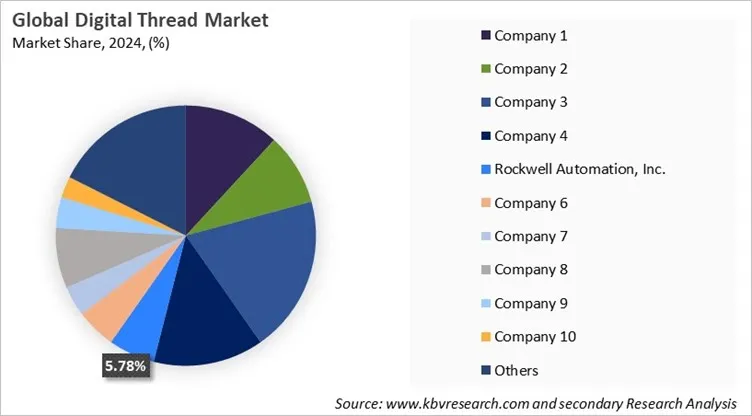
The leading players in the market are competing with diverse innovative offerings to remain competitive in the market. The above illustration shows the percentage of revenue shared by some of the leading companies in the market. The leading players of the market are adopting various strategies to cater demand coming from the different industries. The key developmental strategies in the market are Acquisitions, and Partnerships & Collaborations.
Free Valuable Insights: Digital Thread Market size to reach USD 49.68 Billion by 2032
On the basis of module, the digital thread market is classified into data collection, data management & integration, connectivity & interoperability, data analysis & visualization, and others. The data management & integration segment recorded 22% revenue share in the digital thread market in 2024. It enabled enterprises to harmonize fragmented data sources, ensuring consistency and accessibility for downstream processes. This module facilitated smooth integration between engineering platforms, manufacturing systems, and service operations, thereby reinforcing seamless data continuity.
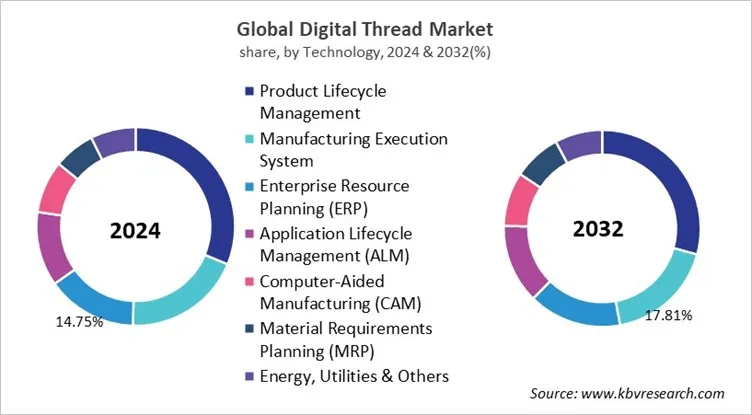
By technology, the digital thread market is segmented into product lifecycle management, manufacturing execution system, enterprise resource planning (ERP), application lifecycle management (ALM), computer-aided manufacturing (CAM), material requirements planning (MRP), and energy, utilities & others. The manufacturing execution system segment recorded 19% revenue share in the digital thread market in 2024. MES platforms facilitated real-time monitoring, control, and synchronization of manufacturing activities, enabling organizations to maintain visibility into production performance and resource utilization. Through accurate execution data and operational insights, this technology supported continuous improvement, quality management, and workflow optimization.
Region-wise, the Digital Thread Market is analyzed across North America, Europe, Asia Pacific, and LAMEA. The North America segment recorded 35% revenue share in the Digital Thread Market in 2024. The digital thread market is projected to gather substantial market share in the North America and Europe region. This is because of large investment by OEMs in automotive, aerospace, and high-tech manufacturing and significant adoption of edge/cloud infrastructure and PLM platforms. Also, adoption is being driven by manufacturers’ requirement for real-time analytics, end-to-end traceability, and integration of engineering, and both corporate spending and provider ecosystems are concentrated in Canada and the US. Moreover, the European digital thread market is expanding, supported by a deep industrial base (precision engineering, automotive, and aerospace), national and EU digitalization initiatives, and increasing demand for regulatory and sustainability traceability.
In the Asia Pacific and LAMEA regions, the digital thread market is estimated to experience expansion in the upcoming years. The expanding manufacturing sector in Asia Pacific nations, including Japan, China, and India, the increasing regional software ecosystem, and large smart-factory investments are some of the factors supporting the expansion of the digital thread market. The growth of electronics, heavy industry, and automotive, with cloud-native PLM, IIoT integrations, is leading market adoption. Additionally, LAMEA digital thread market is offering positive opportunities with Gulf nations and Latin American hubs surging digital thread pilots tied to aerospace & defense, oil & gas, and infrastructure modernization. Also, the digital thread market is predicted to grow at a steady pace, with governments or sovereign projects encouraging Industry 4.0 modernization.
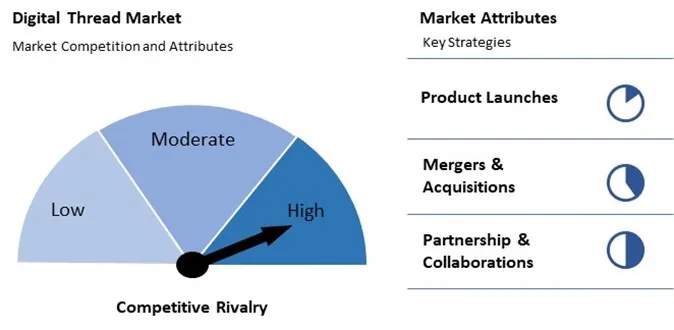
The digital thread market is highly competitive, driven by rapid digital transformation and increasing demand for seamless product lifecycle connectivity across design, engineering, manufacturing, and maintenance stages. Competition intensifies as organizations seek solutions that improve operational visibility, accelerate time-to-market, and enable predictive decision-making. Vendors differentiate through capabilities such as integration flexibility, cybersecurity maturity, industrial interoperability, cloud deployment options, and advanced analytics. The rise of smart factories, IoT connectivity, and model-based engineering further expands the competitive landscape. However, high implementation complexity, integration with legacy systems, and the need for specialized expertise create barriers that strengthen rivalry among established ecosystem players. Continuous innovation, scalability, and proven return on investment remain critical success factors in this evolving market.
| Report Attribute | Details |
|---|---|
| Market size value in 2025 | USD 13.79 Billion |
| Market size forecast in 2032 | USD 49.68 Billion |
| Base Year | 2024 |
| Historical Period | 2021 to 2023 |
| Forecast Period | 2025 to 2032 |
| Revenue Growth Rate | CAGR of 20.1% from 2025 to 2032 |
| Number of Pages | 672 |
| Number of Tables | 574 |
| Report coverage | Market Trends, Revenue Estimation and Forecast, Segmentation Analysis, Regional and Country Breakdown, Competitive Landscape, Market Share Analysis, Porter’s 5 Forces Analysis, Company Profiling, Companies Strategic Developments, SWOT Analysis, Winning Imperatives |
| Segments covered | Deployment, Module, Technology, End User, Region |
| Country scope |
|
| Companies Included | PTC, Inc., IBM Corporation, Siemens AG, Dassault Systemes SE, Rockwell Automation, Inc., Autodesk, Inc., Oracle Corporation, SAP SE, General Electric Company and Accenture PLC |
By Deployment
By Module
By Technology
By End User
By Geography
The market size is projected to reach USD 49.68 Billion by 2032.
The digital thread market is projected to grow at a CAGR of 20.1% between 2025 and 2032.
Rising end-to-end lifecycle data integration driving enhanced supply-chain resilience and traceability.
PTC, Inc., IBM Corporation, Siemens AG, Dassault Systemes SE, Rockwell Automation, Inc., Autodesk, Inc., Oracle Corporation, SAP SE, General Electric Company and Accenture PLC
The Product Lifecycle Management segment is generating maximum revenue share in the Global Digital Thread Market by Technology in 2024, achieving a market value of $14.5 billion by 2032.
The North America region dominated the Global Digital Thread Market by Region in 2024, and would continue to be a dominant market till 2032; thereby, achieving a market value of $16,772.6 million by 2032.
Our team of dedicated experts can provide you with attractive expansion opportunities for your business.











 Unique Offerings