“Global Digital Security Control Market to reach a market value of USD 31.81 Billion by 2032 growing at a CAGR of 9.4%”
The Global Digital Security Control Market size is expected to reach $31.81 billion by 2032, rising at a market growth of 9.4% CAGR during the forecast period.
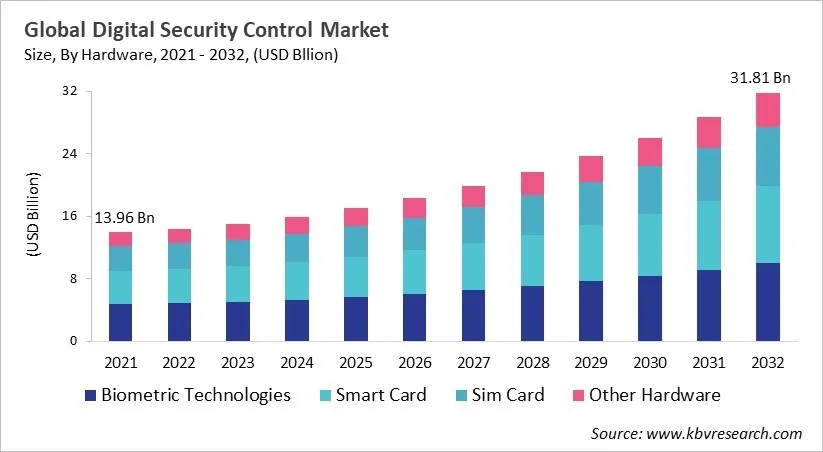
The digital security control market has developed as a foundational pillar of modern economies, supported by cloud adoption, IoT, digitalization, and strict regulatory frameworks. The digital security control market has expanded its usage in banking, digital payments, and e-commerce, which initially was limited to the finance, government, and defense sector. Various industries are raising demand for access controls and stronger identity. Furthermore, the advent of cloud computing has redefined the landscape by introducing new requirements for access management, encryption, and multi-factor authentication. The rise of smart cities, industrial automation, and IoT has widened the importance of digital security. Also, machine learning and AI have now become crucial in detecting cyber threats in real-time.
The digital security control market is witnessing significant growth supported by elements such as increased usage of multi-factor and biometric authentication, expanded deployment of digital security into consumer ecosystem, and critical infrastructure. Key players are focusing on innovations in cryptography, AI integration, and biometrics, along with building trust through compliance, transparency, and ecosystem collaboration. Businesses have become more flexible and are offering subscription-based, hybrid, and on-premise solutions to cater to the diverse needs of the market. Digital security has become a crucial factor in digital transformation.
The major strategies followed by the market participants are Partnerships as the key developmental strategy to keep pace with the changing demands of end users. For instance, In April, 2025, Fortinet, Inc. and Vodafone Business partnered to expand secure networking services globally, integrating SD-WAN and FortiSASE solutions. This supports hybrid workforces and cybersecurity compliance, offering managed services across Europe, Asia, and the U.S. to enhance digital security and threat response. Moreover, In April, 2025, CrowdStrike Holdings, Inc. partnered with Wipro to integrate its Falcon Next-Gen SIEM into Wipro’s CyberShield platform, enhancing global enterprise security with AI-driven threat detection, reduced complexity, and faster response—strengthening cybersecurity operations and modernizing SOCs for improved protection and operational efficiency.
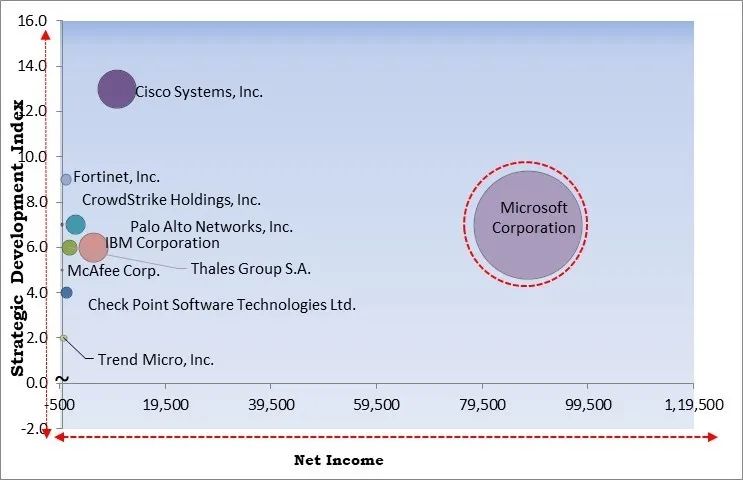
Based on the Analysis presented in the KBV Cardinal matrix; Microsoft Corporation is the forerunners in the Digital Security Control Market. Companies such as Cisco Systems, Inc. and IBM Corporation are some of the key innovators in Digital Security Control Market. In March, 2025, Cisco and NVIDIA launched the Secure AI Factory to embed end-to-end security in AI infrastructure, covering applications, workloads, and networks. This initiative integrates Cisco AI Defense, Hypershield, and compliance standards, strengthening digital security controls for enterprise AI deployments globally.
The COVID-19 pandemic sped up the growth of the digital security control market by a lot. This was because businesses moved to remote work and faced more cyber threats. The need to protect sensitive data quickly led to more people using advanced tools like identity management, endpoint protection, and intrusion detection. Cloud-based and AI-driven solutions became more popular, and zero-trust frameworks and multi-factor authentication became widely used. Telemedicine, online banking, and digital shopping grew quickly, which helped sectors like healthcare, finance, and e-commerce the most. Also, stricter rules about data privacy made people more likely to invest in modern security systems. In general, the pandemic sped up the process of digital transformation and made security providers stronger in the market. Thus, the COVID-19 pandemic had a positive impact on the market.

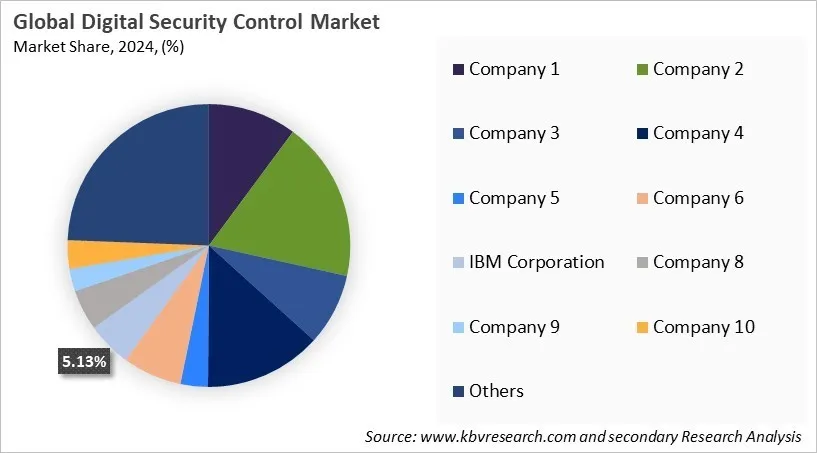
The leading players in the market are competing with diverse innovative offerings to remain competitive in the market. The above illustration shows the percentage of revenue shared by some of the leading companies in the market. The leading players of the market are adopting various strategies in order to cater demand coming from the different industries. The key developmental strategies in the market are Acquisitions, and Partnerships & Collaborations.
Free Valuable Insights: Global Digital Security Control Market size to reach USD 31.81 Billion by 2032
Based on Hardware, the market is segmented into Biometric Technologies, Smart Card, Sim Card, and Other Hardware. The smart card segment attained 30% revenue share in the digital security control market in 2024. Financial institutions worldwide continue to rely on EMV chip-enabled cards to reduce fraud, while governments in regions like Europe and Asia–Pacific have adopted smart cards for healthcare, public services, and transit systems. Enterprises across multiple industries also use smart cards for employee identification and secure access to physical and digital environments.
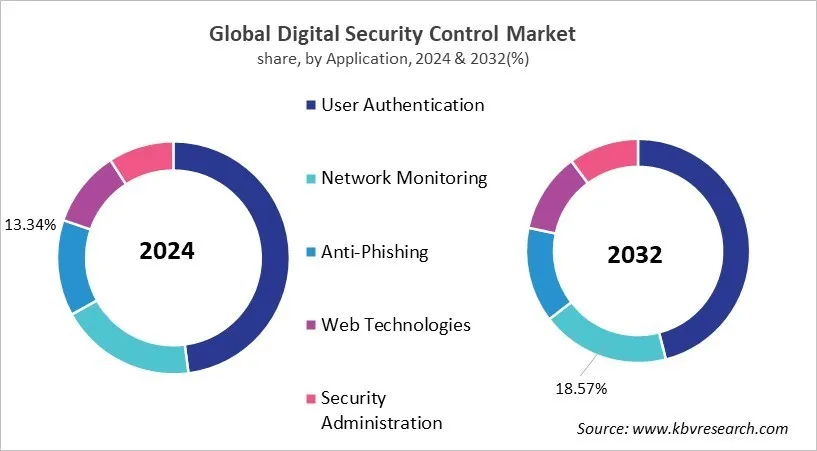
Based on Application, the market is segmented into User Authentication, Network Monitoring, Anti-Phishing, Web Technologies, and Security Administration. The network monitoring segment recorded 19% revenue share in the digital security control market in 2024. Organizations across sectors such as banking, telecom, energy, and cloud computing are increasingly deploying real-time monitoring solutions to identify anomalies, prevent intrusions, and ensure compliance. The adoption of artificial intelligence (AI) and machine learning (ML)–powered monitoring tools has further strengthened the ability to predict, detect, and respond to evolving cyberattacks, solidifying this segment’s importance in global cybersecurity strategies.
Region-wise, the Digital Security Control Market is analyzed across North America, Europe, Asia Pacific, and LAMEA. The North America segment recorded 34% revenue share in the digital security control market in 2024. The digital security control market has witnessed significant growth in North America and Europe. This is because of their stringent regulatory frameworks, advanced digital infrastructure, and large adoption of IoT, cloud services, and digital payments. Regional governments are enforcing strict data protection laws like GDPR in Europe and various cybersecurity mandates by the US government. This supports enterprises in adopting encryption and zero-trust security frameworks. Further, the presence of leading tech-giants, coupled with large investments in R&D across various sectors, supports market growth. The industries such as finance, energy, and healthcare are at main focus by providers.
The Asia Pacific and LAMEA region are projected to procure a prominent share in the digital security control market. The expanding e-commerce sector, rising mobile penetration, and rapid digitalization are some of the key elements driving the market. Regional nations such as Japan, India, and China are largely investing in IoT ecosystems, cloud adoption, and smart cities, thereby creating the requirements of advanced security measures. Moreover, governments are framing stringent regulations on cyber resilience and data privacy, positively influencing consumers and enterprises to adopt stronger monitoring and authentication systems. In addition, in LAMEA, the adoption is rapidly growing, backed by digital government programs, financial inclusion initiatives, and rising investments in infrastructure modernization.
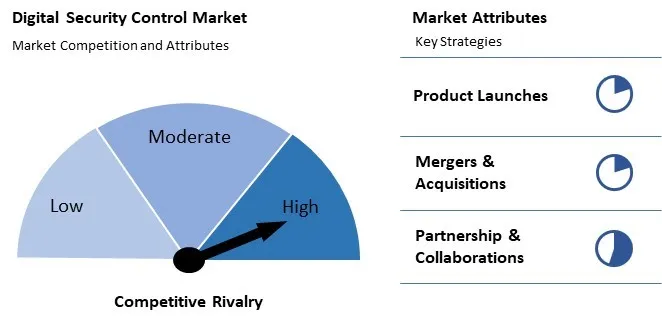
The digital security control market is very competitive because technology is changing quickly and cyber threats are getting more complex. To set themselves apart from the competition, market players focus on innovation by adding AI, biometrics, and advanced encryption to their products. Common ways to get ahead of the competition are to form partnerships, offer more products, and improve services. The landscape is always changing as it adapts to new rules and customer needs. Providers are still competing hard to find the right balance between performance, scalability, and cost-effectiveness in their solutions.
| Report Attribute | Details |
|---|---|
| Market size value in 2025 | USD 16.98 Billion |
| Market size forecast in 2032 | USD 31.81 Billion |
| Base Year | 2024 |
| Historical Period | 2021 to 2023 |
| Forecast Period | 2025 to 2032 |
| Revenue Growth Rate | CAGR of 9.4% from 2025 to 2032 |
| Number of Pages | 589 |
| Number of Tables | 494 |
| Report coverage | Market Trends, Revenue Estimation and Forecast, Segmentation Analysis, Regional and Country Breakdown, Competitive Landscape, Market Share Analysis, Porter’s 5 Forces Analysis, Company Profiling, Companies Strategic Developments, SWOT Analysis, Winning Imperatives |
| Segments covered | Hardware, Application, End-use, Technology, Region |
| Country scope |
|
| Companies Included | Cisco Systems, Inc., Palo Alto Networks, Inc., Check Point Software Technologies Ltd., CrowdStrike Holdings, Inc., Fortinet, Inc., McAfee Corp., Microsoft Corporation, IBM Corporation, Thales Group S.A., and Trend Micro, Inc. |
By Hardware
By Application
By End Use
By Technology
By Geography
This Market size is expected to reach USD 31.81 Billion billion by 2032.
The digital security control market is projected to grow at a CAGR of 9.4% between 2025 and 2032.
Rising cybersecurity threats and increasingly sophisticated attacks are driving the expansion of cloud computing and digital transformation initiatives.
Cisco Systems, Inc., Palo Alto Networks, Inc., Check Point Software Technologies Ltd., CrowdStrike Holdings, Inc., Fortinet, Inc., McAfee Corp., Microsoft Corporation, IBM Corporation, Thales Group S.A., and Trend Micro, Inc.
The Biometric Technologies segment captured the maximum revenue in the Global Digital Security Control Market by Hardware in 2024, thereby, achieving a market value of $10.0 billion by 2032.
The North America region dominated the Global Digital Security Control Market by Region in 2024, and would continue to be a dominant market till 2032; thereby, achieving a market value of $10.3 billion by 2032.
Our team of dedicated experts can provide you with attractive expansion opportunities for your business.












 Unique Offerings