“Global Digital Rights Management Market to reach a market value of USD 12.97 Billion by 2032 growing at a CAGR of 10.2%”
The Global Digital Rights Management Market size is expected to reach USD 12.97 billion by 2032, rising at a market growth of 10.2% CAGR during the forecast period.
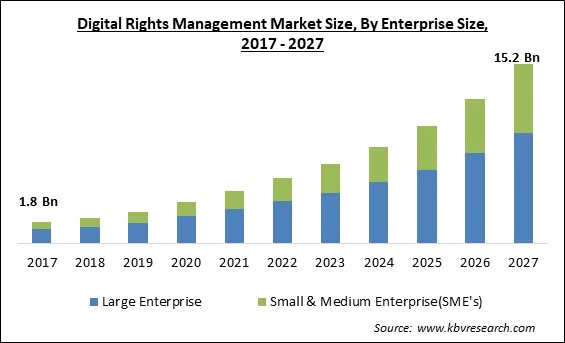
Digital rights management encompasses policies, technologies, and systems that control access to and usage of digital content, assuring that only authorized users can interact with protected media, software, or documents. DRM has evolved because of increasing concerns over piracy and unauthorized distribution, particularly with the expanded prevalence of the internet. Early protection methods like hardware-based controls and encryption enabled a path for more sophisticated systems supported by legal frameworks such as DMCA and technical standards like W3C’s Encrypted Media Extensions (EME). DRM has expanded beyond physical media to streaming services, SaaS platforms, e-books, and cloud-based delivery models, becoming central to rental, subscription, and pay-per-use business models along with supporting regulatory compliance and intellectual property protection.
Digital rights management has evolved into a comprehensive rights enforcement framework integrated with web standards, enterprise security architectures, and cloud platforms. Key technology providers, including Google, Apple, and Microsoft, embed proprietary DRM solutions like Widevine, PlayReady, and FairPlay directly into their ecosystems, offering seamless and secure content delivery across devices. Standard bodies and collaborative initiatives reduce fragmentation and promote interoperability through open specifications such as EME. Enterprises largely adopt digital rights management solutions to protect sensitive documents, meet data privacy regulations, and enforce role-based access. The competitive landscape of the market is shaped by standards-driven collaboration, large platform providers, and innovative niche vendors, with competition emphasizing ecosystem reach, interoperability, technology depth, and the capability to address developing digital rights and compliance requirements across sectors.
The COVID-19 pandemic sped up the use of Digital Rights Management (DRM) solutions a lot because lockdowns and social distancing made people around the world consume more digital content. The rise in online streaming, e-learning platforms, digital publishing, and virtual events made it even more important to protect intellectual property. To stop piracy and the illegal sharing of premium content, organizations and content owners used DRM technologies. The quick switch to remote work and cloud-based collaboration made people even more worried about data security and access control. Businesses used DRM to protect their private documents and control who could access them. The rise of digital education and corporate training also helped DRM demand by keeping licensed learning materials safe. Also, more people using media, entertainment, and games made DRM more popular so that safe ways to make money could be found. Thus, the COVID-19 pandemic had a positive impact on the market.

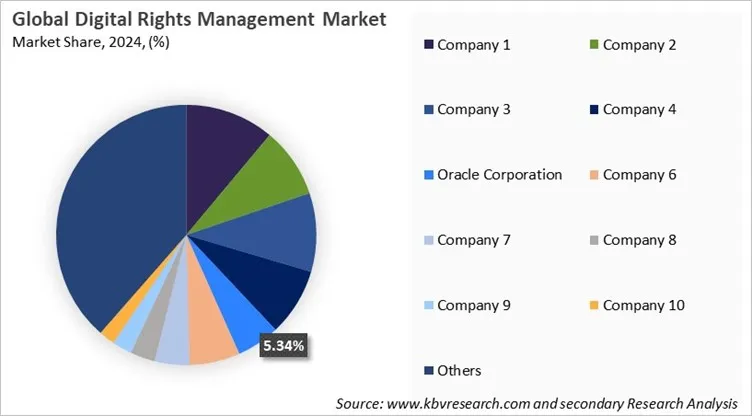
The leading players in the market are competing with diverse innovative offerings to remain competitive in the market. The above illustration shows the percentage of revenue shared by some of the leading companies in the market. The leading players of the market are adopting various strategies to cater demand coming from the different industries. The key developmental strategies in the market are Acquisitions, and Partnerships & Collaborations.
By deployment, the digital rights management market segment is segmented into cloud and on-premise. The on-premise segment attained 43% revenue share in the digital rights management market in 2024. On-premise digital rights management solutions continue to play a significant role for organizations that require greater control over data security, infrastructure, and compliance. This deployment model is widely preferred by enterprises operating in highly regulated environments or managing sensitive digital assets that demand strict internal governance.
Based on end-user industry, the digital rights management market is segmented into media & entertainment, BFSI, IT and telecommunication, healthcare, education, government & public sector, and others. The BFSI segment gained 26% revenue share in the digital rights management market in 2024. In the BFSI sector, digital rights management plays a vital role in safeguarding sensitive financial data, proprietary documents, and digital communications. Financial institutions, banks, and insurance providers use DRM solutions to ensure secure access to confidential reports, customer records, and internal content shared across digital platforms.
Free Valuable Insights: Digital Rights Management Market size to reach USD 12.97 Billion by 2032
Region-wise, the digital rights management market is analyzed across North America, Europe, Asia Pacific, and LAMEA. The North America segment recorded 38% revenue share in the digital rights management market in 2024. The digital rights management market is predicted to grow at a significant rate in the North America and Europe regions. The expansion is supported by widespread adoption of digital content protection across enterprise, media, and software sectors, driven by strong regulatory frameworks such as the DMCA and robust intellectual property laws. The US leads in DRM integration for cloud services, corporate rights enforcement, OTT streaming, and online publishing, with high investment in cybersecurity and advanced IT infrastructure driving significant growth. Moreover, Europe digital rights management market is showcasing substantial expansion. This is due to the strict data protection standards, strong demand in media, publishing, e-learning, and enterprise compliance use cases, and increased focus on interoperable, GDPR-aligned DRM solutions that protect cross-border digital assets and assure regulatory conformity.
In the Asia Pacific and LAMEA region, the digital rights management market is anticipated to witness prominent expansion. This is because of the accelerating digital transformation across Japan, China, India, South Korea, and Southeast Asia. Burgeoning OTT, e-learning, and gaming ecosystems, rapid mobile internet penetration, and increasing digital privacy concerns are some of the elements driving growth and prompting regional enterprises and content providers to embrace advanced DRM technologies. Moreover, the LAMEA digital rights management market is experiencing expansion. The market is driven by expanding streaming industries and rising enterprise demand for content security. Further, the Middle East & Africa are largely adopting DRM owing to digital infrastructure development, increasing OTT usage, and government-supported data protection initiatives.
| Report Attribute | Details |
|---|---|
| Market size value in 2025 | USD 6.57 Billion |
| Market size forecast in 2032 | USD 12.97 Billion |
| Base Year | 2024 |
| Historical Period | 2021 to 2023 |
| Forecast Period | 2025 to 2032 |
| Revenue Growth Rate | CAGR of 10.2% from 2025 to 2032 |
| Number of Pages | 548 |
| Number of Tables | 454 |
| Report coverage | Market Trends, Revenue Estimation and Forecast, Segmentation Analysis, Regional and Country Breakdown, Market Share Analysis, Porter’s 5 Forces Analysis, Company Profiling, Companies Strategic Developments, SWOT Analysis, Winning Imperatives |
| Segments covered | Enterprise Size, Component, Deployment, End-user Industry, Region |
| Country scope |
|
| Companies Included | Adobe, Inc., Google LLC, Microsoft Corporation, Apple, Inc., Oracle Corporation, IBM Corporation, Irdeto B.V. (Naspers), OpenText Corporation, SAP SE and Dell Technologies, Inc. |
By Enterprise Size
By Component
By Deployment
By End-user Industry
By Geography
This Market size is expected to reach USD 12.97 Billion by 2032.
The digital inspection market is projected to grow at a CAGR of 10.2% between 2025 and 2032.
Rapid growth in digital content creation and distribution, coupled with rising demand for secure monetization and scalable digital business models, is fueling market expansion.
Adobe, Inc., Google LLC, Microsoft Corporation, Apple, Inc., Oracle Corporation, IBM Corporation, Irdeto B.V. (Naspers), OpenText Corporation, SAP SE and Dell Technologies, Inc.
The Large Enterprises segment is leading the Global Digital Rights Management Market by Enterprise Size in 2024; thereby, achieving a market value of $7.60 billion by 2032.
The North America region dominated the Global Digital Rights Management Market by Region in 2024, and would continue to be a dominant market till 2032; thereby, achieving a market value of $4.79 billion by 2032.
Our team of dedicated experts can provide you with attractive expansion opportunities for your business.








 Unique Offerings