“Global Digital Experience Platform Market to reach a market value of USD 36.85 Billion by 2032 growing at a CAGR of 13.3%”
The Global Digital Experience Platform Market size is expected to reach $36.85 billion by 2032, rising at a market growth of 13.3% CAGR during the forecast period.
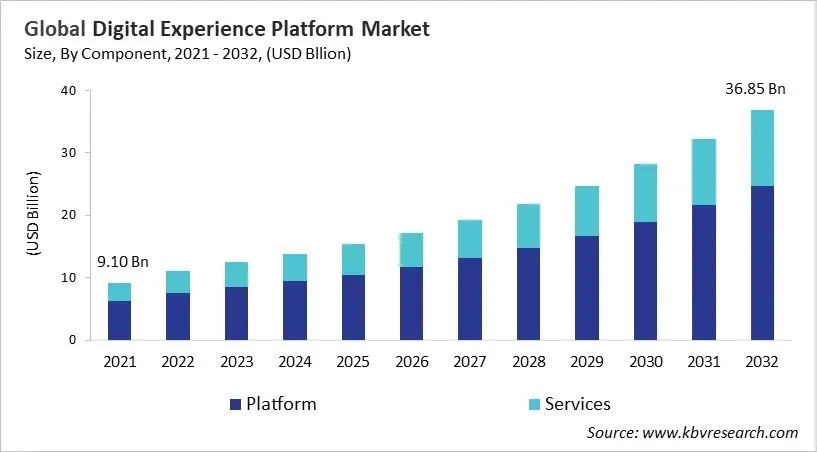
The digital experience platform market has recently developed into content management platforms to become the core infrastructure allowing omnichannel digital interactions. Earlier DXPs emphasized on managing web content, but increasing expectations around IoT, social, mobile, and personalized services encouraged organisations and governments to adopt platforms that integrate data, authentication, workflows, and service delivery. Architectural shifts from on-premises, monolithic systems to cloud-native, API-first, composable, and headless designs have transitioned DXPs into flexible “experience backbones” with capabilities of real-time personalization, automation, and analytics. As digital-first strategies across finance, retail, healthcare, and public services expand, DXPs are largely treated as strategic infrastructure and not just marketing tools.
The key elements shaping the digital experience platform market include a shift toward modular, cloud-native platforms, the integration of machine learning and AI for dynamic personalisation, and a push toward unified and cross-channel customer. Further, the market witnesses that large vendors are leveraging scale, broad portfolios, and global reach, while niche players are competing on agility and vertical specialisation, especially in industries in regional and government services. Vendors are positioning themselves through architecture, workflow automation, AI capabilities, ecosystem openness, and the capability to integrate seamlessly with ERP, HR, finance, and operational systems.
The major strategies followed by the market participants are Product Launches as the key developmental strategy to keep pace with the changing demands of end users. For instance, In July, 2025, SAP SE unveiled a new cloud-based Point-of-Sale (POS) solution, SAP Customer Checkout, aimed at improving retail operations. The platform offers real-time analytics, seamless integrations, and centralized management, empowering businesses to enhance customer engagement and streamline omnichannel retail experiences—strengthening SAP's position in the digital experience ecosystem. Moreover, In March, 2025, Salesforce, Inc. unveiled Agentforce 2dx, introducing proactive AI, multimodal experiences, and digital labor extensions. The platform enables businesses to embed intelligent workflows seamlessly, reinforcing the role of AI in delivering next-gen digital experiences across industries.
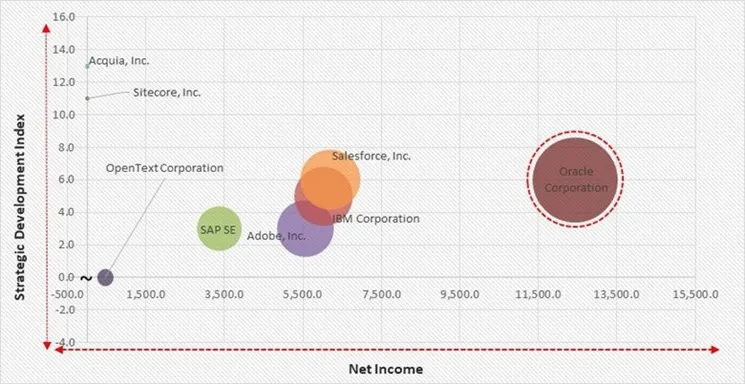
Based on the Analysis presented in the KBV Cardinal matrix; Oracle Corporation is the forerunner in the Digital Experience Platform Market. Companies such as Salesforce, Inc., IBM Corporation, and Adobe, Inc. are some of the key innovators in Digital Experience Platform Market. In March, 2025, Adobe, Inc. unveiled the Experience Platform Agent Orchestrator, enabling real-time coordination of customer interactions across multiple channels. This tool boosts personalization and operational efficiency, offering businesses enhanced automation and decision-making capabilities. It's a key advancement in Adobe's strategy within the digital experience platform market.
The COVID-19 pandemic sped up digital transformation in many fields by a lot. Digital Experience Platforms (DXPs) were quickly adopted by businesses that wanted to keep people engaged while they worked from home and had limited in-person interactions. Businesses are putting more money into DXPs to make sure things keep running smoothly, offer personalized experiences across all channels, and bring together content, commerce, and service delivery. The crisis also sped up the use of cloud-based and SaaS deployment models, which make systems more flexible and scalable. It also pushed for the use of headless and composable architectures. DXPs also became more important for improving employee engagement and communication within remote teams. Thus, the COVID -19 pandemic had a Positive impact on the market.
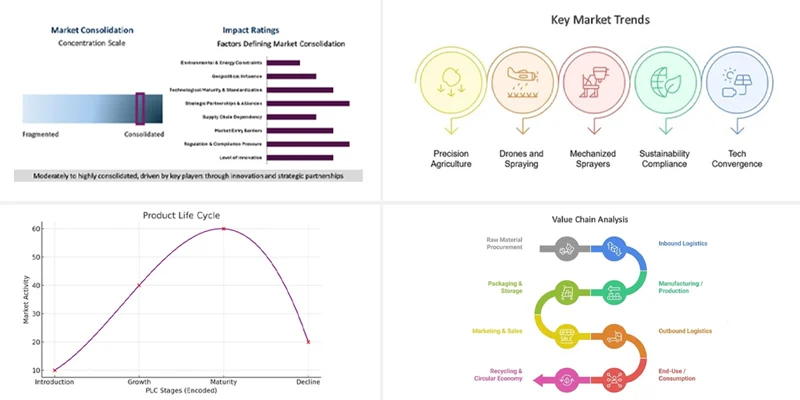

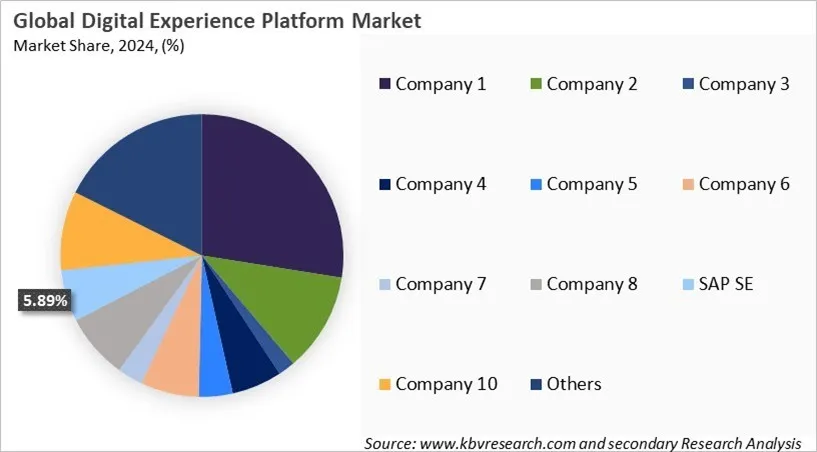
The leading players in the market are competing with diverse innovative offerings to remain competitive in the market. The above illustration shows the percentage of revenue shared by some of the leading companies in the market. The leading players of the market are adopting various strategies in order to cater demand coming from the different industries. The key developmental strategies in the market are Acquisitions, and Partnerships & Collaborations.
Free Valuable Insights: Digital Experience Platform Market size to reach USD 36.85 Billion by 2032
Based on Component, the market is segmented into Platform, and Services. The Services segment acquired 32% revenue share in the market in 2024. This component of the Digital Experience Platform market encompassed all the professional and support services associated with implementing, managing, and optimising DXPs. This included consulting, system integration, customisation, deployment support, training, and ongoing technical assistance. Service providers played a critical role in helping organisations successfully adopt platforms, integrate them with existing systems, and tailor them to meet specific business objectives.
Based on Application, the market is segmented into Business-to-Consumer, Business-to-Business, and Other Application. The Business-to-Business segment attained 35% revenue share in the market in 2024. This segment catered to organisations delivering digital experiences to other businesses, partners, or enterprise clients. This segment emphasised tools and platforms that facilitated complex workflows, integrated services, and collaborative interactions. DXPs in this area enabled companies to provide personalised content, automate communications, and manage business relationships efficiently across multiple digital channels.
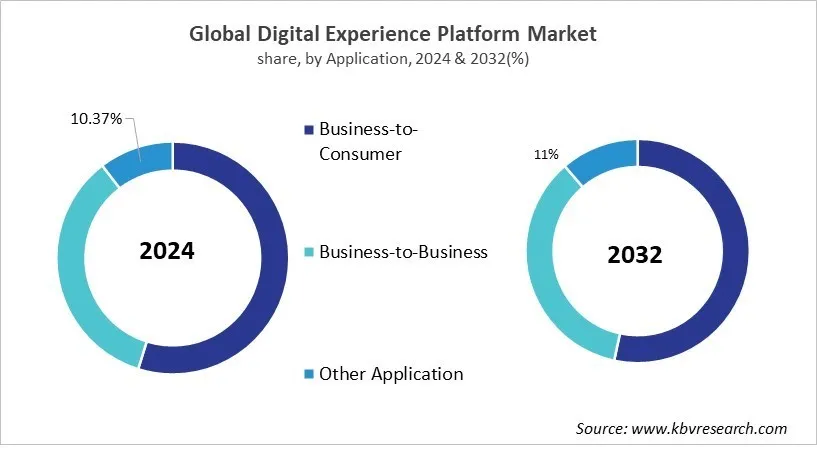
Region-wise, the Digital Experience Platform Market is analyzed across North America, Europe, Asia Pacific, and LAMEA. The North America segment recorded 39% revenue share in the market in 2024. The digital experience platform market is predicted to grow at a significant rate in North America and Europe. This is due to large deployments in retail, finance, and healthcare, rapid enterprise adoption of cloud-native DXPs, and the strong presence of major platform vendors-which keeps both innovation rates and spending levels high. Enterprises in Canada and the US are prioritizing customer-data integration, AI-driven personalization, and composable architectures, supporting double-digit regional growth. Moreover, the European region is also witnessing growth in the digital experience platform market. The demand is strong in Western European nations, including Germany, France, and the United Kingdom. The larger share of mid-market buyers that favour modular approaches over single-vendor suites is anticipated to support the growth.
In the Asia Pacific and LAMEA regions, the digital experience platform market is estimated to experience steady growth in the upcoming years. The growth is supported by the increasing digital commerce, rising tech investment, and mobile-first consumer behaviour, which are surging the deployment of digital experiencing platforms. India is showcasing positive opportunities supported by enterprises modernizing digital channels and expanding cloud adoption. Furthermore, the LAMEA region is also representing growth opportunities with increasing digitalization projects across retail, telecos, and government, driving the demand for a digital experience platform.
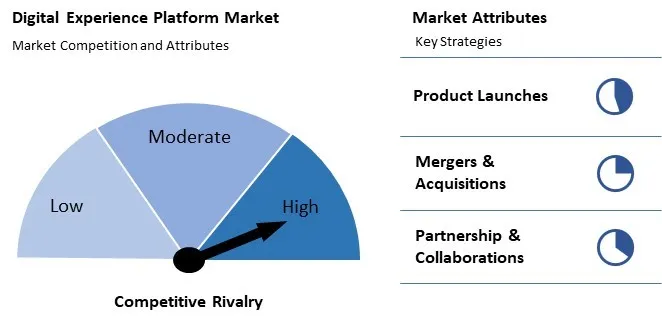
The Digital Experience Platform market is very competitive and driven by new ideas. Vendors are always improving their products by adding new features like advanced integration, personalization, and analytics. To set themselves apart, businesses focus on user-centered design, interoperability, and scalability. Strategic partnerships, acquisitions, and cloud-based innovations make the competition stronger. At the same time, new technologies like AI and automation change how the market works. The need for seamless digital engagement is driving competition in all industries and deployment models around the world.
| Report Attribute | Details |
|---|---|
| Market size value in 2025 | USD 15.38 Billion |
| Market size forecast in 2032 | USD 36.85 Billion |
| Base Year | 2024 |
| Historical Period | 2021 to 2023 |
| Forecast Period | 2025 to 2032 |
| Revenue Growth Rate | CAGR of 13.3% from 2025 to 2032 |
| Number of Pages | 514 |
| Number of Tables | 454 |
| Report coverage | Market Trends, Revenue Estimation and Forecast, Segmentation Analysis, Regional and Country Breakdown, Competitive Landscape, Market Share Analysis, Porter’s 5 Forces Analysis, Company Profiling, Companies Strategic Developments, SWOT Analysis, Winning Imperatives |
| Segments covered | Component, Application, Deployment, End-Use Industry, Region |
| Country scope |
|
| Companies Included | Adobe, Inc., Acquia, Inc. (Vista Equity Partners Management, LLC), Magnolia International Ltd., IBM Corporation, Liferay, Inc., Salesforce, Inc., OpenText Corporation, Oracle Corporation, SAP SE, and Sitecore, Inc. |
By Component
By Application
By Deployment
By End-Use Industry
By Geography
The market size is projected to reach USD 36.85 billion by 2032.
The digital experience platform market is projected to grow at a CAGR of 13.3% between 2025 and 2032.
Increasing demand for personalized customer experiences, together with the integration of advanced technologies like AI and machine learning, is accelerating market transformation.
Adobe, Inc., Acquia, Inc. (Vista Equity Partners Management, LLC), Magnolia International Ltd., IBM Corporation, Liferay, Inc., Salesforce, Inc., OpenText Corporation, Oracle Corporation, SAP SE, and Sitecore, Inc.
The Platform segment captured the maximum revenue in the Global Digital Experience Platform Market by Component in 2024, thereby, achieving a market value of $24.7 billion by 2032.
The North America region dominated the Global Digital Experience Platform Market by Region in 2024, and would continue to be a dominant market till 2032; thereby, achieving a market value of $13.6 billion by 2032.
Our team of dedicated experts can provide you with attractive expansion opportunities for your business.











 Unique Offerings