“Global Data Intelligence And Integration Software Market to reach a market value of USD 58.35 billion by 2032 growing at a CAGR of 16%”
The Global Data Intelligence And Integration Software Market size is expected to reach USD 58.35 billion by 2032, rising at a market growth of 16.0% CAGR during the forecast period.
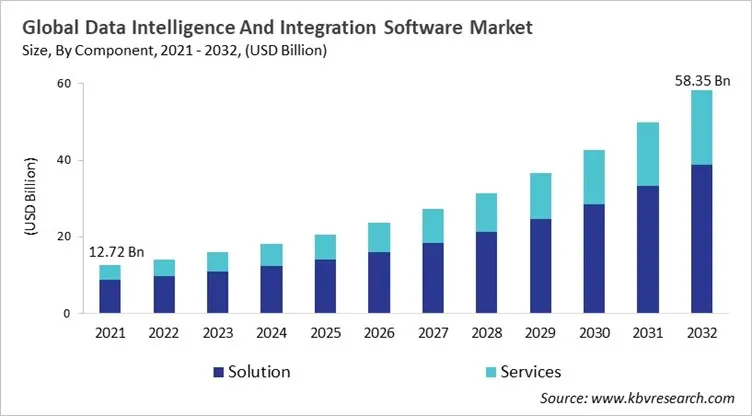
The data intelligence and integration software market has developed into real-time, sophisticated, AI-driven platforms that unify governance, data integration, analytics, and quality. As data volumes, formats, and sources expanded across on-premises, cloud, IoT, and digital channels-legacy integration architectures proved insufficient. This drives the growth of modern frameworks like data mesh and data fabric, designed to deliver automation, pervasive connectivity, and decentralised data ownership. Further, cloud migration, digital transformation, regulatory burdens, and advanced analytics technologies encouraged enterprises to treat data as a strategic asset requiring trusted governance, operational intelligence, and rapid insight generation. Nowadays, platforms emphasize hybrid and multi-cloud flexibility, modular microservices, event-driven streaming, and low/no code tools that democratize integration and accelerate time to value.
Along with technological development, market dynamics reflect rising competition among large software providers, agile cloud-native providers, and specialized integration and governance platforms. Providers are consolidating capabilities-spanning quality, cataloging, integration, AI, and governance-into unified platforms, while embedding automation and machine learning to reduce manual effort and improve production. Strategic moves largely include vertical-specific solutions (e.g., healthcare, utilities, and manufacturing), ecosystem collaborations for real-time data sharing, and cloud-native architectures that support deployment across diverse environments. Further, the data intelligence and integration software market is witnessing a transformation from standalone integration tools to comprehensive, smart-driven data platforms.
The major strategies followed by the market participants are Partnerships as the key developmental strategy to keep pace with the changing demands of end users. For instance, In June 2025, Informatica Inc. announced the partnership with Snowflake, a software company for new cloud data integration capabilities, including support for Apache Iceberg and Polaris, and a Master Data Management SaaS Extension for Snowflake’s AI Data Cloud. These innovations help customers unify trusted data for advanced AI and analytics across multiple domains and sources. Additionally, In June, 2025, SAP SE announced the partnership with CData, a software company to embed its connectors into SAP Business Data Cloud, enabling real-time, enterprise-grade access to external data sources without replication or custom code. This integration empowers customers with secure, fast data connectivity for AI, analytics, and operational workloads across diverse platforms.
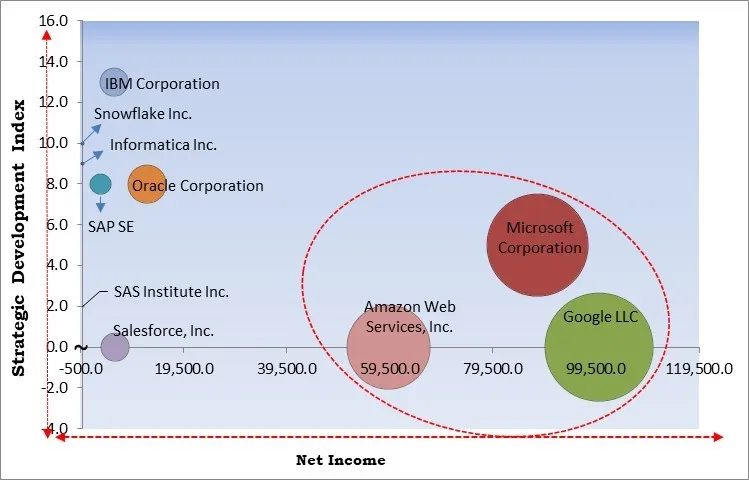
Based on the Analysis presented in the KBV Cardinal matrix; Google LLC, Microsoft Corporation, and Amazon Web Services, Inc. are the forerunners in the Data Intelligence And Integration Software Market. Companies such as Oracle Corporation, Salesforce, Inc., and IBM Corporation are some of the key innovators in Data Intelligence and Integration Software Market. In June, 2025, Microsoft Corporation teamed up with Databricks, a software company to boost data and AI innovation on Azure Databricks. This collaboration deepens native integrations across Azure services, empowering organizations to unify, govern, and harness data for advanced AI applications and next-generation intelligent systems.
When the pandemic first started, businesses quickly moved from working on-site to working from home or in a hybrid model. This made the need for better data management, integration, and analytics tools even more urgent. This change made businesses use advanced data integration and intelligence software to bring together systems that were not working together, keep things running smoothly, and get real-time insights. Investments in tools that help with visibility, scenario modeling, and quick decision-making grew even more as uncertainty and supply chain problems grew. Faster cloud migration also led to more use of cloud-native integration platforms that can grow with your business. The crisis also made organizations pay more attention to data quality, governance, and reliable insights as they dealt with digital workflows and customer interactions that were changing quickly. Thus, the COVID -19 pandemic had a Positive impact on the market.

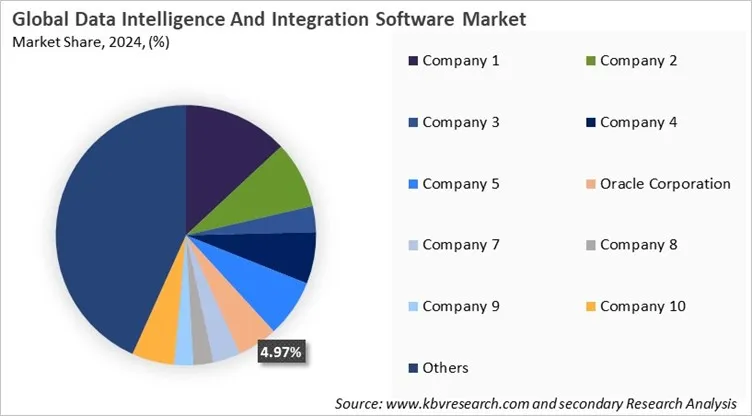
The leading players in the market are competing with diverse innovative offerings to remain competitive in the market. The above illustration shows the percentage of revenue shared by some of the leading companies in the market. The leading players of the market are adopting various strategies to cater demand coming from the different industries. The key developmental strategies in the market are Acquisitions, and Partnerships & Collaborations.
Free Valuable Insights: Data Intelligence And Integration Software Market size to reach USD 58.35 Billion by 2032
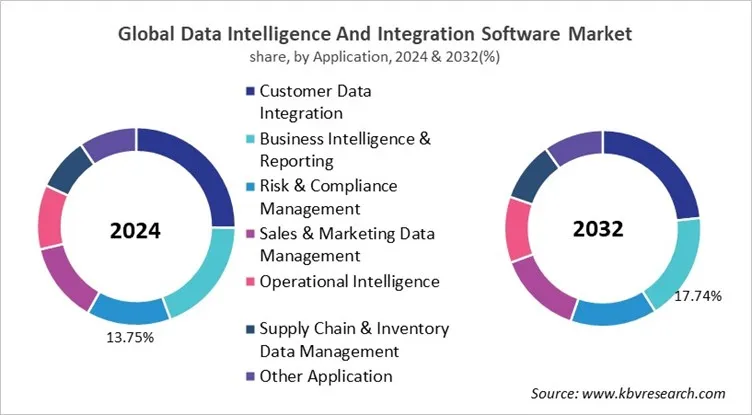
Based on Application, the Data Intelligence And Integration Software Market is segmented into Customer Data Integration, Business Intelligence & Reporting, Risk & Compliance Management, Sales & Marketing Data Management, Operational Intelligence, Supply Chain & Inventory Data Management, and Other Application. The Business Intelligence & Reporting segment attained 19.18% revenue share in the market in 2024. This segment represented a key area of growth, as enterprises sought data-driven insights to guide strategic planning and performance measurement. This segment focused on software tools that aggregated, visualized, and analyzed data to support real-time decision-making. Organizations across sectors leveraged these applications to enhance operational transparency, identify performance gaps, and forecast market trends.
Based on Vertical, the Data Intelligence And Integration Software Market is segmented into BFSI, Healthcare & Life Science, Retail & E-commerce, Manufacturing, Telecommunications & IT, Government and Public Sector, Media & Entertainment, and Other Vertical. The Healthcare & Life Science segment attained 14.72% revenue share in the market in 2024. This segment experienced significant growth as hospitals, research organizations, and pharmaceutical companies increasingly adopted data intelligence and integration software to manage clinical, operational, and patient data.
Region-wise, the Data Intelligence And Integration Software Market is analyzed across North America, Europe, Asia Pacific, and LAMEA. The North America segment recorded 35.37% revenue share in the market in 2024. The data intelligence and integration software market is anticipated to expand at a substantial rate in North America and Europe. The market is driven by large enterprise spending in US, wide deployment of AI/analytics projects, early cloud adoption that requires robust integration and governance capabilities. Deep systems-integration ecosystems, large vendors, and continued modernization of legacy ETL pipelines into cloud-native data fabrics are supporting regional adoption. Additionally, Europe market is witnessing expansion with strong demand for data governance, sovereign-cloud options, and privacy-compliant architectures, which encourage adoption toward government integration platforms.
In the Asia Pacific and LAMEA regions, the data intelligence and integration software market is estimated to experience substantial growth. This is because of large digital transformation programs in India, China, and Southeast Asia, rapid adoption of managed/SaaS integration services, and steady cloud migration in enterprises and public sectors. In addition to this, the LAMEA data intelligence and integration software market represents growth opportunities. The investments in telco, fintech, and public services in South Africa, Brazil, and the UAE are resulting in increased adoption of cloud-native integration to regulatory reporting and support analytics. Regional cloud investments and modernization projects are resulting in growth opportunities for vendors offering lower-touch managed or SaaS integration.
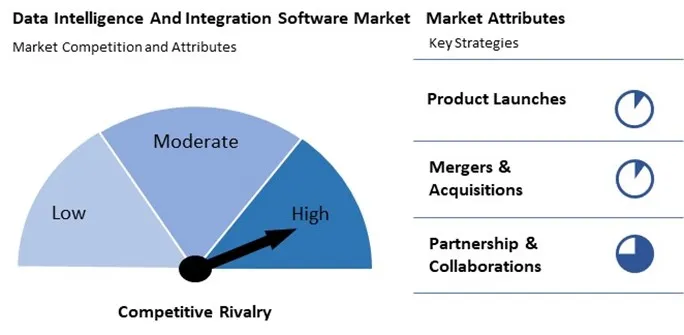
The Data Intelligence and Integration Software market is marked by intensifying competition, driven by rapid digital transformation, rising data volumes, and the need for unified data ecosystems. Vendors compete on capabilities such as scalability, real-time processing, automation, governance, and advanced analytics. Increasing adoption of cloud platforms and AI-driven workflows further heightens rivalry as providers strive to offer seamless integration, stronger security, and lower total cost of ownership. Continuous innovation and differentiation remain essential to gain market share.
| Report Attribute | Details |
|---|---|
| Market size value in 2025 | USD 20.65 Billion |
| Market size forecast in 2032 | USD 58.35 Billion |
| Base Year | 2024 |
| Historical Period | 2021 to 2023 |
| Forecast Period | 2025 to 2032 |
| Revenue Growth Rate | CAGR of 16.0% from 2025 to 2032 |
| Number of Pages | 598 |
| Number of Tables | 434 |
| Report coverage | Market Trends, Revenue Estimation and Forecast, Segmentation Analysis, Regional and Country Breakdown, Competitive Landscape, Market Share Analysis, Porter’s 5 Forces Analysis, Company Profiling, Companies Strategic Developments, SWOT Analysis, Winning Imperatives |
| Segments covered | Component, Application, Vertical, Region |
| Country scope |
|
| Companies Included | Informatica Inc., SAP SE, Snowflake Inc., Microsoft Corporation, IBM Corporation, Oracle Corporation, Salesforce, Inc., Amazon Web Services, Inc. (Amazon.com, Inc.), Google LLC and SAS Institute Inc. |
By Component
By Application
By Vertical
By Geography
This Market size is expected to reach USD 58.35 Billion by 2032.
The data intelligence and integration software market is projected to grow at a CAGR of 16% between 2025 and 2032.
Rising demand for real-time data processing and analytics fueled by the growing adoption of cloud-based data management solutions.
Informatica Inc., SAP SE, Snowflake Inc., Microsoft Corporation, IBM Corporation, Oracle Corporation, Salesforce, Inc., Amazon Web Services, Inc. (Amazon.com, Inc.), Google LLC and SAS Institute Inc.
The Customer Data Integration segment is generating maximum revenue in the Global Data Intelligence And Integration Software Market by Application in 2024, thereby, achieving a market value of $13.58 billion by 2032.
The North America region dominated the Global Data Intelligence And Integration Software Market by Region in 2024 and would continue to be a dominant market till 2032; thereby, achieving a market value of $19,798.3 million by 2032.
Our team of dedicated experts can provide you with attractive expansion opportunities for your business.












 Unique Offerings