“Global Core Banking Software Market to reach a market value of USD 25.10 Billion by 2032 growing at a CAGR of 10%”
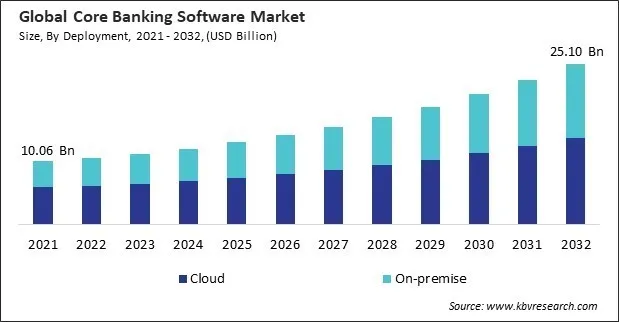
The Global Core Banking Software Market size is expected to reach $25.10 billion by 2032, rising at a market growth of 10.0% CAGR during the forecast period.
The COVID-19 pandemic further accelerated cloud migration, compelling financial institutions to support remote operations and digital-first strategies. Cloud-native platforms also benefit from modern architectural frameworks such as containerization and microservices, which improve system reliability and security. Vendors like Temenos, nCino, Finxact (a Fiserv company), and Mambu have become leading players in the cloud CBS space, often in collaboration with major cloud providers such as Amazon Web Services and Microsoft Azure.
The banking industry is undergoing a significant digital transformation, driven by evolving customer expectations and technological advancements. Modern customers demand seamless, personalized, and accessible banking experiences across multiple channels. To meet these expectations, banks are investing in CBS that offers real-time processing, omnichannel support, and integrated customer relationship management. Thus, digital transformation and the focus on customer-centric banking are compelling banks to adopt advanced CBS solutions.
Additionally, the adoption of cloud computing in the banking sector is revolutionizing the way financial institutions operate. Cloud-based CBS offers scalability, flexibility, and cost-effectiveness, enabling banks to respond swiftly to market changes and customer needs. By migrating to the cloud, banks can reduce their reliance on legacy infrastructure, lower operational costs, and enhance system reliability. Therefore, the shift towards cloud-based CBS is driven by the need for agility, efficiency, and innovation in the banking sector.
However, implementing a modern Core Banking Software (CBS) system requires significant investment, making high implementation costs and extended timelines one of the primary restraints in the market. The transition from legacy systems to modern CBS involves expenses that go beyond software acquisition. Banks must invest in new hardware, system integration, data migration, employee training, and ongoing technical support. In conclusion, many mid-sized and smaller banks delay CBS modernization, fearing financial strain and operational risk.
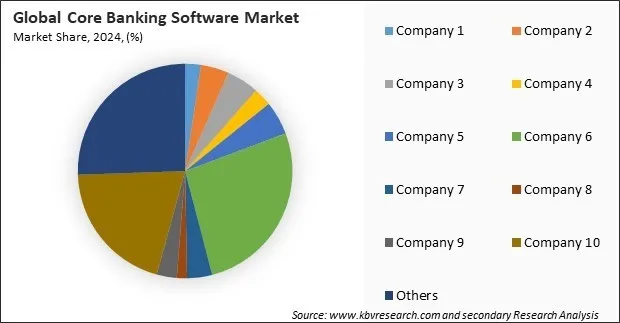
The leading players in the market are competing with diverse innovative offerings to remain competitive in the market. The above illustration shows the percentage of revenue shared by some of the leading companies in the market. The leading players of the market are adopting various strategies in order to cater demand coming from the different industries. The key developmental strategies in the market are Acquisitions, and Partnerships & Collaborations.

Based on Deployment, the market is segmented into Cloud and On-premise. on-premise CBS deployment remains prevalent among institutions with legacy infrastructure, complex custom workflows, or regulatory mandates requiring data residency and full system control. These solutions are typically managed internally, offering banks direct oversight of hardware, software, and data. On-premise systems continue to dominate in regions where cloud regulation is evolving slowly, or where large volumes of sensitive data demand tight internal control.
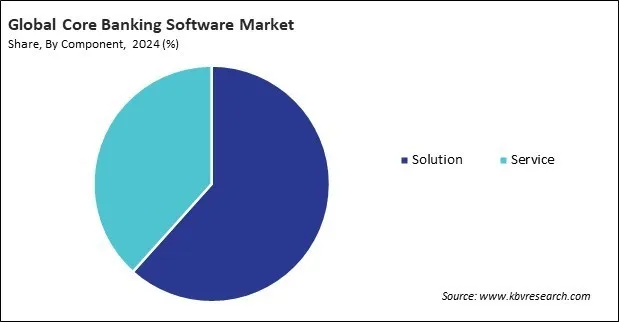
Based on Component, the market is segmented into Solution (Deposits, Loans, Enterprise Customer Solutions, and Other Solution Type) and Service (Professional Service and Managed Service). The Service segment supports the deployment and lifecycle management of core banking solutions. It includes consulting, integration, customization, migration, testing, training, and support services. As CBS platforms become more complex and adaptable to varied banking environments, the role of services in ensuring successful implementation and long-term performance has become increasingly important.
Based on End Use, the market is segmented into Banks, Financial Institutions, and Other End Use. Banks represent the largest segment in the CBS market and are the primary drivers of demand for robust, scalable, and secure platforms. Commercial, retail, and cooperative banks depend on CBS to manage customer accounts, process transactions, support lending operations, and integrate digital banking services.
Free Valuable Insights: Global Core Banking Software Market size to reach USD 25.10 Billion by 2032
Region-wise, the market is analyzed across North America, Europe, Asia Pacific, and LAMEA. The Core Banking Software Market in North America is witnessing a significant shift toward platform modernization, driven by the growing pressure on financial institutions to deliver seamless, real-time digital services while maintaining operational resilience. With the increasing use of embedded finance, banks in the region are rethinking their core systems to integrate directly into third-party ecosystems such as retail platforms, fintech apps, and enterprise software environments.
| Report Attribute | Details |
|---|---|
| Market size value in 2024 | USD 11.91 Billion |
| Market size forecast in 2032 | USD 25.10 Billion |
| Base Year | 2024 |
| Historical Period | 2021 to 2023 |
| Forecast Period | 2025 to 2032 |
| Revenue Growth Rate | CAGR of 10.0% from 2025 to 2032 |
| Number of Pages | 355 |
| Number of Tables | 511 |
| Report coverage | Market Trends, Revenue Estimation and Forecast, Segmentation Analysis, Regional and Country Breakdown, Market Share Analysis, Porter’s 5 Forces Analysis, Company Profiling, Companies Strategic Developments, SWOT Analysis, Winning Imperatives |
| Segments covered | Deployment, End Use, Component, Region |
| Country scope |
|
| Companies Included | Capgemini SE, Finastra Group Holdings Limited (Vista Equity Partners), Temenos AG, HCL Technologies Ltd., Oracle Corporation, Fiserv, Inc., Infosys Limited, SAP SE, Tata Consultancy Services Ltd., and Jack Henry & Associates, Inc. |
By Deployment
By End Use
By Component
By Geography
This Market size is expected to reach $25.10 billion by 2032.
Digital Transformation and Customer-Centric Banking are driving the Market in coming years, however, High Implementation Costs and Extended Timelines restraints the growth of the Market.
Capgemini SE, Finastra Group Holdings Limited (Vista Equity Partners), Temenos AG, HCL Technologies Ltd., Oracle Corporation, Fiserv, Inc., Infosys Limited, SAP SE, Tata Consultancy Services Ltd., and Jack Henry & Associates, Inc.
The expected CAGR of this Market is 10.0% from 2023 to 2032.
The Financial Institutions segment led the maximum revenue in the Market by End Use in 2024, thereby, achieving a market value of $6.00 billion by 2032.
The North America region dominated the Market by Region in 2024, thereby, achieving a market value of $8.31 billion by 2032.
Our team of dedicated experts can provide you with attractive expansion opportunities for your business.








 Unique Offerings