“Global Contextual Advertising Market to reach a market value of USD 593.84 Billion by 2032 growing at a CAGR of 13.8%”
The Global Contextual Advertising Market size is expected to reach $593.84 billion by 2032, rising at a market growth of 13.8% CAGR during the forecast period.
Activity-based advertising is a type of contextual advertising that targets users based on their recent online behaviors, such as website visits, searches, or interactions. This approach enables advertisers to deliver highly relevant ads aligned with user intent, increasing engagement, conversion rates, and the overall effectiveness of digital marketing campaigns.
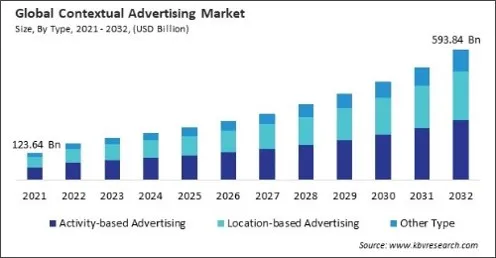
The COVID-19 pandemic significantly disrupted the contextual advertising market, primarily due to widespread cuts in advertising budgets across industries. As businesses faced revenue losses and economic uncertainty, many companies chose to pause or reduce their marketing expenditures, including digital ad campaigns. This sudden decline in advertising demand adversely affected contextual advertising platforms that rely on active bidding and campaign management. Small and medium-sized enterprises, which form a major portion of advertisers, were especially impacted, leading to a sharp contraction in market activity. Additionally, the pandemic caused a substantial shift in consumer behavior, which rendered many pre-COVID contextual data models less effective. Thus, the COVID-19 pandemic had a negative impact on the market.

In recent years, the digital advertising ecosystem has undergone a fundamental shift in response to growing public concern over personal data misuse. Consumers are now more informed and cautious about how their online activities are tracked and monetized. This shift in sentiment has pressured advertisers and technology platforms to re-evaluate their targeting methodologies. Contextual advertising has emerged as a privacy-respecting alternative, offering effective ad placement without relying on third-party cookies or invasive user tracking. The appeal of contextual advertising lies in its ability to deliver relevant ads based solely on the content of a webpage, app, or digital environment—eliminating the need for personally identifiable information (PII). Thus, the growing emphasis on user privacy and ethical data usage is not a temporary trend but a structural shift in digital advertising.
Additionally, The infusion of artificial intelligence (AI) and machine learning (ML) technologies into the advertising sector has revolutionized how contextual targeting operates. Traditional contextual advertising used basic keyword matching to place ads next to related content. While effective to a degree, this method often lacked nuance and failed to grasp the broader meaning of content. With modern AI-driven engines, however, contextual advertising has become smarter, faster, and far more precise. Natural Language Processing (NLP) and computer vision are two key technologies now enabling machines to interpret content just as humans do—or better. Hence, AI and machine learning have transformed contextual advertising from basic keyword-matching into a sophisticated targeting engine capable of human-like understanding.
While contextual advertising has gained popularity for its privacy-first approach, one of its key limitations lies in its inability to deliver deep user-level personalization—something behavioral advertising traditionally excelled at. This lack of personalization can be a significant restraint, especially for advertisers seeking to tailor their messaging based on individual preferences, purchase histories, or browsing behaviors. Behavioral targeting can create finely segmented campaigns based on demographic data, online behavior, retargeting parameters, and cross-device user identities. Thus, while contextual advertising excels in privacy compliance, its lack of deep personalization restricts its effectiveness in precision marketing.
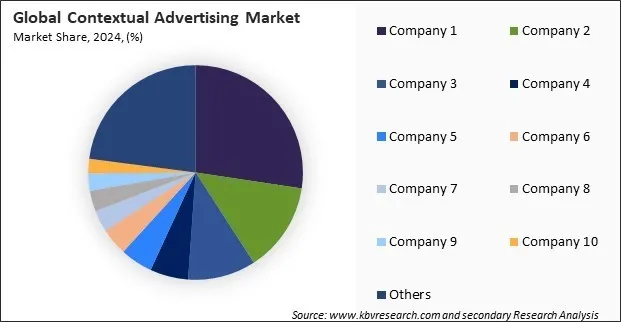
The leading players in the market are competing with diverse innovative offerings to remain competitive in the market. The above illustration shows the percentage of revenue shared by some of the leading companies in the market. The leading players of the market are adopting various strategies in order to cater demand coming from the different industries. The key developmental strategies in the market are Acquisitions, and Partnerships & Collaborations.
Based on type, the contextual advertising market is characterized into activity-based advertising, location-based advertising, and others. The location-based advertising segment procured 37% revenue share in the contextual advertising market in 2024. Location-based advertising targets users based on their geographic location, delivering content that is relevant to their immediate surroundings. This form of advertising is particularly useful for businesses aiming to reach local audiences, promote in-store offers, or increase foot traffic to physical locations.
| Category | Details |
|---|---|
| Use Case Title | Confidential |
| Date | 2025 |
| Entities Involved | Confidential |
| Objective | To drive in-store traffic and real-world engagement by delivering targeted advertisements based on users’ geographic location, movement patterns, and proximity to points of interest. |
| Context and Background | The adoption of smartphones and advancements in geolocation technology have enabled advertisers to offer hyperlocal targeting. Retailers and service providers leverage location-based advertising to deliver timely offers and drive immediate action, capitalizing on consumers’ proximity to stores or events. |
| Description | Location-based advertising uses GPS, Wi-Fi, Bluetooth beacons, and mobile app data to identify a user’s real-time or historical location. Brands and advertisers create geofences around physical locations to trigger targeted ads and promotions when users enter or exit specific zones. This approach is popular for time-sensitive campaigns, event marketing, and local business promotions. |
| Key Capabilities Deployed |
|
| Benefits |
|
| Source | Confidential |
On the basis of approach, the contextual advertising market is classified into mass contextual advertising, focused contextual advertising, contextual behavioral advertising, and contextual billboard advertising. The focused contextual advertising segment recorded 31% revenue share in the contextual advertising market in 2024. Focused contextual advertising is a more refined approach that targets specific categories, niches, or audience segments based on contextual relevance. Advertisers using this method align their ads with carefully selected content, such as placing fitness product ads on health blogs or travel deals on tourism websites.
By deployment, the contextual advertising market is divided into mobile devices, desktops, and digital billboards. The desktops segment garnered 34% revenue share in the contextual advertising market in 2024. Desktops remain an important deployment channel for contextual advertising, particularly in work or home office environments where users engage in longer browsing sessions and more detailed research. Advertisements delivered on desktop platforms benefit from larger screen sizes and often higher attention spans, making them suitable for content-rich formats such as video ads, interactive banners, or sponsored articles.
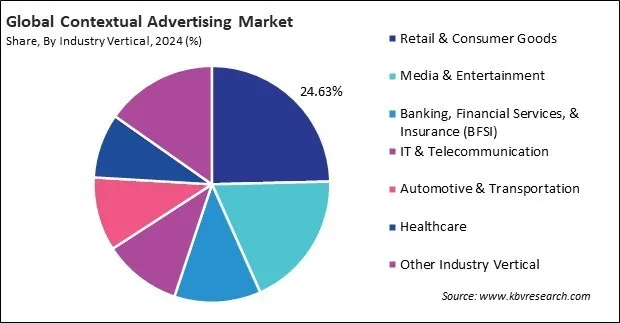
Based on industry vertical, the contextual advertising market is segmented into retail & consumer goods, media & entertainment, banking, financial services, & insurance (BFSI), IT & telecommunication, automotive & transportation, healthcare, and others. The media & entertainment segment acquired 19% revenue share in the contextual advertising market in 2024. The media and entertainment industry utilizes contextual advertising to promote content such as films, streaming shows, music, and live events. With a wide variety of digital content formats available, this sector benefits from placing ads alongside contextually related material to attract the attention of viewers and listeners. For example, a new movie trailer may be shown on entertainment news sites or video platforms based on a user's viewing preferences.
Free Valuable Insights: Global Contextual Advertising Market size to reach USD 593.84 Billion by 2032
Region-wise, the contextual advertising market is analyzed across North America, Europe, Asia Pacific, and LAMEA. The North America segment recorded 37% revenue share in the contextual advertising market in 2024. North America holds a prominent position in the contextual advertising market, driven by its mature digital ecosystem, high digital ad spending, and early adoption of advanced marketing technologies. The region benefits from a well-established presence of global technology giants, digital content platforms, and programmatic advertising firms.
| Report Attribute | Details |
|---|---|
| Market size value in 2024 | USD 214.59 Billion |
| Market size forecast in 2032 | USD 593.84 Billion |
| Base Year | 2024 |
| Historical Period | 2021 to 2023 |
| Forecast Period | 2025 to 2032 |
| Revenue Growth Rate | CAGR of 13.8% from 2025 to 2032 |
| Number of Pages | 442 |
| Number of Tables | 500 |
| Report coverage | Market Trends, Revenue Estimation and Forecast, Segmentation Analysis, Regional and Country Breakdown, Market Share Analysis, Porter’s 5 Forces Analysis, Company Profiling, Companies Strategic Developments, SWOT Analysis, Winning Imperatives |
| Segments covered | Type, Approach, Deployment, Industry Vertical, Region |
| Country scope |
|
| Companies Included | Google LLC (Alphabet Inc.), Microsoft Corporation, Amazon Web Services, Inc. (Amazon.com, Inc.), Yahoo Inc., Adobe, Inc., Media.Net Advertising FZ-LLC, Playwire LLC, PubMatic, Inc., Baidu, Inc., and GumGum, Inc. |
By Type
By Approach
By Deployment
By Industry Vertical
By Geography
This Market size is expected to reach $593.84 billion by 2032.
Increasing Consumer Demand For Privacy-First Advertising Solutions are driving the Market in coming years, however, Limited User-Level Personalization Compared To Behavioral Targeting restraints the growth of the Market.
Google LLC (Alphabet Inc.), Microsoft Corporation, Amazon Web Services, Inc. (Amazon.com, Inc.), Yahoo Inc., Adobe, Inc., Media.Net Advertising FZ-LLC, Playwire LLC, PubMatic, Inc., Baidu, Inc., and GumGum, Inc.
The expected CAGR of this Market is 13.8% from 2023 to 2032.
The Mobile Devices segment led the maximum revenue in the Market by Deployment in 2024, thereby, achieving a market value of $308.1 billion by 2032.
The North America region dominated the Market by Region in 2024, and would continue to be a dominant market till 2032; thereby, achieving a market value of $212.2 billion by 2032.
Our team of dedicated experts can provide you with attractive expansion opportunities for your business.












 Unique Offerings