“Global Container Handling Equipment Market to reach a market value of USD 10.96 Billion by 2032 growing at a CAGR of 26.3%”
The Global Container Handling Equipment Market size is estimated at $8.17 billion in 2025 and is expected to reach $10.96 billion by 2032, rising at a market growth of 4.3% CAGR during the forecast period (2025-2032). The projected growth of the global container handling equipment market is driven by rising seaborne trade, port expansion projects, and increasing containerization of cargo. Modernization of aging port infrastructure, automation of terminals, and demand for efficient, high-capacity cranes and handling systems further support steady market expansion through 2032.
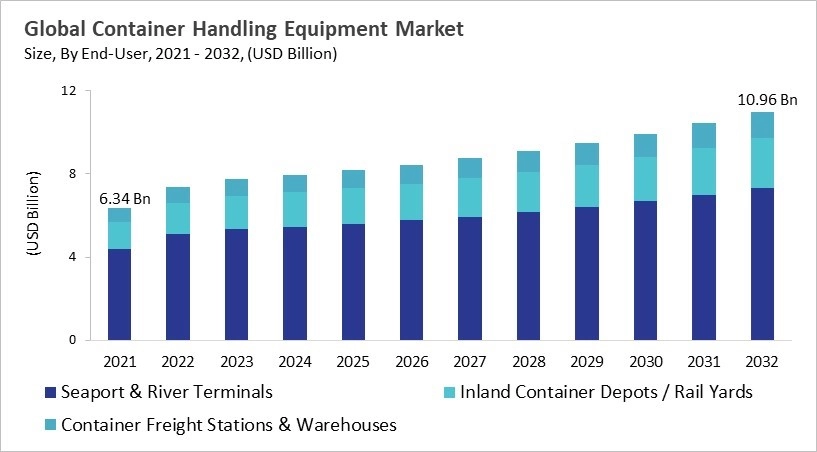
The global container handling equipment market is essential to the smooth functioning of maritime trade, as it enables the efficient movement and handling of containers within ports and terminals. Its development has closely mirrored the rise of containerized shipping, evolving from simple lifting equipment to advanced, high-capacity machines designed to handle larger vessels and growing trade volumes. In recent years, automation and digital technologies have become increasingly important, with ports adopting automated cranes and smart control systems to boost efficiency, improve safety, and optimize space. At the same time, stricter environmental regulations and sustainability goals are accelerating the shift toward electric and hybrid equipment, placing greater emphasis on energy efficiency and lower emissions without compromising performance.
Current market trends are influenced by the growing deployment of ultra-large container vessels, which has increased demand for cranes with greater lifting capacity and extended reach. Leading manufacturers such as Konecranes, Liebherr, Kalmar, and ZPMC are focusing on innovation, diversified product portfolios, and long-term service offerings to address the evolving needs of port operators. Competition in the market is driven by technological strength, automation capabilities, service reliability, and long-term operational value, with established global players maintaining a strong presence. Overall, the market continues to evolve within a mature framework, supported by ongoing trade growth, port modernization efforts, and a rising focus on automation and sustainable port operations.

The COVID-19 pandemic hurt the market for container handling equipment because it messed up trade and logistics around the world. Shipping volumes fell sharply because ports were less busy and needed less equipment because of lockdowns and border restrictions. It was hard to make things because factories were closing, there weren't enough workers, and it was hard to get raw materials. This slowed down production. Because there weren't enough parts, deliveries took longer and new installations had to be put off. People who were involved in the port didn't want to spend money on new infrastructure because they wanted to keep things running. Because of financial uncertainty, many projects had to be put on hold or canceled, especially in developing countries. Because there weren't enough staff and training programs were delayed, people used the equipment less and automation took longer to catch on. In general, these things slowed down market growth and made the industry take longer to bounce back. Thus, the COVID-19 pandemic had a negative impact on the market.
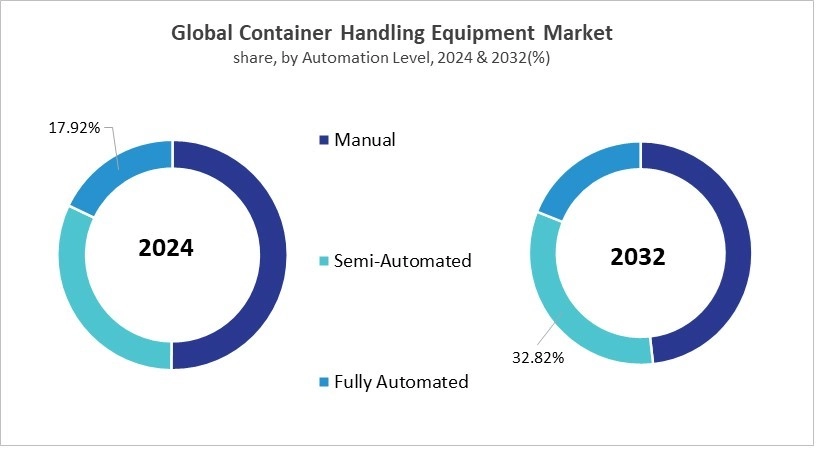
Based on Automation Level, the Container Handling Equipment Market is segmented into Manual, Semi-Automated, and Fully Automated. The Semi-Automated segment attained 31.91% revenue share in the market in 2024. The semi-automated automation level segment represents a balanced integration of mechanical systems and operator-assisted technologies within container handling operations. Equipment in this category combines automated features such as sensor-based positioning, assisted steering, load monitoring, and programmable movement patterns with active human supervision and control.
Based on End-User, the Container Handling Equipment Market is segmented into Seaport & River Terminals, Inland Container Depots / Rail Yards, and Container Freight Stations & Warehouses. The Inland Container Depots / Rail Yards segment attained 20.79% revenue share in the market in 2024. The inland container depots and rail yards segment focuses on facilitating container storage, consolidation, deconsolidation, and intermodal transfers away from congested port areas. Container handling equipment used in this segment includes reach stackers, forklifts, gantry cranes, and rail-mounted handling systems designed to support efficient loading and unloading of containers between trucks and rail wagons.
Free Valuable Insights: Container Handling Equipment Market Size to reach $10.96 by 2032
Region-wise, the Container Handling Equipment Market is analyzed across North America, Europe, Asia Pacific, and LAMEA. The Asia Pacific segment recorded 43.14% revenue share in the market in 2024. North America and Europe are well-established markets for container handling equipment, supported by modern port infrastructure, high trade activity, and early adoption of automation. In North America, port operators are mainly focused on upgrading existing terminals with automated and electrified equipment to improve efficiency, ease congestion, and comply with stricter environmental regulations. Europe remains a close follower, driven by strong regional and international trade, advanced port digitalization, and ambitious decarbonization targets. European ports are especially active in deploying automated cranes, electric rubber-tired gantry cranes, and energy-efficient systems aligned with sustainability goals and Industry 4.0 initiatives.
Asia Pacific and LAMEA are emerging as high-growth regions, fueled by expanding maritime trade, large-scale port development projects, and rising container volumes. Asia Pacific, led by countries such as China, South Korea, Singapore, and India, handles a significant share of global container traffic, creating strong demand for high-capacity and automated handling equipment to support mega-vessels and busy terminals. At the same time, LAMEA is seeing steady progress as investments increase in port modernization, logistics infrastructure, and trade facilitation, driving greater adoption of modern container handling equipment and positioning the region as a long-term growth market.
| Report Attribute | Details |
|---|---|
| Market size value in 2025 | USD 8.17 Billion |
| Market size forecast in 2032 | USD 10.96 Billion |
| Base Year | 2024 |
| Historical period | 2021 to 2023 |
| Forecast Period | 2025 to 2032 |
| Revenue Growth Rate | CAGR of 4.3% from 2025 to 2032 |
| Number of Pages | 598 |
| Tables | 505 |
| Report Coverage | Market Trends, Revenue Estimation and Forecast, Segmentation Analysis, Regional and Country Breakdown, Porter’s 5 Forces Analysis, Company Profiling, Companies Strategic Developments, SWOT Analysis, Winning Imperatives |
| Segments Covered | Automation Level, End-User, Propulsion Type, Equipment Type, Region |
| Country Scope |
|
| Companies Included | Cosco Shipping Lines Co. Ltd., A.P. Moller - Maersk A/S, CMA CGM Group, MSC Mediterranean Shipping Company S.A., Ocean Network Express Pte. Ltd., Evergreen Marine Corp. (Taiwan) Ltd. (Evergreen Group), Hapag-Lloyd AG, ZIM Integrated Shipping Services Ltd. (KENON HOLDINGS LTD.), DP World Logistics FZE (SeaRates) and SANY Group |
By Automation Level
By End User
By Propulsion Type
By Equipment Type
By Geography
Our team of dedicated experts can provide you with attractive expansion opportunities for your business.







 Unique Offerings