“Global Construction Equipment Finance Market to reach a market value of USD 144.91 Billion by 2032 growing at a CAGR of 6.1%”
The Global Construction Equipment Finance Market size is expected to reach USD 144.91 billion by 2032, rising at a market growth of 6.1% CAGR during the forecast period.
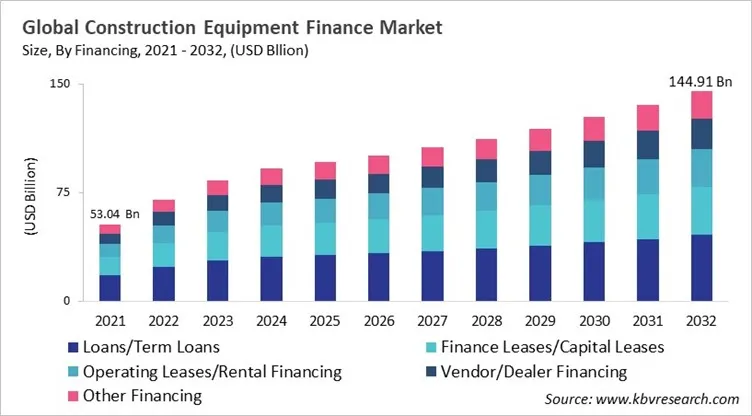
The construction equipment finance market has developed into a sophisticated ecosystem of financing solutions that support equipment acquisition, operation, and lifecycle management. Construction equipment financing now includes hire-purchases, credit lines, and leases tailored to contractors’ cash-flow requirements. As equipment manufacturers (OEMs) like Caterpillar and others expanded worldwide, captive finance arms emerged, integrating equipment sales with maintenance and financial services. This model allows bundled protection, flexible payment options, and digital asset management while promoting stronger customer relationships. The construction equipment finance market’s growth has been accelerated by the surge in infrastructure projects across emerging economies, where financing has become an essential enabler for rental operators and contractors. Modern financing models now encompass telematics, allowing residual value guarantees, upgrade programs, and monitoring, transforming equipment finance into a lifecycle-based service.
The construction equipment finance market is predicted to expand, driven by elements including the increasing popularity of embedded and captive finance models as OEMs provide integrated, point-of-sale financing solutions to improve sales and customer loyalty. Further, contractors increasingly prefer flexible lease and rental-type arrangements with deferred or seasonal payments that align with project cycles, preserving cash flow and allowing fleet modernization. Data analytics and digitalization now underpin the industry, with finance providers using telematics to optimise residual value, assess risk, and design usage-based payment structures. Key market players like Caterpillar’s Cat Financial are adopting strategies that combine financing with digital asset management, expanding into emerging economies, and integrating data-driven risk models. OEM-captive finance units, specialist leasing companies, and banks are seeking advantage through regional finance solutions, digital innovation, and integrated service offerings.
The COVID-19 pandemic had a big effect on the global construction equipment finance market in 2020. The economy shrank by 3.2% and trade fell by 5.3%, which meant fewer equipment sales and delayed investments. Sales and profits for big companies like Caterpillar fell by 27% and 41%, respectively, which made it harder to get financing. Finance companies had fewer new loans, a lot of people putting off payments, and more people not paying back their loans. More than 90% of companies offered payment deferrals, and more than 75% expected more people to not pay back their loans. Supply chain problems, stopped projects, and a lack of workers made it even harder to deploy equipment and make payments. Overall, the sector had less demand, more credit risk, and less cash flow because of uncertainty around the world. Thus, the COVID-19 pandemic had a negative impact on the market.

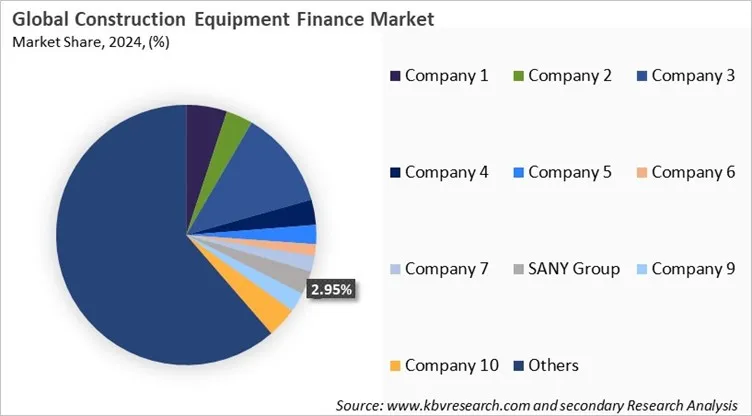
The leading players in the market are competing with diverse innovative offerings to remain competitive in the market. The above illustration shows the percentage of revenue shared by some of the leading companies in the market. The leading players of the market are adopting various strategies to cater demand coming from the different industries. The key developmental strategies in the market are Acquisitions, and Partnerships & Collaborations.
Based on financing, the construction equipment finance market is characterized into loans/term loans, finance leases/capital leases, operating leases/rental financing, vendor/dealer financing, and others. The finance leases/capital leases segment attained 23% revenue share in the construction equipment finance market in 2024. The finance-lease / capital-lease segment plays a key role for many companies when they wish to preserve cash flows yet still secure long-term access to equipment. OEM finance arms highlight that a “finance lease gives you long-term access to equipment with the option to purchase it when the lease ends”. This model is particularly aligned to organisations that prefer outright ownership eventually but wish to spread payments or gain tax or balance‐sheet benefits associated with leasing rather than a straight loan.
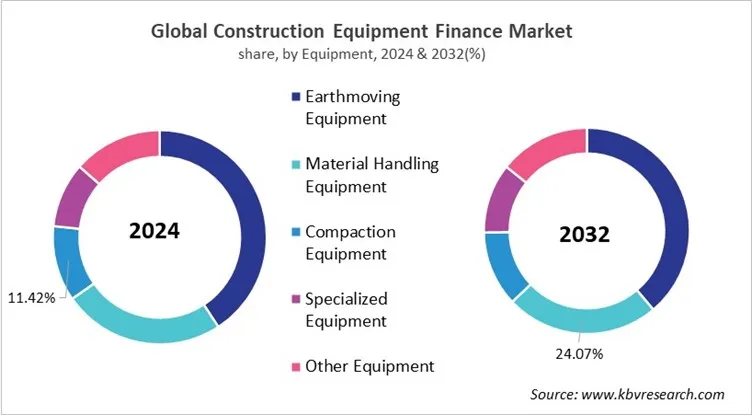
On the basis of equipment, the construction equipment finance market is classified into earthmoving equipment, material handling equipment, compaction equipment, specialized equipment, and others. The material handling equipment segment recorded 24% revenue share in the construction equipment finance market in 2024. Material handling equipment is another key category in equipment-finance portfolios. This covers forklifts, telehandlers, cranes, boom lifts and other equipment used for lifting, moving or transporting materials on site.
Free Valuable Insights: Construction Equipment Finance Market size to reach USD 144.91 Billion by 2032
Region-wise, the Construction Equipment Finance Market is analyzed across North America, Europe, Asia Pacific, and LAMEA. The Asia Pacific segment gained 40% revenue share in the construction equipment finance market in 2024. The construction equipment finance market is predicted to have prominent growth in North America and Europe. In North America, demand is increasing mainly by replacement cycles, vendor/captive financing, and fleet modernization, producing steady mid-single-digit market growth and making loans or term-loans the biggest financing segment. Further, in Europe, the accelerating replacement spending remains the main element where fleets must comply with emission and safety rules. This transition to rental and more flexible finance structures is supporting specialist lessors and OEM captive finance arms, leading to market expansion.
In the Asia Pacific and LAMEA regions, the construction equipment finance market is anticipated to grow at a substantial rate. The expansion is driven by urbanization, infrastructure investment, and fleet expansion in earthmoving and mining. Strong OEM activities, increasing vendor finance programs, and enhanced penetration of formal leasing make APAC the primary growth engine for captive finance providers. Moreover, the LAMEA market is expanding, driven by infrastructure, oil & gas government pipeline projects. In these regions, high demand for flexible terms, longer tenor solutions, and used equipment financing are allowing financiers to expand.
| Report Attribute | Details |
|---|---|
| Market size value in 2025 | USD 95.81 Billion |
| Market size forecast in 2032 | USD 144.91 Billion |
| Base Year | 2024 |
| Historical Period | 2021 to 2023 |
| Forecast Period | 2025 to 2032 |
| Revenue Growth Rate | CAGR of 6.1% from 2025 to 2032 |
| Number of Pages | 560 |
| Number of Tables | 411 |
| Report coverage | Market Trends, Revenue Estimation and Forecast, Segmentation Analysis, Regional and Country Breakdown, Market Share Analysis, Porter’s 5 Forces Analysis, Company Profiling, Companies Strategic Developments, SWOT Analysis, Winning Imperatives |
| Segments covered | Financing, Equipment, Industry, Region |
| Country scope |
|
| Companies Included | Caterpillar, Inc., Deere & Company, Wells Fargo & Company, Komatsu Ltd., CNH Industrial Capital (India) Private Limited (CNH Industrial N.V.), Liebherr-International AG, First-Citizens Bank & Trust Company (First Citizens BancShares, Inc.), SANY Group, Hitachi Construction Machinery Co., Ltd. (Hitachi, Ltd.) and Volvo Construction Equipment AB (Volvo Group) |
By Financing
By Equipment
By Industry
By Geography
This Market size is expected to reach USD 144.91 billion by 2032.
"The construction equipment finance market is projected to grow at a CAGR of 6.1% between 2025 and 2032. "
Accelerating global infrastructure investment and urbanisation, coupled with the high capital cost of advanced equipment and the shift toward asset-light models, is reshaping equipment demand dynamics.
Caterpillar, Inc., Deere & Company, Wells Fargo & Company, Komatsu Ltd., CNH Industrial Capital (India) Private Limited (CNH Industrial N.V.), Liebherr-International AG, First-Citizens Bank & Trust Company (First Citizens BancShares, Inc.), SANY Group, Hitachi Construction Machinery Co., Ltd. (Hitachi, Ltd.) and Volvo Construction Equipment AB (Volvo Group)
The Earthmoving Equipment segment is generating the maximum revenue share in the Global Construction Equipment Finance Market by Equipment in 2024, thereby, achieving a market value of $56.29 billion by 2032.
The Asia Pacific region dominated the Global Construction Equipment Finance Market by Region in 2024 and would continue to be a dominant market till 2032; thereby, achieving a market value of $58.35 billion by 2032.
Our team of dedicated experts can provide you with attractive expansion opportunities for your business.







 Unique Offerings