“Global Connected Car Market to reach a market value of USD 396.71 Billion by 2032 growing at a CAGR of 19.3%”
The Global Connected Car Market size is expected to reach USD 396.71 billion by 2032, rising at a market growth of 19.3% CAGR during the forecast period.
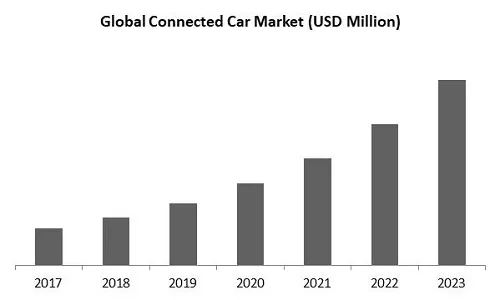
From early telematics systems that concentrated on basic navigation and emergency assistance, the global connected car market has developed into an advanced, data-driven mobility ecosystem. The foundation for vehicle connectivity was laid by early innovations like General Motors' OnStar in the middle of the 1990s, and it grew dramatically with the development of mobile networks, including 3G, 4G/LTE, and now 5G. In order to provide services like over-the-air software updates, sophisticated driver-assistance systems, infotainment, predictive maintenance, and vehicle-to-everything (V2X) communication, connected cars now combine computing, sensors, cloud platforms, and real-time communication. By encouraging interoperability, safety procedures, and next-generation connectivity frameworks, governments, standards organizations, and business partners have aided this development and positioned connected cars as crucial parts of smart cities and intelligent transportation systems.
Major trends like software-defined cars, increased V2X communication, and consumer-focused digital services are currently influencing the market. In order to enable ongoing feature upgrades and subscription-based revenue models, automakers are increasingly integrating connectivity at the center of vehicle architecture. Beyond traditional OEMs, there is competition from tech firms, telecom providers, cloud service providers, and specialized software companies, all of which contribute to a highly competitive yet cooperative ecosystem. Partnerships, cybersecurity, regulatory compliance, and scalable cloud-based platforms are now strategic priorities. Overall, connected cars have transitioned from optional innovations to integral mobility platforms, reflecting the convergence of automotive engineering, telecommunications, and information technology in shaping the future of transportation.
The major strategies followed by the market participants are Product Launches as the key developmental strategy to keep pace with the changing demands of end users. For instance, In, February2024, General Motors Co. unveiled OnStar in Bahrain, offering connected vehicle services for enhanced safety, security, and convenience. The platform provides real-time assistance, navigation, and emergency response, ensuring a smarter driving experience. This expansion aligns with GM’s commitment to innovation and customer-centric mobility solutions in the Middle East. Additionally, In October, 2024, Tesla, Inc. unveiled DIMO connected car app, allowing owners to access real-time vehicle data, enhance diagnostics, and optimize performance. This collaboration enables Tesla users to track efficiency, battery health, and driving habits, providing a seamless experience for monitoring and managing their vehicles through DIMO’s platform.
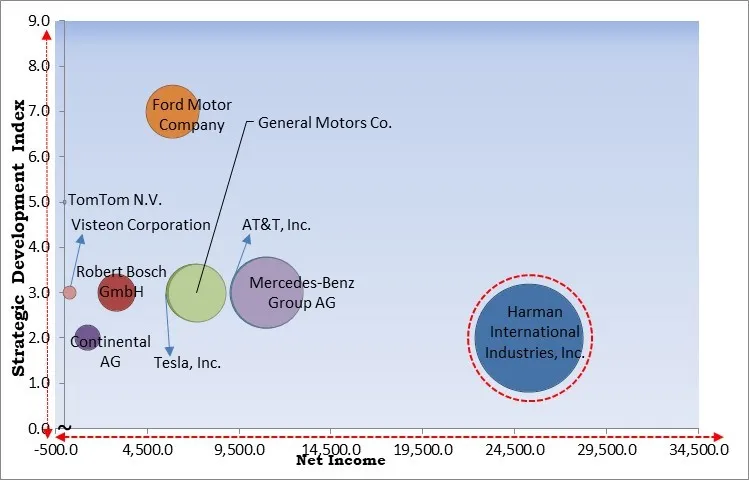
Based on the Analysis presented in the KBV Cardinal matrix; Harman International Industries, Inc. is the forerunner in the Connected Car Market. Companies such as Mercedes-Benz Group AG, AT&T, Inc., and General Motors Co. are some of the key innovators in Connected Car Market. In March, 2025, Mercedes-Benz Group AG unveiled the all-electric CLA, featuring the advanced MB.OS software. This next-generation vehicle boasts improved performance, efficiency, and smart connectivity. Designed for a seamless digital experience, the CLA integrates cutting-edge technology, enhancing driver assistance and infotainment capabilities while setting new standards for luxury and sustainability in electric mobility.
The COVID-19 pandemic negatively impacted the connected car market by disrupting global automotive production through lockdowns, factory shutdowns, and delayed vehicle launches. Since connected technologies are integrated during manufacturing, reduced vehicle output directly limited the deployment of telematics, infotainment, and driver assistance systems. Severe supply chain disruptions, particularly semiconductor shortages and logistics delays, further constrained production and increased costs. Automakers postponed or simplified connected features as they prioritized operational stability. Consumer and fleet demand declined amid economic uncertainty and reduced mobility needs. Investment in connected fleet and mobility solutions slowed significantly. Additionally, R&D activities and smart mobility pilot projects were delayed, temporarily weakening innovation and market momentum. Thus, the COVID-19 pandemic had a Negative impact on the market.

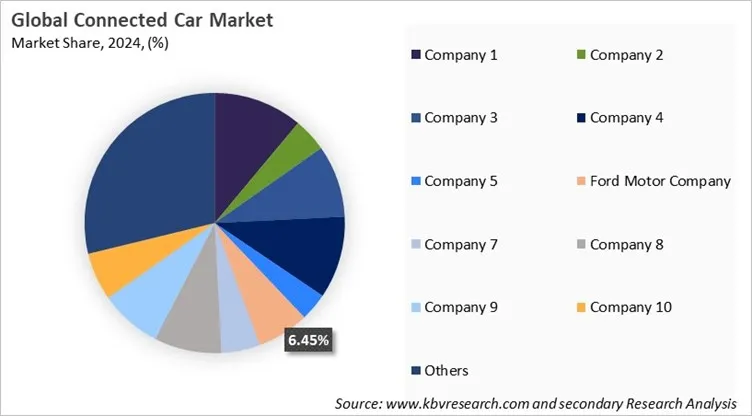
The leading players in the market are competing with diverse innovative offerings to remain competitive in the market. The above illustration shows the percentage of revenue shared by some of the leading companies in the market. The leading players of the market are adopting various strategies in order to cater demand coming from the different industries. The key developmental strategies in the market are Acquisitions, and Partnerships & Collaborations.
Free Valuable Insights: Connected Car Market size to reach USD 396.71 Billion by 2032
Based on communication technology, the Connected Car Market is characterized into Vehicle-to-Vehicle (V2V) and Vehicle-to-Infrastructure (V2I). The Vehicle-to-Infrastructure (V2I) segment attained 43% revenue share in the Connected Car Market in 2024. The Vehicle-to-Infrastructure (V2I) communication segment plays an essential role in the global Connected Car Market by enabling interaction between vehicles and roadway infrastructure. V2I technology allows vehicles to communicate with traffic signals, road sensors, tolling systems, parking facilities, and traffic management platforms.
On the basis of sales channel, the Connected Car Market is classified into OEM and aftermarket. The aftermarket segment recorded 31% revenue share in the Connected Car Market in 2024. The aftermarket segment holds a significant position in the global Connected Car Market, supported by the vast number of vehicles already in operation that were not originally equipped with connected features. Aftermarket solutions allow vehicle owners and fleet operators to adopt connectivity through plug-in telematics devices, infotainment upgrades, tracking systems, and diagnostic tools.
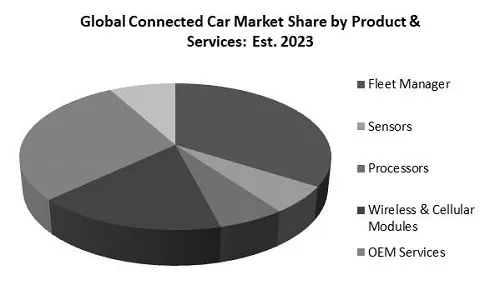
Region-wise, the Connected Car Market is analyzed across North America, Europe, Asia Pacific, and LAMEA. The North America segment recorded 33% revenue share in the Connected Car Market in 2024. In North America and Europe, the connected car market is quite advanced. It has a high adoption rate of connectivity features, strong government oversight, and solid digital infrastructure. North America has embraced embedded telematics, over-the-air software updates, and subscription-based connected services. This has happened largely due to cooperation between car manufacturers, tech companies, and telecom providers. The region focuses on innovation in software-defined vehicles, advanced driver-assistance systems, and communication between vehicles and everything around them. Safety, cybersecurity, and making money from data are top priorities. In Europe, there is a heavy focus on meeting regulations, ensuring devices work well together, and promoting sustainability. Strict data protection laws, vehicle safety rules, and emissions standards have influenced how connected car platforms are developed. These regulations encourage manufacturers to adopt secure, standardized, and compatible connectivity solutions. Additionally, smart city projects and intelligent transportation systems are enhancing connected vehicle integration in urban areas in both regions.
The present scenario for the connected car industry in the Asia Pacific and LAMEA regions represents various stages of adoption and development, with a focus on rapid urbanization and growth in vehicle numbers. The Asia Pacific region encompasses fast growth in the use of connected vehicles, driven by the manufacture of a large volume of vehicles, the emergence of consumer demand for digital services, and initiatives by governments in the development of smart and telecom revolution. The region is led by China, Japan, and South Korea for the development of connected and intelligent vehicles, and cost-effective methods of connectivity gain popularity in the emerging Asian markets. In contrast, the LAMEA region exhibits stable growth and various stages of use for the connected car segment, which gets driven by applications that include vehicle management, safety, and tracking services for optimal use of the connected car. The telecom infrastructure development in the Middle East and the need for smart services and commercial mobility in Latin America and Africa encourage growth in the use of connected cars.
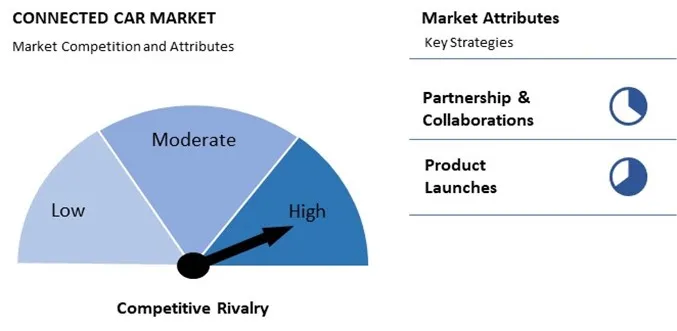
Competition in the connected car market is intense and multi-layered, driven by rapid technological innovation and convergence between automotive, telecom, and digital service ecosystems. Players compete on connectivity reliability, software capabilities, data security, and user experience. Continuous feature upgrades, over-the-air updates, and integration with smart infrastructure create differentiation. Market participants also focus on partnerships, regional customization, and subscription-based services. As connectivity becomes standard rather than premium, pricing pressure and innovation speed increasingly define competitive positioning.
| Report Attribute | Details |
|---|---|
| Market size value in 2025 | USD 115.20 Billion |
| Market size forecast in 2032 | USD 396.71 Billion |
| Base Year | 2024 |
| Historical Period | 2021 to 2023 |
| Forecast Period | 2025 to 2032 |
| Revenue Growth Rate | CAGR of 19.3% from 2025 to 2032 |
| Number of Pages | 664 |
| Number of Tables | 557 |
| Report coverage | Market Trends, Revenue Estimation and Forecast, Segmentation Analysis, Regional and Country Breakdown, Competitive Landscape, Market Share Analysis, Porter’s 5 Forces Analysis, Company Profiling, Companies Strategic Developments, SWOT Analysis, Winning Imperatives |
| Segments covered | Communication Technology, Sales Channel, Connectivity Solution, Technology, Application, Region |
| Country scope |
|
| Companies Included | Continental AG, AT&T, Inc., HARMAN International Industries, Inc. (Samsung Electronics Co., Ltd.), Robert Bosch GmbH, TomTom N.V., Ford Motor Company, Mercedes-Benz Group AG, Visteon Corporation, Tesla, Inc. and General Motors Co. |
By Communication Technology
By Sales Channel
By Connectivity Solution
By Technology
By Application
By Geography
This Market size is expected to reach USD 396.71 Billion by 2032.
The connected car market is projected to grow at a CAGR of 19.3% between 2025 and 2032.
Global focus on road safety and emergency response modernization, along with rapid advances in digital and telecommunications infrastructure, is accelerating market growth.
Continental AG, AT&T, Inc., HARMAN International Industries, Inc. (Samsung Electronics Co., Ltd.), Robert Bosch GmbH, TomTom N.V., Ford Motor Company, Mercedes-Benz Group AG, Visteon Corporation, Tesla, Inc. and General Motors Co.
The OEM segment is generating maximum revenue share in the Global Connected Car Market by Sales Channel in 2024, thereby, achieving a market value of $266.48 billion by 2032.
The North America region dominated the Global Connected Car Market by Region in 2024, and would continue to be a dominant market till 2032; thereby, achieving a market value of $124.80 billion by 2032.
Our team of dedicated experts can provide you with attractive expansion opportunities for your business.







 Unique Offerings