“Global Computer Vision AI in Retail Market to reach a market value of USD 8.58 Billion by 2032 growing at a CAGR of 24.3%”
The Global Computer Vision AI in Retail Market size is expected to reach USD 8.58 billion by 2032, rising at a market growth of 24.3% CAGR during the forecast period.
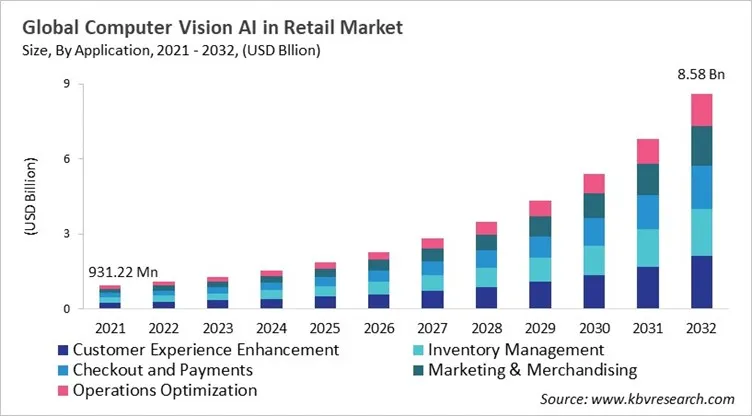
Recently, the computer vision in AI retail market has developed into a key component of smart retail infrastructure. Computer vision’s role has expanded with AI integration enabling real-time interpretation of visual data for analytics, automation and enhancing customer experience, which initially was limited to theft prevention. Advancements in IoT, edge computing and deep learning allow retailers to integrate real-time, low-latency visual intelligence for applications like behaviour tracking, cashierless checkout, and inventory management. These innovations transformed visual data into driving operational efficiency, actionable insights, enhancing customization, and reducing losses. Nowadays, computer vision AI supports smart retail operations, by serving seamless omnichannel experiences, autonomous stores, and predictive analytics within digital retail environments.
The computer vision in AI retail market is growing driven by the integration of vision intelligence into autonomous retail systems, the combination of visual technologies with digital commerce, and the adoption of hybrid AI models. Retailers are integrating edge computing for more secure and faster in-store processing, while computer vision’s deployment with digital signage and robotics is allowing automated retail orchestration, and proactive. Market players are pursuing strategies focused on in-house AI development, pilot-based scaling, strategic partnerships, and ethical AI practices to assure compliances, and transparency. Computer vision in AI retail market is witnessing intensive competition with major tech companies, data-driven retailers, and agile startups competing to offer scalable and innovative vision solutions. Altogether, these advancements position computer vision AI as a shifting force reshaping how global retailers increase engagement in customers, optimize performance and manage operations.
The major strategies followed by the market participants are Partnerships as the key developmental strategy to keep pace with the changing demands of end users. For instance, In June 2025, NVIDIA Corporation came into partnership with L’Oréal, LVMH, and Nestlé to transform retail operations using AI-powered digital twins and generative tools, enhancing product design, marketing, and logistics efficiency, with additional support from Accenture and Microsoft Azure. Additionally, In May, 2025, Cognex Corporation and IMA E-COMMERCE partnered to enhance sustainable and efficient order fulfillment using AI-powered vision systems and barcode readers. This collaboration enables accurate packaging, reduces waste, supports automation, and meets eco-friendly demands in the evolving retail and e-commerce logistics sector.
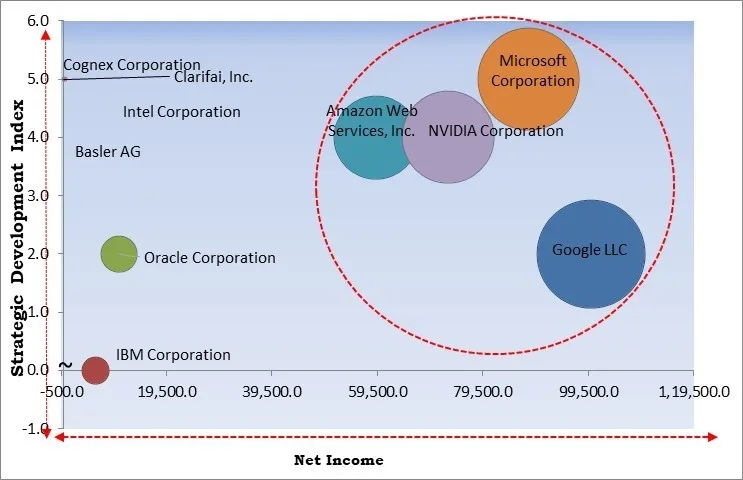
Based on the Analysis presented in the KBV Cardinal matrix; Google LLC, Microsoft Corporation, NVIDIA Corporation and Amazon Web Services, Inc. are the forerunners in the Computer Vision AI in Retail Market. Companies such as Oracle Corporation and IBM Corporation are some of the key innovators in Computer Vision AI in Retail Market. In June, 2025, Google LLC and Everseen partnered to enhance physical retail operations using Vision AI. The collaboration integrates real-time video analytics to reduce shrink, optimize inventory, and improve customer experience, offering scalable, AI-powered solutions via Google Cloud Marketplace for global retail transformation.
The COVID-19 pandemic significantly accelerated the adoption of computer vision AI in the retail industry as retailers sought contactless, safe, and efficient operations. AI-driven systems were deployed to monitor social distancing, mask compliance, and occupancy limits, ensuring safety and operational continuity. Retailers embraced technologies like cashier-less checkouts, smart shelves, and visual product recognition to enhance convenience and reduce human contact. Additionally, computer vision improved inventory tracking, logistics, and demand forecasting amid supply chain disruptions. Its integration into e-commerce enabled visual search, virtual try-ons, and personalized recommendations, solidifying computer vision as a key driver of post-pandemic retail innovation and efficiency. Thus, the COVID-19 pandemic had a positive impact on the market.

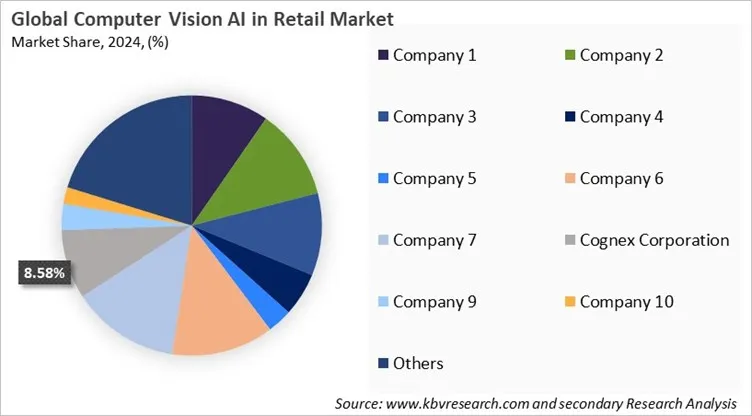
The leading players in the market are competing with diverse innovative offerings to remain competitive in the market. The above illustration shows the percentage of revenue shared by some of the leading companies in the market. The leading players of the market are adopting various strategies in order to cater demand coming from the different industries. The key developmental strategies in the market are Acquisitions, and Partnerships & Collaborations.
Free Valuable Insights: Computer Vision AI in Retail Market size to reach USD 8.58 Billion by 2032
Based on application, the computer vision AI in retail market is characterized into customer experience enhancement, inventory management, checkout & payments, marketing & merchandising, and operations optimization. The inventory management segment attained 22% revenue share in the computer vision AI in retail market in 2024. The inventory management segment has seen strong adoption of computer vision AI as retailers strive to achieve higher accuracy and efficiency in stock monitoring and replenishment. Vision-enabled systems are used to track product availability, detect misplaced items, and prevent out-of-stock situations. Automated shelf scanning and smart cameras allow for continuous oversight of store inventory, reducing human error and operational costs.
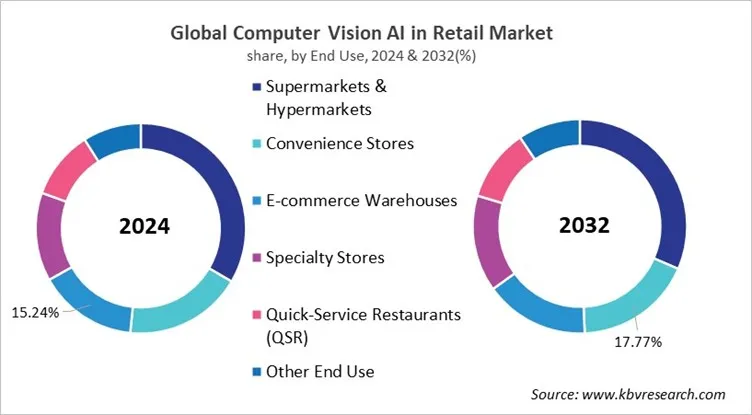
On the basis of end use, the computer vision AI in retail market is classified into supermarkets & hypermarkets, convenience stores, e-commerce warehouses, specialty stores, quick-service restaurants (QSR), and others. The convenience stores segment recorded 18% revenue share in the computer vision AI in retail market in 2024. In convenience stores, computer vision AI is being adopted to enhance speed, automation, and personalized service. Smaller store formats benefit greatly from intelligent cameras and sensors that monitor foot traffic, analyze product interactions, and enable frictionless checkout. AI-driven vision systems help store operators track inventory in real time and optimize space utilization, allowing for faster restocking and improved product availability.
Region-wise, the Computer Vision AI in Retail Market is analyzed across North America, Europe, Asia Pacific, and LAMEA. The North America segment recorded 36% the largest revenue share in the computer vision AI in Retail Market in 2024. The computer vision in AI retail market is anticipated to grow at a significant rate in North America and Europe. The market growth is backed by advanced retail infrastructure, early technology adoption, and strong investment in analytics and automation. In North America, major retailers like Amazon and Walmart are innovating with AI-driven store operations, including shelf monitoring, customer behaviour analytics, and cashierless checkouts. The region’s emphasis on data-driven decision-making, well-established cloud ecosystem, and presence of leading AI firms support the rapid integration of vision-based retail solutions. Additionally, emphasis on sustainability, ethical AI, and data privacy under regulatory frameworks such as GDPR encourage responsible implementation. Retailers across European nations like Germany, France, and the UK are deploying AI vision for planogram compliance, omnichannel engagement, and loss prevention, supported by strong collaboration among retail chains and technology providers.
In the LAMEA and Asia Pacific region, the computer vision in the AI retail market is estimated to represent growth opportunities as retailers are embracing AI vision to cater to evolving operational challenges and consumer demands. In the Asia Pacific, expanding retail networks, increasing digitalization, and smart city initiatives in nations such as Japan, China, India, and South Korea are surging large adoption of AI-based visual analytics. Regional tech ecosystems and government supported AI innovation further result in expansion with a focus on edge computing for real time insights, and mobile based visual solutions. Furthermore, the LAMEA region is experiencing market expansion supported by the increasing investments in retail modernization and collaborations with global technology providers. Retailers in Saudi Arabia, Brazil, and the UAE are integrating computer vision for queue management, customer engagement, and inventory tracking to support digital transformation, thereby representing long-term growth opportunities.
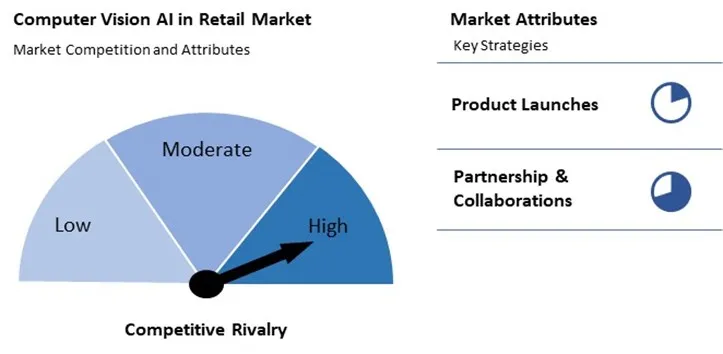
The competition in the computer vision AI in retail market is intense, and innovation driven. Companies compete through advancements in deep learning, edge computing, and real-time analytics to improve store operations and customer experiences. The market faces strong rivalry due to rapid technological evolution and high adoption rates. Differentiation mainly depends on solution accuracy, integration flexibility, and scalability. Continuous partnerships and product enhancements are essential as players strive to gain a competitive edge in an increasingly dynamic and technology-centric environment.
| Report Attribute | Details |
|---|---|
| Market size value in 2025 | USD 1.86 Billion |
| Market size forecast in 2032 | USD 8.58 Billion |
| Base Year | 2024 |
| Historical Period | 2021 to 2023 |
| Forecast Period | 2025 to 2032 |
| Revenue Growth Rate | CAGR of 24.3% from 2025 to 2032 |
| Number of Pages | 655 |
| Number of Tables | 513 |
| Report coverage | Market Trends, Revenue Estimation and Forecast, Segmentation Analysis, Regional and Country Breakdown, Competitive Landscape, Market Share Analysis, Porter’s 5 Forces Analysis, Company Profiling, Companies Strategic Developments, SWOT Analysis, Winning Imperatives |
| Segments covered | Application, End Use, Technology, Deployment, Region |
| Country scope |
|
| Companies Included | Intel Corporation, Amazon Web Services, Inc. (Amazon.com, Inc.), Google LLC, IBM Corporation, Basler AG, Microsoft Corporation, NVIDIA Corporation, Cognex Corporation, Oracle Corporation and Clarifai, Inc. |
By Application
By End Use
By Technology
By Deployment
By Geography
The market size is projected to reach USD 8.58 billion by 2032.
The computer vision AI in retail market is projected to grow at a CAGR of 24.3% between 2025 and 2032.
Rising demand for automation and operational efficiency is complemented by a growing focus on personalized and immersive customer experiences.
Intel Corporation, Amazon Web Services, Inc. (Amazon.com, Inc.), Google LLC, IBM Corporation, Basler AG, Microsoft Corporation, NVIDIA Corporation, Cognex Corporation, Oracle Corporation and Clarifai, Inc.
The Object Detection & Tracking segment is generating the maximum revenue share in the Global Computer Vision AI in Retail Market by Technology in 2024; thereby, achieving a market value of $2.27 billion by 2032.
The North America region dominated the Global Computer Vision AI in Retail Market by Region in 2024, and would continue to be a dominant market till 2032; thereby, achieving a market value of $2.95 billion by 2032.
Our team of dedicated experts can provide you with attractive expansion opportunities for your business.







 Unique Offerings