“Global Computer Aided Engineering (CAE) Market to reach a market value of USD 22.64 Billion by 2032 growing at a CAGR of 9.9%”
The Global Computer Aided Engineering Market size is expected to reach USD 22.64 billion by 2032, rising at a market growth of 9.9% CAGR during the forecast period.
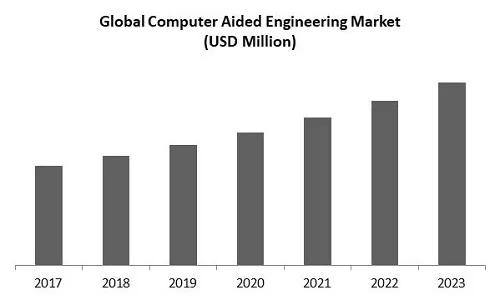
Computer aided engineering involves the usage of advanced software tools like CFD, FEA, and multibody dynamics to simulate, analyze, and optimize engineering designs before physical production. Initially developed for defense & aerospace applications, computer aided engineering has developed into a core component of digital product development across sectors, including energy, infrastructure, automotive, and manufacturing. Advancements in government-backed research programs, computing power, and wider industrial adoption have allowed engineers to decrease development risks, accelerate innovation, and reduce prototyping costs. With time, computer aided engineering has transformed from a specialized analysis function to a foundational technology supporting smart manufacturing, Industry 4.0, and lifecycle-based engineering.
The computer aided engineering market is being driven by artificial intelligence, digital twin technologies, and cloud computing. AI-driven simulation surges analysis, enhances accuracy, and automates data exploration, whereas cloud-based platforms democratize access to high-performance simulation by reducing infrastructure costs and allowing global collaboration. Further, digital twins extend CAE from design into real-time operational optimization by combining simulation with IoT data. Key market players like Siemens, ANSYS, Altair, and Dassault Systemes compete in AI innovation, industry-specific solutions, cloud scalability, and integrated engineering ecosystems, creating an increasingly connected, intelligent, and competitive computer aided engineering landscape.
The COVID-19 pandemic hurt the CAE market, especially during the first lockdowns when factories, cars, and planes all had to stop working. Due to budget problems and uncertainty about demand, a lot of businesses put off or canceled their purchases of CAE software and simulation projects. Disruptions in the supply chain and limited access to high-performance computing on-site slowed down engineering and simulation work. Companies that provide CAE services and consulting firms had fewer clients and projects that took longer to finish. Problems with collaboration and restrictions on physical testing made simulation workflows even more difficult. Small and medium-sized businesses were hit the hardest, putting advanced engineering tools lower on their list of priorities. Overall, drops in important end-use industries caused a temporary slowdown in the growth of the CAE market, even though interest in digital engineering grew later.

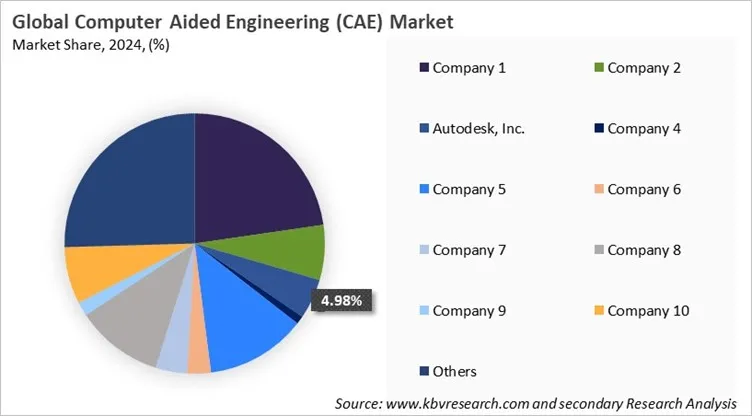
The leading players in the market are competing with diverse innovative offerings to remain competitive in the market. The below illustration shows the percentage of revenue shared by some of the leading companies in the market. The leading players of the market are adopting various strategies in order to cater demand coming from the different industries. The key developmental strategies in the market are Acquisitions, and Partnerships & Collaborations.
Based on deployment model, the computer aided engineering (CAE) Market is characterized into on-premise and cloud-based. The cloud-based segment attained 38% revenue share in the computer aided engineering (CAE) market in 2024. Cloud-based deployment has established a substantial presence in the global Computer Aided Engineering (CAE) market, supported by increasing demand for flexibility, scalability, and cost efficiency. This model enables organizations to access advanced simulation tools and high-performance computing resources on demand, reducing the need for significant upfront investment in infrastructure.
On the basis of component, the computer aided engineering (CAE) market is classified into software and services. The services segment recorded 27% revenue share in the computer aided engineering (CAE) market in 2024. The segment plays a critical role in enabling effective adoption and long-term utilization of simulation technologies. CAE-related services include consulting, system integration, customization, development services, training, technical support, and maintenance. These services help organizations tailor CAE solutions to specific industry requirements, manage complex simulation projects, and build internal engineering expertise.
Free Valuable Insights: Computer Aided Engineering (CAE) Market size to reach USD 22.64 Billion by 2032
Region-wise, the computer aided engineering (CAE) market is analyzed across North America, Europe, Asia Pacific, and LAMEA. The North America segment recorded 33% revenue share in the computer aided engineering (CAE) market in 2024. The computer aided engineering (CAE) market is expected to grow at a substantial rate in North America and Europe. This is because of its strong industrial base in aerospace, defense, automotive, and advanced manufacturing. The United States is witnessing adoption with substantial R&D investment, widespread usage of cloud-based simulation platforms, and digital twin, and regulatory drivers that support product compliance and precision engineering. Robust ecosystem of research institutions and vendors, and rising digital transformation continue to sustain stable regional computer aided engineering market growth. Moreover, Europe market is also witnessing expansion. The adoption is largely supported by aerospace engineering and automotive, with the rising emphasis on eco-design, sustainability, and advanced material simulation. Smart manufacturing initiatives and Industry 4.0, along with regulatory compliance for safety and emissions, further support the region’s investments in CAE technologies.
In Asia Pacific and LAMEA, the computer aided engineering market is projected to capture prominent growth. This is because of expanding electronic and automotive industry, rapid industrialization, and strong government support for smart manufacturing and digitalization. Japan, South Korea, India, and China are leading adopters, using CAE tools to accelerate time-to-market, enhance product quality, and support innovation in semiconductor design, robotics, and EVs. Furthermore, the LAMEA computer aided engineering market is growing, supported by oil & gas and energy projects, infrastructure modernization, and automotive and defense sectors, especially in nations such as Mexico, UAE, Brazil, Egypt, and South Africa. These regions are largely investing in digital engineering tools to support economic diversification and infrastructure development, thereby offering growth opportunities in the LAMEA computer aided engineering market.
| Report Attribute | Details |
|---|---|
| Market size value in 2025 | USD 11.68 Billion |
| Market size forecast in 2032 | USD 22.64 Billion |
| Base Year | 2024 |
| Historical Period | 2021 to 2023 |
| Forecast Period | 2025 to 2032 |
| Revenue Growth Rate | CAGR of 9.9% from 2025 to 2032 |
| Number of Pages | 643 |
| Number of Tables | 545 |
| Report coverage | Market Trends, Revenue Estimation and Forecast, Segmentation Analysis, Regional and Country Breakdown, Competitive Landscape, Market Share Analysis, Porter’s 5 Forces Analysis, Company Profiling, Companies Strategic Developments, SWOT Analysis, Winning Imperatives |
| Segments covered | Deployment Model, Component, End-use Industry, Region |
| Country scope |
|
| Companies Included | ANSYS, Inc., Altair Engineering Inc., Autodesk, Inc., Bentley Systems, Inc., Dassault Systemes SE, ESI Group (Keysight Technologies, Inc.), Hexagon AB, Siemens AG, PTC, Inc. and The MathWorks, Inc. |
By Deployment Model
By Component
By End-use Industry
By Geography
This Market size is expected to reach USD 22.64 billion by 2032.
The computer aided engineering (CAE) market is projected to grow at a CAGR of 9.9% between 2025 and 2032.
Increasing product design complexity and need for virtual prototyping, driving strong CAE adoption across automotive electrification, aerospace innovation, and mobility technologies.
ANSYS, Inc., Altair Engineering Inc., Autodesk, Inc., Bentley Systems, Inc., Dassault Systemes SE, ESI Group (Keysight Technologies, Inc.), Hexagon AB, Siemens AG, PTC, Inc. and The MathWorks, Inc.
The On-premise segment registered maximum revenue in the Global Computer Aided Engineering (CAE) Market by Deployment Model in 2024, growing at a CAGR of 9.6 % during the forecast period.
The North America region dominated the Global Computer Aided Engineering (CAE) Market by Region in 2024, and would continue to be a dominant market till 2032; thereby, achieving a market value of $7.12 billion by 2032.
Our team of dedicated experts can provide you with attractive expansion opportunities for your business.












 Unique Offerings