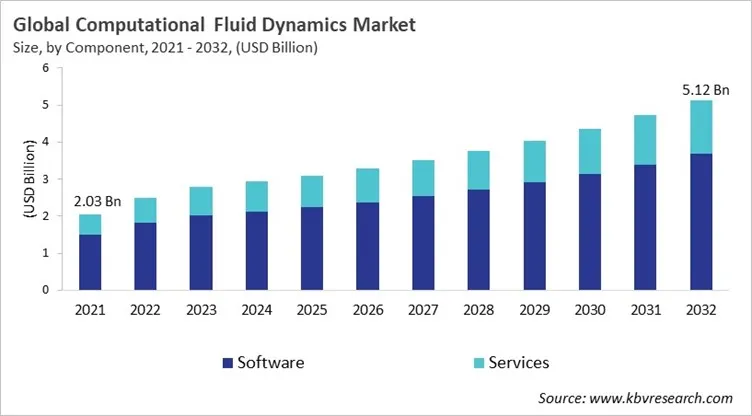
“Global Computational Fluid Dynamics Market to reach a market value of USD 5.12 Billion by 2032 growing at a CAGR of 7.5%”
The Global Computational Fluid Dynamics Market is expected to reach $5.12 billion by 2032, rising at a market growth of 7.5% CAGR during the forecast period.
Computational Fluid Dynamics (CFD) is an important tool utilized in various fields owing to its precision in modelling as to how gases and liquids move and behave. It supports engineering professionals to make more efficient and safer goods thereby reducing the requirement of expensive prototypes and physical testing. CFD fuels enhance the performance and innovation in various sectors from aerospace; being used to improve heat transfer and airflow in planes and spacecraft, to the automobile sector; emphasizing the aerodynamics of vehicle and cooling for electric vehicles. The ability of CFD to foresee helps the environment to reduce the pollution and saves time and money.
CFD is utilized across various sectors including healthcare, engineering, electronics, oil & gas and marine. From activities such as simulate power plants combustion, monitor blood flows for medical devices and regulate heat in microchips and data centers. With the increase in adoption of cloud-based platforms and Software-as-a-service (SaaS) models, the startups and small businesses now look forward to utilizing CFD owing to the cost-effectiveness of these offerings. The novel advancements such as Digital twins, AI integration and multi-physics models are transforming its potential to compute and optimize in real time. Open-source tools such as OpenFOAM and government initiatives are expected to be more environment friendly are proving CFD to be more popular across the world.
To keep abreast of the evolving demands from the end users, the market participants are adopting Partnerships as the major strategy. For e.g. in June, 2025, ANSYS, Inc. declared the partnership with DCAI and NVIDIA to develop quantum algorithms for fluid dynamics. This GPU-accelerated quantum-classical approach enables efficient simulation of quantum lattice Boltzmann methods, advancing the role of quantum computing in engineering fields like computational fluid dynamics. In May 2025, Altair Engineering Inc. teamed up with Georgia Tech to develop aerospace research with the help of simulation, Data Analytics and Artificial Intelligence.
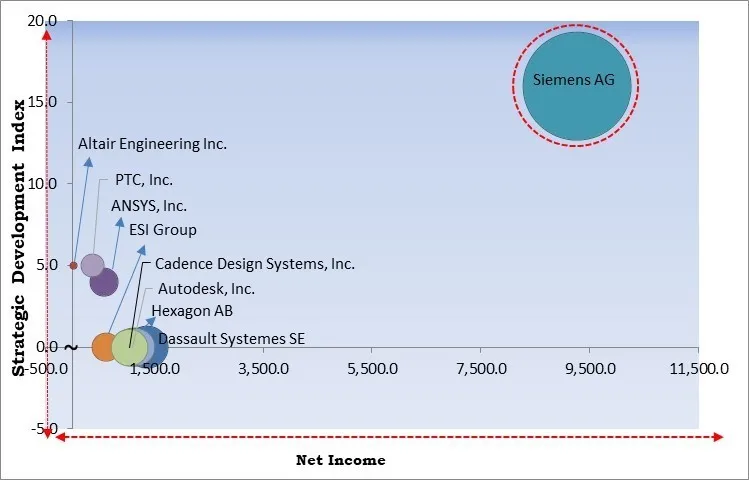
Based on the Analysis presented in the KBV Cardinal matrix; Siemens AG is the forerunner in the Computational Fluid Dynamics Market. Companies such as Dassault Systemes SE, Hexagon AB, and Autodesk, Inc. are some of the key innovators in Computational Fluid Dynamics Market. In June, 2025, Siemens AG announced the partnership with NVIDIA to advance industrial AI and digitalization. By integrating NVIDIA’s accelerated computing with Siemens' Xcelerator platform and CFD software (Simcenter Star-CCM+), they enable faster, AI-driven product design, manufacturing, and simulation—boosting efficiency, reducing costs, and transforming factories with real-time digital twin technology and smart automation.
Lockdowns, supply chain disruptions, and labor shortages caused many manufacturing and engineering operations to be suspended or drastically reduced during the height of the COVID-19 pandemic. The automotive, aerospace, and energy sectors—all of which have historically relied heavily on CFD software for testing and simulation—were all negatively impacted by this disruption. Purchases of new CFD software, service agreements, and license renewals consequently decreased. Many R&D projects were postponed or cancelled entirely due to lower budgets and greater uncertainty. Consequently, the market was negatively impacted by the COVID-19 pandemic.

High-performance computing (HPC) has come a long way in the past decade, and this has helped sectors that need a lot of processing power, such computational fluid dynamics (CFD). CFD simulations need to solve complex partial differential equations over highly discretized geometries, which takes a lot of processing power, memory capacity, and the ability to do multiple things at once. Due to the development of adaptable HPC platforms with multi-core processors, GPUs, and advanced parallelization techniques, it is now much easier to do complex CFD simulations with higher resolution and shorter run times. So, developing and growing HPC capabilities is still a major component in the CFD market's rapid growth.
High-performance computing (HPC) has gotten a lot stronger in the recent ten years. This has assisted places that need a lot of computer capacity, including computational fluid dynamics (CFD). You need to be able to solve complicated partial differential equations across very small geometries for CFD simulations. You need a lot of processing power, memory bandwidth, and the ability to do a lot of things at once for this. It is now much easier to execute complex CFD models with higher resolution and less time because of the rise of scalable HPC platforms with multi-core processors, GPUs, and sophisticated parallelization technologies. So, improving and expanding HPC powers is still a key part of the CFD market's rapid growth.
Also, the shift toward virtual prototyping is changing the way that products are developed in the automobile and aerospace industries, which have historically depended on CFD the most. Traditional physical testing is not only costly and time-consuming, but it also has limits on how broad and repeatable it can be. CFD, on the other hand, lets engineers do detailed analysis in a virtual environment by modeling airflow, thermal transfer, turbulent conditions, combustion, and multiphase flows with a lot of complexity.
This means they don't have to make physical models. So, the CFD market keeps growing since product development is quickly moving toward simulation-driven methods. The shift toward virtual prototyping is affecting how product development cycles function in the aerospace and automotive industries, which have used CFD the most in the past. Not only is traditional physical testing expensive and time-consuming, but it also can't be done repeatedly. CFD, on the other hand, lets engineers undertake in-depth analysis without building physical models since it emulates airflow, heat transfer, turbulence, combustion, and multiphase flows in a very detailed way in a virtual world. The CFD market keeps increasing because of this quick change to making goods based on simulations.
Even with all the amazing progress in technology, putting up a CFD simulation continues to be an extremely specialized job that takes a lot of understanding about fluid physics, numerical methods, and how to use software. This complexity makes it hard for new businesses or sectors to get in, especially if they don't have any CFD experts on staff. The accuracy and usefulness of CFD results are directly related to how detailed the first inputs are, such as setting up the geometry, meshing, boundary conditions, solver settings, and turbulence models.
All these need to be thoroughly calibrated. So, one of the greatest things holding back the expansion of the CFD industry is still how complicated it is and how much knowledge it takes. Even though technology has come a long way, putting up a CFD simulation is still an extremely specialized job that requires a lot of knowledge of fluid physics, math, and computer skills. This level of difficulty makes it impossible for new businesses to enter the market, especially those who don't have adequate CFD expertise. It's crucial to carefully set up the geometry, meshing, boundary conditions, solver settings, and turbulence models that are used as initial inputs because these things have a direct effect on how accurate and helpful the CFD results are. So, one of the greatest things keeping the CFD market from growing is still the necessity for a lot of knowledge and experience.
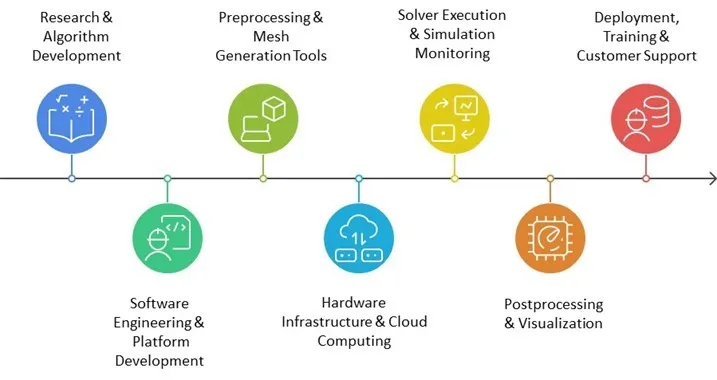
The Computational Fluid Dynamics (CFD) Market value chain consists of several integrated stages. It begins with Research & Algorithm Development, where numerical models and simulation techniques are formulated. Next, Software Engineering & Platform Development ensures these models are coded into robust platforms. Preprocessing & Mesh Generation Tools handle geometry setup and mesh design. Simulations are run in Solver Execution & Simulation Monitoring. Post-analysis occurs in Postprocessing & Visualization, followed by Hardware Infrastructure & Cloud Computing support. Lastly, Deployment, Training & Customer Support ensures smooth end-user adoption and service continuity.
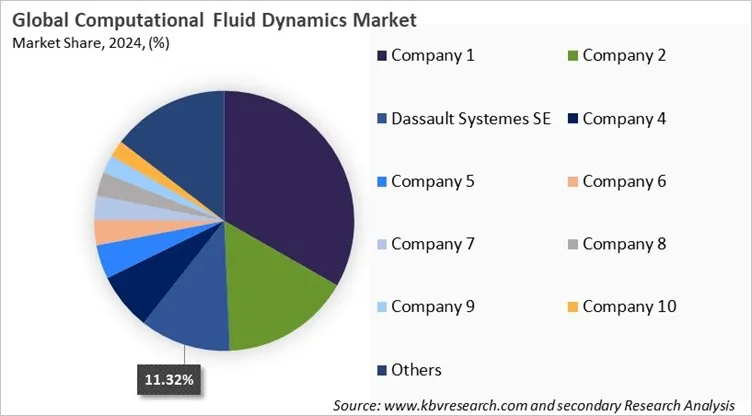
The leading players in the market are competing with diverse innovative offerings to remain competitive in the market. The above illustration shows the percentage of revenue shared by some of the leading companies in the market. The leading players of the market are adopting various strategies to cater demand coming from the different industries. The key developmental strategies in the market are Partnerships & Collaborations.
Free Valuable Insights: Global Computational Fluid Dynamics Market size to reach USD 5.12 Billion by 2032
On the basis of component, the computational fluid dynamics market is classified into software and services. The services segment recorded 27% revenue share in the computational fluid dynamics market in 2024. This covers maintenance, customization, training, support for simulations, and consulting. Many organizations depend on outside providers for simulation projects and implementation advice, particularly those without internal CFD expertise. The need for expert services to guarantee accurate modeling and optimal software utilization is anticipated to increase steadily as CFD applications spread into newer industries and more complex use cases.
| Category | Details |
|---|---|
| Use Case Title | Confidential |
| Date | 2025 |
| Entities Involved | Confidential |
| Objective | Provide expert CFD consulting services to ensure safe and efficient flow behavior within subsea oil pipelines, accounting for multiphase transport and pressure drop analysis. |
| Context and Background | CFD services are frequently outsourced by companies lacking in-house simulation capacity or requiring domain-specific expertise. In oil & gas, services are used to model complex fluid behaviors such as wax deposition, hydrate formation, and gas-liquid flows under extreme pressure/temperature conditions. |
| Description | Siemens PLM engineers were contracted by Petrobras to simulate flow assurance in a new deepwater field in Brazil. The CFD team analyzed hydrate risk zones and optimized insulation and pigging schedules. DNV was involved in validating the simulation models for regulatory compliance. |
| Key Capabilities Deployed |
|
| Regions Covered |
|
| Benefits |
|
| Source | Confidential |
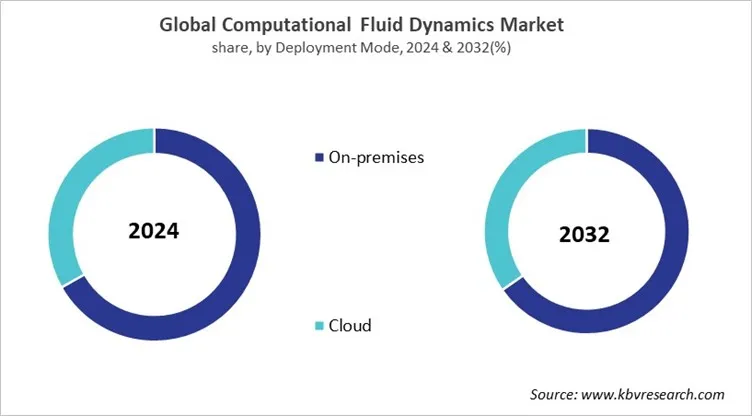
Based on deployment mode, the computational fluid dynamics market is characterized into on-premises and cloud. The on-premises segment garnered 67% revenue share in the computational fluid dynamics market in 2024. The market for computational fluid dynamics (CFD) is dominated by the on-premises segment, primarily because it provides better simulation control, security, and customization. To manage delicate, extensive fluid dynamics simulations, sectors like aerospace, automotive, and energy frequently need secure environments and high-performance computing infrastructure.
The computational fluid dynamics market is segmented by end user into aerospace, automotive, energy, manufacturing, material and chemical processing, and other areas. The energy segment made for 14% of the computational fluid dynamics market's revenue in 2024. People who work in the energy sector use CFD to model how fluids move in oil and gas pipes, nuclear reactors, wind turbines, and power plants. These models assist make sure that important infrastructure is run safely, that pollutants are tracked, and that the combustion process is as efficient as possible. CFD tools are becoming increasingly significant in the design and operation of modern energy systems as the focus shifts to cleaner energy sources and using resources more efficiently.
Region-wise, the computational fluid dynamics market is analyzed across North America, Europe, Asia Pacific, and LAMEA. The North America segment recorded 34% revenue share in the computational fluid dynamics market in 2024.
North America has the highest share of the computational fluid dynamics (CFD) market because cutting-edge industries like aerospace, cars, and energy need it a lot. Big defense businesses, car producers, and colleges and universities in the US spend a lot of money on simulation technology to help people come up with new ideas and make new things. Many kinds of enterprises employ CFD solutions. The region's strong infrastructure, considerable spending on research and development, and early use of high-performance computing systems all make this possible.
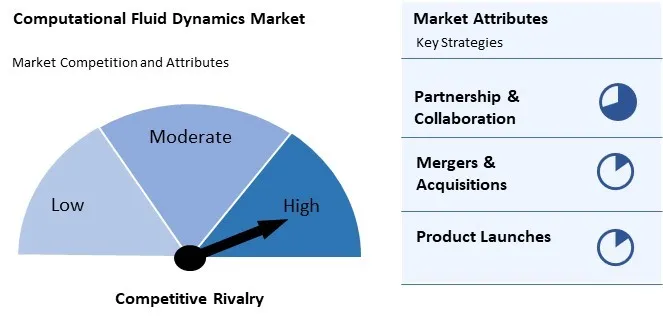
The Computational Fluid Dynamics (CFD) market is highly competitive, driven by technological innovation, customization capabilities, and domain-specific applications across aerospace, automotive, and energy sectors. Key attributes of shaping competition include simulation accuracy, multi-physics integration, user-friendly interfaces, and scalability for high-performance computing. Vendors also compete with support services, cloud deployment options, and licensing flexibility. As digital twins and AI-enhanced simulations gain traction, market players strive to differentiate through advanced modeling capabilities and seamless integration with broader engineering workflows.
| Report Attribute | Details |
|---|---|
| Market size value in 2024 | USD 2.92 Billion |
| Market size forecast in 2032 | USD 5.12 Billion |
| Base Year | 2024 |
| Historical Period | 2021 to 2023 |
| Forecast Period | 2025 to 2032 |
| Revenue Growth Rate | CAGR of 7.5% from 2025 to 2032 |
| Number of Pages | 354 |
| Number of Tables | 368 |
| Report coverage | Market Trends, Revenue Estimation and Forecast, Segmentation Analysis, Regional and Country Breakdown, Competitive Landscape, Market Share Analysis, Porter’s 5 Forces Analysis, Company Profiling, Companies Strategic Developments, SWOT Analysis, Winning Imperatives |
| Segments covered | Deployment Mode, Component, End User, Region |
| Country scope |
|
| Companies Included | ANSYS, Inc., Siemens AG, Dassault Systemes SE, Altair Engineering Inc., Hexagon AB, ESI Group (Keysight Technologies, Inc.), PTC, Inc., The MathWorks, Inc., Autodesk, Inc. and Cadence Design Systems, Inc. |
By Deployment Mode
By Component
By End User
By Geography
This Market size is expected to reach $5.12 billion by 2032.
Advancement in High-Performance Computing (HPC) Infrastructure are driving the Market in coming years, however, High Costs of Licensing, Hardware, and Maintenance restraints the growth of the Market.
ANSYS, Inc., Siemens AG, Dassault Systemes SE, Altair Engineering Inc., Hexagon AB, ESI Group (Keysight Technologies, Inc.), PTC, Inc., The MathWorks, Inc., Autodesk, Inc. and Cadence Design Systems, Inc.
The expected CAGR of this Market is 7.5% from 2023 to 2032.
The Software segment is leading the Market by Component in 2024; thereby, achieving a market value of $3,674.6 million by 2032.
The North America region dominated the Market by Region in 2024, and would continue to be a dominant market till 2032; thereby, achieving a market value of $1.65 billion by 2032.
Our team of dedicated experts can provide you with attractive expansion opportunities for your business.










 Unique Offerings