“Global Cognitive Agents Market to reach a market value of USD 8.63 Billion by 2032 growing at a CAGR of 39.4%”
The Global Cognitive Agents Market size is expected to reach $8.63 billion by 2032, rising at a market growth of 39.4% CAGR during the forecast period
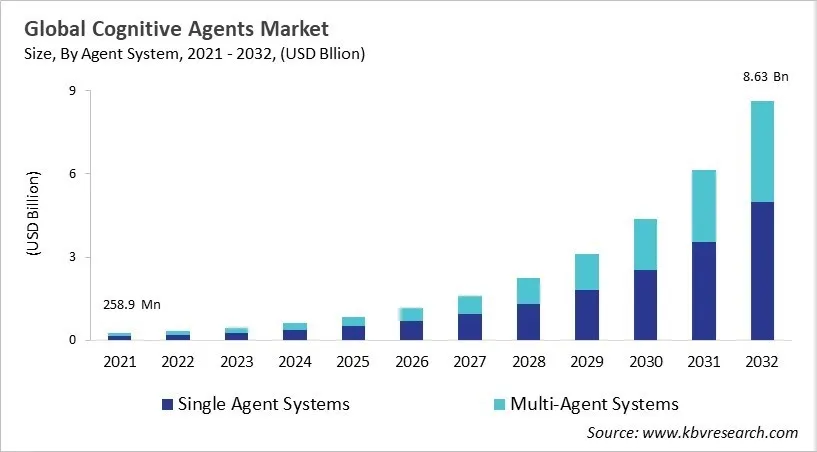
Cognitive agents have evolved as advanced and adaptive AI collaborators supported with neural networks, machine learning, generative AI, and large language models. Cognitive agents are considered enterprise-ready tools utilized in logistics, public services, finance, and healthcare, which were initially limited to defence, space, and infrastructure funded by government programs. Moreover, the increased popularity of virtual assistants such as Alexa and Siri have brought cognitive agents into everyday life. Nowadays, cognitive agents are not limited to back-office and reactive automation but also function as multimodal, proactive systems, having capabilities of creativity, strategic decision-making, and contextual reasoning.
The cognitive agents market is witnessing expansion supported by elements such as trust, autonomy, and multimodal deployment. Agents are transforming from reactive to proactive tools, agentic AI systems that can plan, define goals-important in supply chains, smart city management, and defense logistics. Moreover, compliance and governance have become crucial differentiators, with regulations such as the EU AI Act raising demand for transparency and accountability. Further, generative AI improves its value, allowing agents to manage images, voice, text, and video in real-time for applications in customer engagement, emergency response, and healthcare. Acquisitions, collaborations, and reputation-centric strategies ensure that the competitive landscape in the market fosters innovation, along with maintaining trust, positioning cognitive agents as the future of digital collaborations and smart decision-making.
The major strategies followed by the market participants are Partnerships as the key developmental strategy to keep pace with the changing demands of end users. For instance, In June, 2025, IBM Corporation teamed up with Inclusive Brains to enhance brain-machine interfaces using AI and quantum technologies. Their multimodal cognitive agents interpret physiological signals to enable “mental commands,” offering personalized, real-time interactions. The collaboration aims to improve accessibility, autonomy for users with disabilities, and advance research in ethical, responsible neurotechnology applications. Moreover, In September, 2025, Cognizant Technology Solutions Corporation teamed up with Pearson to enhance AI workforce readiness through AI-powered learning, reskilling, and career transition programs. Leveraging generative and agentic AI, the collaboration aims to upskill employees, improve talent strategies, and integrate digital credentials, analytics, and cognitive assessments, preparing the workforce to thrive alongside AI agents.
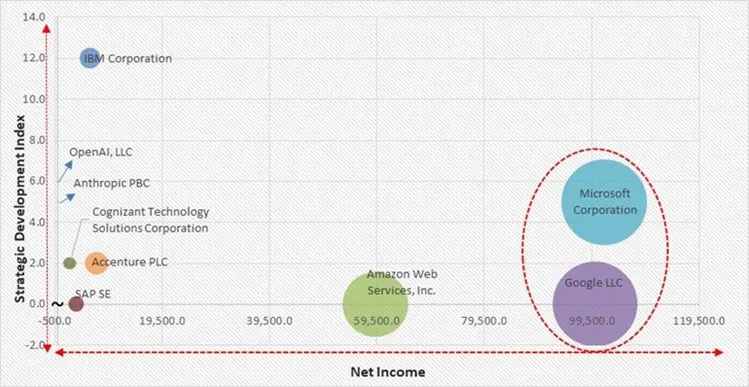
Based on the Analysis presented in the KBV Cardinal matrix; Microsoft Corporation and Google LLC are the forerunners in the Cognitive Agents Market. In May, 2024, Microsoft Corporation announced the partnership with Cognition Labs, an AI company to integrate Devin, an autonomous AI software agent, into Azure. Devin helps developers with tasks like code migration and modernization, boosting productivity. Backed by $175 million funding at a $2 billion valuation, Cognition Labs aims to scale Devin widely, complementing Microsoft’s developer tools such as GitHub Copilot. Companies such as Amazon Web Services, Inc., Accenture PLC, IBM Corporation are some of the key innovators in Cognitive Agents Market.
The COVID-19 pandemic sped up the use of digital technologies by a lot, which led to strong growth in the cognitive agents market. Companies that were having trouble with their operations were relying more and more on AI-driven solutions to keep things running smoothly. Cognitive agents could handle repetitive tasks and provide customer service around the clock. The move to remote work made the need for virtual assistants to help employees and answer routine questions even greater. At the same time, rising expectations for quick, personalized communication made them even more valuable. The healthcare industry saw the biggest benefits, using AI-powered tools for patient triage, appointment management, and public health updates. This made things easier for frontline staff. Also, industries like banking, retail, and education sped up their investments in automation because they saw cognitive agents as key to staying strong. Overall, the pandemic turned cognitive agents into very important tools, which helped the market grow and people keep using them. Thus, the COVID-19 pandemic had a positive impact on the market.

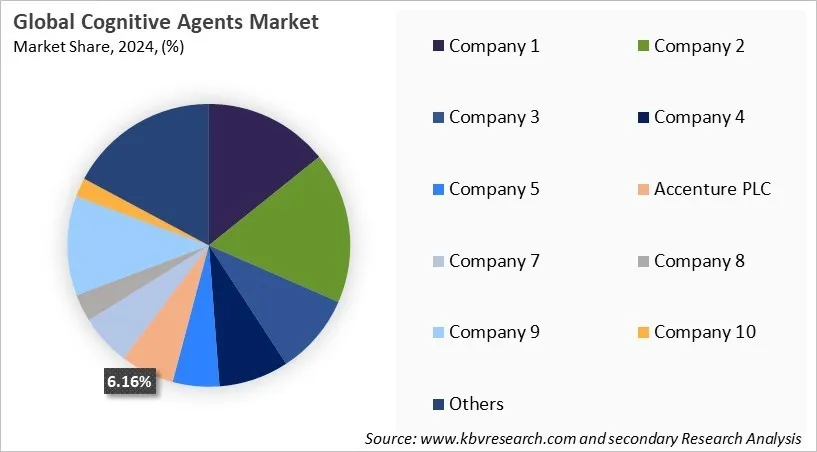
The leading players in the market are competing with diverse innovative offerings to remain competitive in the market. The above illustration shows the percentage of revenue shared by some of the leading companies in the market. The leading players of the market are adopting various strategies in order to cater demand coming from the different industries. The key developmental strategies in the market are Acquisitions, and Partnerships & Collaborations.
Free Valuable Insights: Global Cognitive Agents Market size to reach USD 8.63 Billion by 2032
Based on Agent System, the market is segmented into Single Agent Systems, and Multi-Agent Systems. The multi-agent systems segment recorded 41% revenue share in the market in 2024. These systems are particularly beneficial in complex scenarios that require distributed problem-solving, negotiation, and coordination among several intelligent entities. While their adoption is still developing, they hold significant promise for future applications in areas such as smart grids, supply chain optimization, and large-scale simulations.
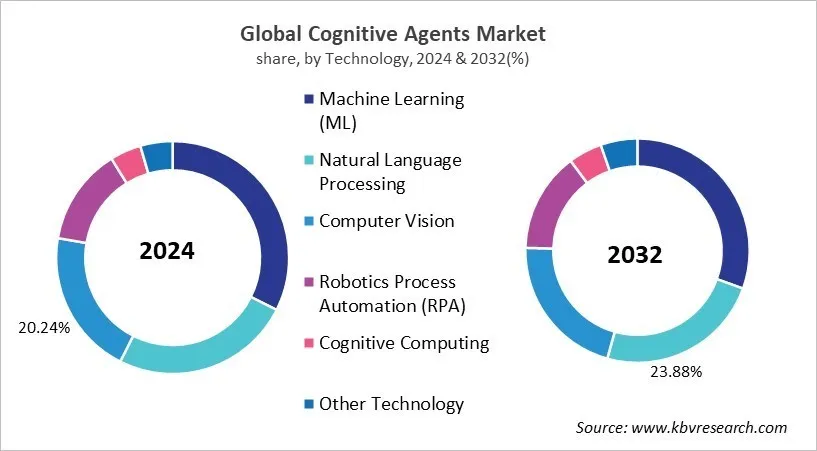
Based on Technology, the market is segmented into Machine Learning (ML), Natural Language Processing, Computer Vision, Robotics Process Automation (RPA), Cognitive Computing, and Other Technology. The natural language processing segment recorded 25% revenue share in the market in 2024. The segment plays a crucial role in enabling cognitive agents to interact effectively with humans. By allowing machines to understand, interpret, and generate human language, NLP underpins applications like chatbots, voice assistants, and conversational platforms. Businesses rely on NLP to improve customer support, sentiment analysis, and multilingual communication.
Region-wise, the cognitive agents market is analyzed across North America, Europe, Asia Pacific, and LAMEA. The North America segment recorded 37% revenue share in the market in 2024. The cognitive agents market is anticipated to grow at a significant rate in North America and Europe. This expansion is driven by robust R&D ecosystems, strong enterprise adoption, and stringent regulatory frameworks. In North America, the US is leading the market with large deployments across industries like defense, finance, public services, and healthcare, supported by players like IBM, Google, and Microsoft that adopt cognitive agents into their cloud ecosystems. Further, government initiatives such as executive orders on AI encourage adoption, along with boosting innovation. Moreover, Europe region has also captured a significant share in the cognitive agents market. The market is shaped by national AI strategies focused on ethical use, accountability, and transparency. Further, the EU AI Act also offers lucrative opportunities for market growth in the region. Enterprises in Europe region are largely applying cognitive agents in areas such as smart manufacturing, energy management, and customer service, with an increased emphasis on public trust and compliance.
In the Asia Pacific and LAMEA region, the cognitive agents market is predicted to procure promising market share. This is backed by government investment, expanding enterprise adoption, and digital transformation. In the Asia Pacific, regions such as South Korea, India, China, and Japan are integrating cognitive agents in e-commerce, telecom, logistics, and smart city projects, along with governments largely investing in AI research and infrastructure development. Also, the region’s mobile-first economies and large consumer base make generative agents relevant. Additionally, the cognitive agents market in the LAMEA region is estimated to grow. The cognitive agents are gaining traction from telecom, banking, and government services. The growing demand for cost-efficient customer engagement, public service automation, and investment in digital infrastructure is anticipated to support the expansion. As enterprises and government seek adaptive and scalable AI solutions to support economic modernization is also leading to positive market opportunities.
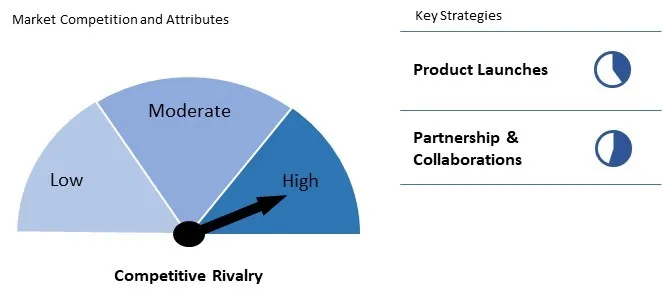
The market for cognitive agents is growing quickly because of improvements in natural language processing, machine learning, and artificial intelligence. This growth is making it harder for businesses to stand out and come up with new ideas. Companies are working on making agents better, making the user experience better, and connecting agents from different industries. The market is also moving toward autonomous systems, which means that companies need to change their strategies to stay ahead of the competition. In general, the landscape is always changing, and companies are always looking for ways to take advantage of opportunities and overcome obstacles in order to become leaders in this growing field.
| Report Attribute | Details |
|---|---|
| Market size value in 2025 | USD 844.74 Million |
| Market size forecast in 2032 | USD 8.63 Billion |
| Base Year | 2024 |
| Historical Period | 2021 to 2023 |
| Forecast Period | 2025 to 2032 |
| Revenue Growth Rate | CAGR of 39.4% from 2025 to 2032 |
| Number of Pages | 556 |
| Number of Tables | 403 |
| Report coverage | Market Trends, Revenue Estimation and Forecast, Segmentation Analysis, Regional and Country Breakdown, Competitive Landscape, Market Share Analysis, Porter’s 5 Forces Analysis, Company Profiling, Companies Strategic Developments, SWOT Analysis, Winning Imperatives |
| Segments covered | Agent System, Technology, End Use, Region |
| Country scope |
|
| Companies Included | Google LLC, Microsoft Corporation, IBM Corporation, OpenAI, LLC, Anthropic PBC, Accenture PLC, Deloitte Touche Tohmatsu Limited, SAP SE, Amazon Web Services, Inc. (Amazon.com, Inc.), and Cognizant Technology Solutions Corporation |
By Agent System
By Technology
By End Use
By Geography
The market size is projected to reach USD 8.63 Billion by 2032.
The cognitive agents market is projected to grow at a CAGR of 39.4% between 2025 and 2032.
Advances in artificial intelligence and natural language processing are reinforcing the need for trust, transparency, and ethical design in technology solutions.
Google LLC, Microsoft Corporation, IBM Corporation, OpenAI, LLC, Anthropic PBC, Accenture PLC, Deloitte Touche Tohmatsu Limited, SAP SE, Amazon Web Services, Inc. (Amazon.com, Inc.), and Cognizant Technology Solutions Corporation
The Machine Learning (ML) segment led the maximum revenue in the Global Cognitive Agents Market by Technology in 2024, thereby, achieving a market value of $2.6 billion by 2032.
The North America region dominated the Global Cognitive Agents Market by Region in 2024, and would continue to be a dominant market till 2032; thereby, achieving a market value of $3.1 billion by 2032.
Our team of dedicated experts can provide you with attractive expansion opportunities for your business.







 Unique Offerings