“Global Climate Tech Market to reach a market value of USD 166.96 Billion by 2032 growing at a CAGR of 20.5%”
The Global Climate Tech Market size is estimated at $45.30 billion in 2025 and is expected to reach $166.96 billion by 2032, rising at a market growth of 20.5% CAGR during the forecast period (2025-2032). This market is driven by stricter government regulations on emissions, increased corporate sustainability commitments, rapid advancements in clean technology, and greater investment in renewable energy, carbon management, and climate resilience solutions.
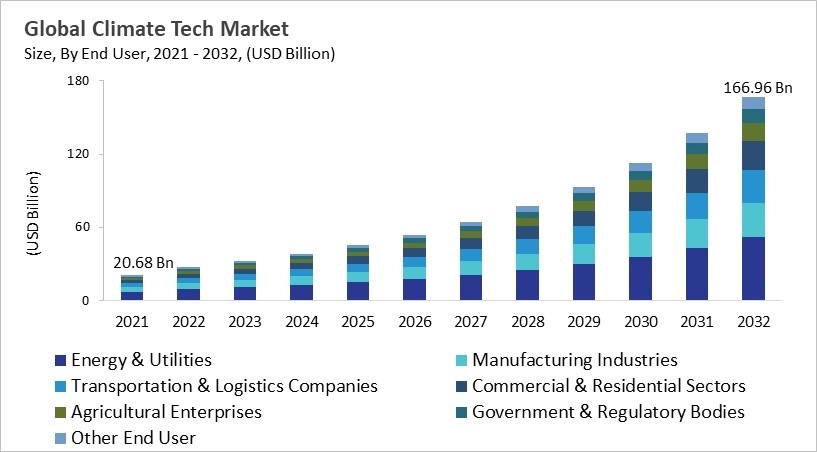
The climate tech market comprises a broad range of technologies focused on reducing greenhouse gas emissions, strengthening resilience to climate change, including energy efficiency, renewable energy, smart grids, electrified transport, digital climate solutions, and sustainable agriculture. Its development has been strongly influenced by international climate frameworks like the Paris Agreement and the UNFCCC, which embedded technology innovation. Governments and public institutions and governments have played a crucial role through policy support and financing mechanisms, while international bodies such as IRENA have highlighted the rapid scale-up of wind and solar as dominant sources of new power capacity. These efforts have transitioned climate tech from early pilot projects into an interconnected industry aligned with decarbonization goals and economic growth.
The climate tech market is driven by converging trends in digitalization, large-scale renewable deployment, and strong corporate participation. Advances in IoT, AI, and data platforms are enhancing energy optimization, climate resilience, and emission tracking, while corporations like Schneider Electric and Microsoft are embedding climate tech into core business strategies through smart infrastructure, renewable procurement, and digital energy management solutions. Competitive dynamics involve multinational firms, governments, public-private partnerships, and startups, with competition driven by collaboration, innovation, and alignment with policy incentives. These forces are surging the mainstream adoption of climate technologies and positioning themselves as a central pillar of global climate action.
The major strategies followed by the market participants are Partnerships as the key developmental strategy to keep pace with the changing demands of end users. For instance, In March, 2025, Schneider Electric SE announced the partnership with NVIDIA, a computer manufacturer to develop digital twins of AI data centers. These virtual replicas aim to optimize electricity usage, enhancing power consumption efficiency and supporting Schneider's expansion into data center solutions. In March, 2024 Johnson Controls International PLC announced the partnership with Mahindra Group, an automobile manufacturer to launch the Net Zero Buildings Initiative aimed at decarbonizing commercial, urban residential, and public buildings in India. This initiative provides organizations with resources and workshops to facilitate the creation of sustainable spaces, supporting India's net-zero goals.
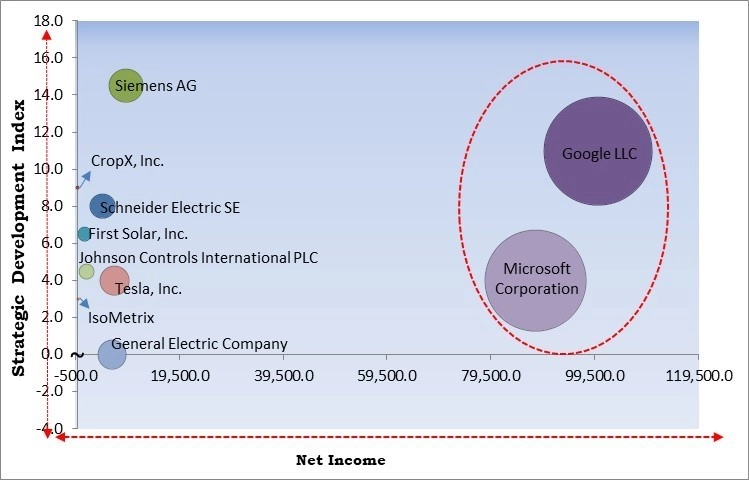
Based on the Analysis presented in the KBV Cardinal matrix; Google LLC and Microsoft Corporation are the forerunners in the Climate Tech Market. In January, 2025, Google LLC teamed up with Charm Industrial, uses plants to capture CO₂ from the atmosphere to remove 100,000 tons of CO₂ by 2030 using biochar, a carbon-rich material derived from biomass. This collaboration aligns with Google's broader carbon removal initiatives. Companies such as Siemens AG, Tesla, Inc., and General Electric Company are some of the key innovators in Climate Tech Market.
The COVID-19 pandemic significantly impacted the climate tech market, disrupting global supply chains, prolonging project timelines, and increasing the costs of operating clean energy projects. Lockdowns, travel bans, and factory closures made it more difficult to obtain essential components, which slowed the rollout of solar, wind, and energy storage projects. At the same time, increased economic uncertainty led to a temporary drop in investment activity, as investors prioritized short-term stability over long-term climate innovation. Many startups focused on climate change struggled to raise funds, which made it harder for them to conduct research, development, and business operations. Governments and businesses also postponed sustainability projects in favor of short-term health and economic recovery, which temporarily reduced the demand for climate tech solutions. As a result, structural weaknesses in the ecosystem were revealed, which slowed market growth and made it more challenging to achieve climate and sustainability goals. Thus, the COVID-19 pandemic had a Negative impact on the market.

Based on End User, the market is segmented into Energy & Utilities, Manufacturing Industries, Transportation & Logistics Companies, Commercial & Residential Sectors, Agricultural Enterprises, Government & Regulatory Bodies and Other End User. The manufacturing industries segment attained 18% revenue share in the climate tech market in 2024. The manufacturing industries segment is shaped by the need to reduce carbon footprints, improve energy efficiency, and comply with environmental regulations. Climate technologies are being adopted to optimize production processes, minimize waste, and enable the use of sustainable materials.
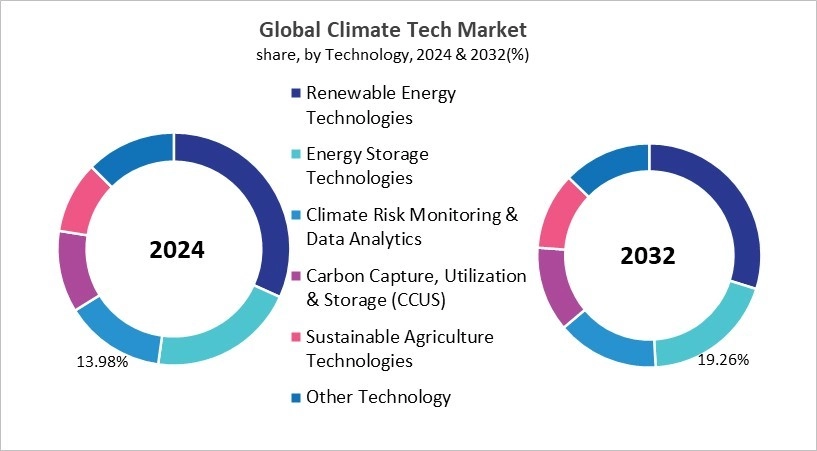
Based on Technology, the market is segmented into Renewable Energy Technologies, Energy Storage Technologies, Climate Risk Monitoring & Data Analytics, Carbon Capture, Utilization & Storage (CCUS), Sustainable Agriculture Technologies and Other Technology. The energy storage technologies segment recorded 20% revenue share in the climate tech market in 2024. The energy storage technologies segment is shaped by the growing need for grid stability, energy reliability, and effective integration of renewable power sources. Climate tech solutions in this segment include battery storage systems, thermal storage, and advanced energy management platforms.
Free Valuable Insights: Climate Tech Market Size to reach $166.96 by 2032
Region-wise, the Climate Tech Market is analyzed across North America, Europe, Asia Pacific, and LAMEA. The North America segment recorded 35% revenue share in the climate tech market in 2024. The climate tech market is predicted to capture a prominent market share in the North America and Europe region. The market is driven by elements including advanced infrastructure, strong institutional support, and high levels of private investment. In North America, especially Canada and the US, growth is propelled by federal incentives, public financing mechanisms, and clean energy tax credits that surge the commercialization of energy storage, renewables, clean mobility, digital climate solutions, and carbon management. The region benefits from a robust innovation ecosystem, with large technology firms, startups, and utilities collaborating to scale solutions across transportation, power grids, and industrial decarbonization. Moreover, Europe climate tech market is anticipated to grow at a steady pace. The market is shaped by ambitious regulatory frameworks like the Fit for 55 package and the European Green Deal, which mandate emissions reductions and promote renewable energy, circular economy technologies, and smart infrastructure. Standardized regulations, strong cross-border collaboration, and sustainability-focused corporate strategies position Europe as a lucrative market for climate tech deployment.
In the Asia Pacific and LAMEA regions, the climate tech market is estimated to experience noticeable growth during the projection period. The market is driven by increasing urbanization, growing energy demand, and climate vulnerability. Regional nations such as Japan, India, China, and Southeast Asia are investing largely in wind, solar, battery storage, EVs, and smart grid technologies. Government-supported industrial strategies, declining renewable costs, and large-scale manufacturing capabilities are surging in adoption, whereas digital climate solutions are gaining traction in agriculture, smart cities, and energy management. Furthermore, the LAMEA climate tech market is anticipated to grow at a steady pace. Latin America is leveraging abundant renewable resources, the Middle East region is investing in hydrogen, solar, and carbon capture to expand energy economies, and Africa is also focusing on climate-resilient agriculture, decentralized renewables, and off-grid solutions.
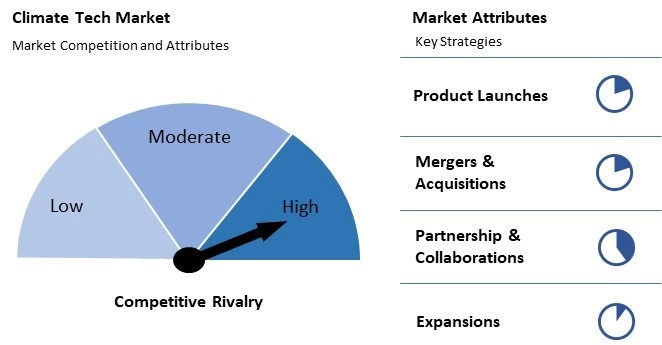
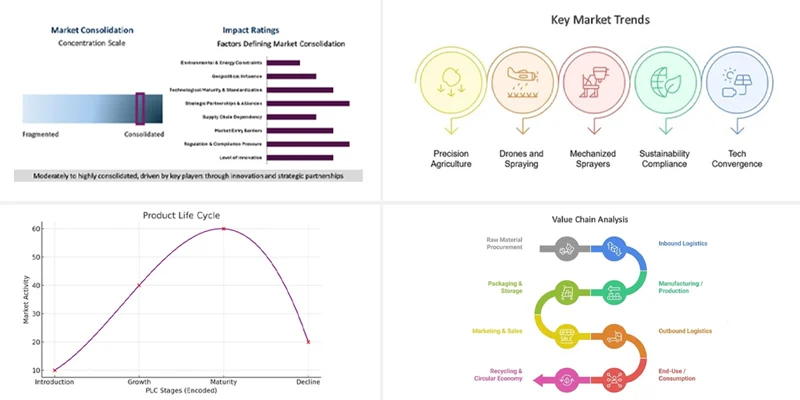
There is a lot of competition in the climate tech market because new ideas and solutions are coming out all the time. Companies compete on how different their technology is, how scalable it is, and how it affects the environment. Strategic partnerships, intellectual property, and access to capital are important ways to compete. To stand out, market players focus on building ecosystems and showing that they can have a big impact on the environment. The landscape rewards being flexible and having a lot of knowledge in a specific field. Ongoing competition drives the development and use of climate-smart technologies.
| Report Attribute | Details |
|---|---|
| Market size value in 2025 | USD 45.30 Billion |
| Market size forecast in 2032 | USD 166.96 Billion |
| Base Year | 2024 |
| Historical period | 2021 to 2023 |
| Forecast Period | 2025 to 2032 |
| Revenue Growth Rate | CAGR of 20.5% from 2025 to 2032 |
| Number of Pages | 531 |
| Tables | 338 |
| Report Coverage | Market Trends, Revenue Estimation and Forecast, Segmentation Analysis, Regional and Country Breakdown, Competitive Landscape, Porter’s 5 Forces Analysis, Company Profiling, Companies Strategic Developments, SWOT Analysis, Winning Imperatives |
| Segments Covered | End User, Technology, Region |
| Country Scope |
|
| Companies Included | Google LLC (Alphabet Inc.), First Solar, Inc., Schneider Electric SE, CropX, Inc., General Electric Company, IsoMetrix, Microsoft Corporation, Tesla, Inc., Siemens AG, and Johnson Controls International PLC |
By End User
By Technology
By Geography
Our team of dedicated experts can provide you with attractive expansion opportunities for your business.








 Unique Offerings