“Global Cleaning Robot Market to reach a market value of USD 31.82 Billion by 2032 growing at a CAGR of 23%”
The Global Cleaning Robot Market size is expected to reach $31.82 billion by 2032, rising at a market growth of 23.0% CAGR during the forecast period.
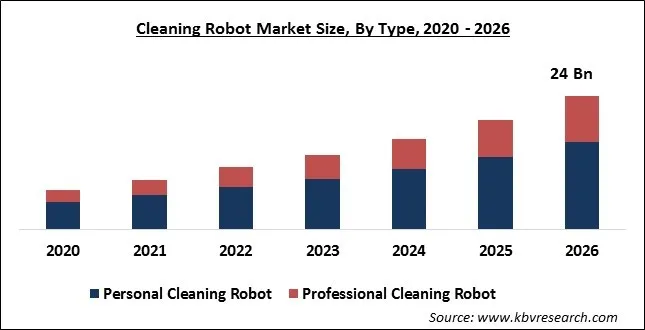
The cleaning robot market has developed from basic automated vacuum devices to advanced multifunctional robots driven by connectivity, AI, and enhanced navigation technologies. Initial models offered limited precision, but advancements like SLAM, LiDAR, and machine learning algorithms have transformed cleaning robots into intelligent tools capable of identifying high-dirt areas and optimizing routes. The adoption of cleaning robots has expanded across offices, hospitals, airports, homes, and industrial facilities with enhanced hygiene standards and accelerated government support towards automation. Stronger motors, enhanced materials, and integration with smart home systems further have surged their mainstream usage. The cleaning robot market has further benefited from sustainability initiatives with OEMs improving energy-efficiency, battery-life and recyclable components.
The cleaning robot market is experiencing expansion driven by elements including higher commercial adoption, smarter navigation, and the growth of multifunctional robots capable of disinfecting, vacuuming, and mopping. Leading players in the market are competing through product portfolio expansion, innovation, and ecosystem integration with digital platforms and home automation systems. Collaborations with facility operators, and technology providers help manufacturers tailor solutions for professional environments. The competition is intensive in cleaning robot market, with leading players leveraging advanced robotics expertise while new players emphasis on niche features and affordability. The cleaning robot market continues to expand backed by surging hygiene expectations, technology advancements, and the rising need for automated, efficient cleaning solutions.
The major strategies followed by the market participants are Product Launches as the key developmental strategy to keep pace with the changing demands of end users. For instance, In July, 2025, Haier Smart Home Co., Ltd. unveiled its CIVIC X11 robot‑vacuum cleaner series in India, featuring laser navigation, smart obstacle detection, and integration with its HaiSmart app and Google‑voice control — targeting modern households looking for automated, hands‑free cleaning. Moreover, In December, 2025, Ecovacs Robotics Co., Ltd. unveiled the DEEBOT X11 OmniCyclone in India as its latest premium robotic vacuum, showcasing advanced cleaning features, superior suction, and intelligent navigation. This launch emphasises the company’s expansion in the Indian market and its commitment to delivering smart home automation solutions with enhanced performance and convenience.
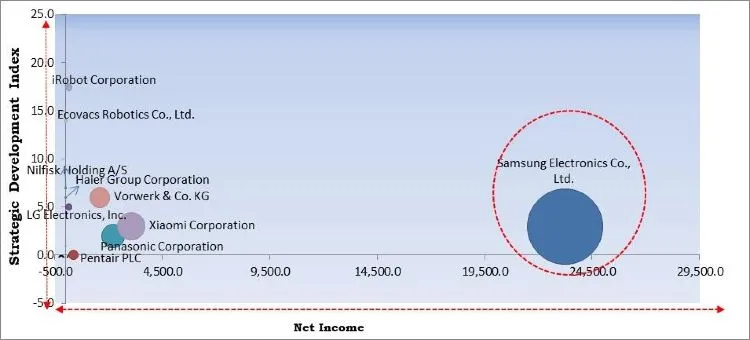
Based on the Analysis presented in the KBV Cardinal matrix; Samsung Electronics Co., Ltd. is the forerunner in the Cleaning Robot Market. In January, 2021, Samsung Electronics Co., Ltd. unveiled its new AI‑powered robot vacuum, JetBot 90 AI+, featuring advanced LiDAR navigation, 3D object recognition, and smart cleaning algorithms for efficient autonomous floor cleaning. The move signals growing momentum and innovation in the cleaning‑robot market. Companies such as Panasonic Holdings Corporation, Haier Smart Home Co., Ltd., and Nilfisk Holding A/S are some of the key innovators in Cleaning Robot Market.
The COVID-19 pandemic had a small negative effect on the cleaning robot market. This was mostly because global supply chains were disrupted, which made it harder to get important parts like sensors, batteries, and microcontrollers. This slowed down production and delivery times a little bit. Commercial demand dropped for a while as malls, offices, and hotels cut back on spending because of operational restrictions. However, essential businesses kept investing in automation. Travel restrictions had a moderate effect on service-related tasks like installation and maintenance. This led to a shift toward remote diagnostics and servicing with little contact. There were short-term changes in orders because of different lockdown rules in different areas, but demand from homes stayed mostly strong. In general, these things only caused a small slowdown, and they didn't change the market's long-term growth path very much. Thus, the COVID-19 pandemic had a mild negative impact on the market.

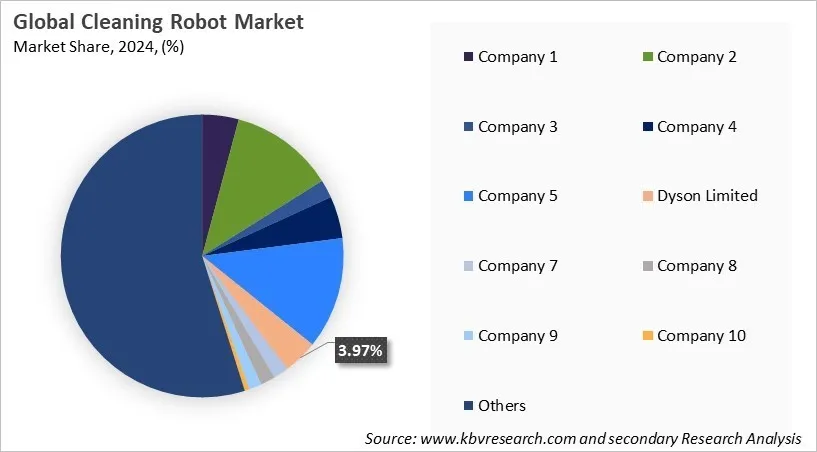
The leading players in the market are competing with diverse innovative offerings to remain competitive in the market. The above illustration shows the percentage of revenue shared by some of the leading companies in the market. The leading players of the market are adopting various strategies in order to cater demand coming from the different industries. The key developmental strategies in the market are Acquisitions, and Partnerships & Collaborations.
Free Valuable Insights: Cleaning Robot Market size to reach USD 31.82 Billion by 2032
Based on Product, the market is segmented into In-House and Outdoor. The outdoor segment attained 27% revenue share in the cleaning robot market in 2024. The outdoor segment encompasses cleaning robots designed for external spaces such as lawns, pools, patios, and building exteriors. These robots are built to handle varied terrain, weather conditions, and more demanding cleaning requirements, including grass cutting, pool debris removal, and outdoor surface maintenance. Their adoption is growing steadily as property owners, facility managers, and commercial establishments seek automated solutions to reduce manual labor and maintain outdoor spaces more efficiently.
Based on Charging, the market is segmented into Automatic Charging and Manual Charging. The manual charging segment recorded 32% revenue share in the cleaning robot market in 2024. The manual charging segment remains relevant for consumers who prioritize affordability and simplicity in robotics solutions. Cleaning robots in this category require users to connect the device to a power source when charging is needed, making them accessible options for budget-conscious buyers or those with minimal automation requirements. Despite lacking autonomous charging functionality, these robots still offer reliable cleaning performance and essential smart features.
Based on Distribution Channel, the market is segmented into Online and Offline. The offline segment registered 40% revenue share in the cleaning robot market in 2024. The offline segment remains an important component of the cleaning robot market, particularly for consumers who prefer hands-on evaluation before making a purchase. Physical retail stores, electronic outlets, and specialized appliance showrooms allow customers to interact with products, receive personalized guidance, and understand functionality through live demonstrations. This segment caters to buyers who prioritize in-person shopping experiences, immediate product availability, and direct customer service.
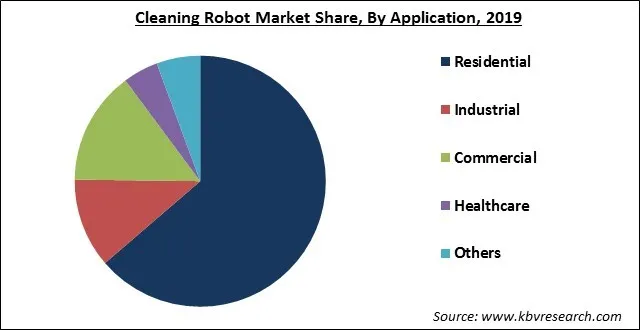
Region-wise, the cleaning robot market is analyzed across North America, Europe, Asia Pacific, and LAMEA. The North America segment recorded 34% revenue share in the cleaning robot market in 2024. The cleaning robot market is estimated to experience immense growth in the North America and Europe region. This is because of the large adoption of smart home technologies, strict hygiene standards across public as well as commercial environments, and advanced robotics manufacturing capabilities. The region benefits from early adoption of autonomous cleaning tools, large integration of connected home appliances and strong consumer spending. Several industries like transportation, healthcare, and retail further deploy cleaning robots to fulfil government-recommended sanitation practices. Moreover, in Europe, the demand is supported by rising focus on sustainability regulations, energy-efficient devices, and automation in industrial and residential facilities. European technology innovators and OEMs continue to improve navigation systems, recyclable components, and AI-based cleaning intelligence, resulting in market expansion across the region.
In the Asia Pacific and LAMEA, the cleaning robot market is projected to capture a prominent share in the upcoming years. The adoption is accelerated due to elements such as expanding middle-class households, rapid urbanization, and smart city projects, driving the need for automated cleaning solutions. The APAC region is witnessing high manufacturing activity, strong support for digital adoption, and surge affordability of robotic devices. Commercial sectors like airports, malls, and other large spaces largely deploy autonomous cleaning robots with the aim of maintaining hygiene standards and managing large footfall. Furthermore, LAMEA region is offering profitable opportunities supported by infrastructure development and increasing interest in automation across oil & gas facilities, hospitality, and public institutions. The Middle East region, especially, is adopting advanced cleaning robots for government buildings, airports, and large commercial spaces. Also, Latin America and Africa are incorporating robotic cleaning technologies as a part of modernisation efforts.
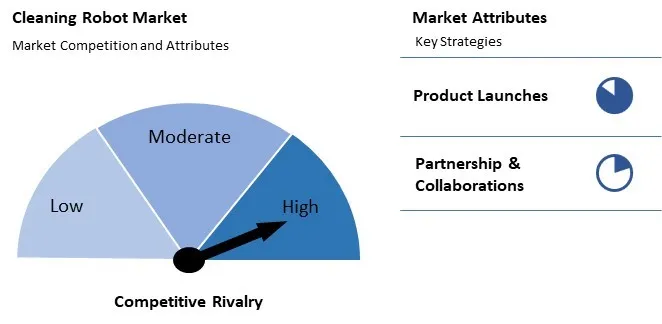
There is a lot of competition in the cleaning robot market because of new technologies, new ideas, and changing customer needs. Companies are trying to stand out by adding features, improving design, and making their products smarter. At the same time, they are also working on making their products more efficient, connected, and user-friendly. The quick adoption of automation and integration with smart home systems makes competition even tougher. Strategic partnerships, product diversification, and new ways of marketing are all important factors that shape the market. To be successful, you need to stand out and connect with customers.
| Report Attribute | Details |
|---|---|
| Market size value in 2025 | USD 7.47 Billion |
| Market size forecast in 2032 | USD 31.82 Billion |
| Base Year | 2024 |
| Historical Period | 2021 to 2023 |
| Forecast Period | 2025 to 2032 |
| Revenue Growth Rate | CAGR of 23.0% from 2025 to 2032 |
| Number of Pages | 663 |
| Number of Tables | 603 |
| Report coverage | Market Trends, Revenue Estimation and Forecast, Segmentation Analysis, Regional and Country Breakdown, Competitive Landscape, Market Share Analysis, Porter’s 5 Forces Analysis, Company Profiling, Companies Strategic Developments, SWOT Analysis, Winning Imperatives |
| Segments covered | Product, Charging, Operation Mode, End-use, Distribution Channel, Type, Region |
| Country scope |
|
| Companies Included | LG Electronics, Inc. (LG Corporation), Ecovacs Robotics Co., Ltd., Panasonic Holdings Corporation, Samsung Electronics Co., Ltd. (Samsung Group), iRobot Corporation, Dyson Limited, AB Electrolux, Haier Smart Home Co., Ltd. (Haier Group Corporation), Miele, Inc., and Nilfisk Holding A/S |
By Product
By Charging
By Operation Mode
By End-use
By Distribution Channel
By Type
By Geography
This Market size is expected to reach USD 31.82 billion by 2032.
The cleaning robot market is projected to grow at a CAGR of 23% between 2025 and 2032.
Rising adoption of smart home ecosystems, supported by advancements in artificial intelligence and autonomous navigation.
LG Electronics, Inc. (LG Corporation), Ecovacs Robotics Co., Ltd., Panasonic Holdings Corporation, Samsung Electronics Co., Ltd. (Samsung Group), iRobot Corporation, Dyson Limited, AB Electrolux, Haier Smart Home Co., Ltd. (Haier Group Corporation), Miele, Inc., and Nilfisk Holding A/S
The In-House segment registered the maximum revenue in the Global Cleaning Robot Market by Product in 2024, thereby, achieving a market value of $22.5 billion by 2032.
The North America region dominated the Global Cleaning Robot Market by Region in 2024, and would continue to be a dominant market till 2032; thereby, achieving a market value of $10.2 billion by 2032.
Our team of dedicated experts can provide you with attractive expansion opportunities for your business.









 Unique Offerings