“Global Chatbot-Based Mental Health Apps Market to reach a market value of USD 5.85 Billion by 2032 growing at a CAGR of 16.4%”
The Global Chatbot-Based Mental Health Apps Market size is expected to reach USD 5.85 billion by 2032, rising at a market growth of 16.4% CAGR during the forecast period.
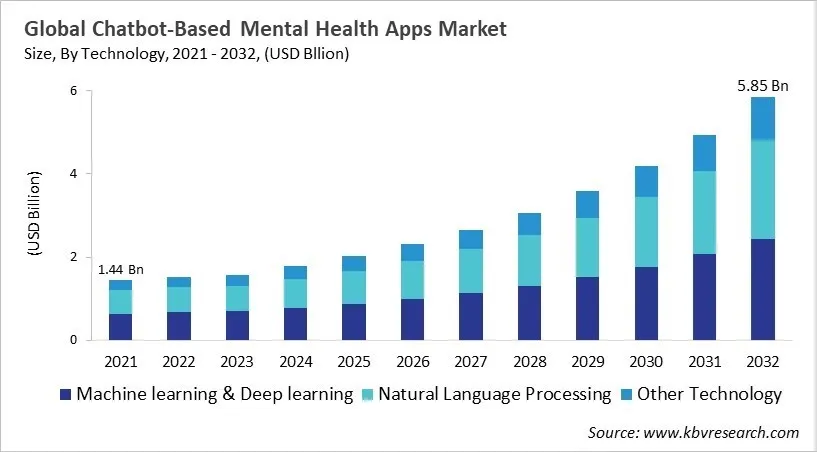
The chatbot-based mental health apps market is driven by advancements in AI, mobile technology, and public health initiatives, has expanded from early rule-based dialogue systems to a key component of digital health strategies. These tools have been adopted by governments, insurance companies, and health systems in order to increase access, solve the shortage of clinicians, and offer reasonably priced mental health care. Offerings changed over time from wellness companions to clinically integrated platforms with features like mood tracking, triage, chat modules based on cognitive behavioural therapy, and integration with electronic health records. Ethical and legal requirements have strengthened adoption, prompting developers to incorporate safety features, escalation routes, and privacy protections. Today, these apps are recognized as scalable, accessible solutions that combine automation with human oversight to improve continuity of care.
Current market trends show a move towards advanced generative AI, hybrid care models, and clinical validation. In an effort to establish credibility and obtain reimbursement, developers are pursuing clinical research and partnerships with health systems more and more. Hybrid strategies facilitate smooth transitions from self-care to structured treatment by combining automated assistance with human clinicians. While generative AI improves conversational flow and personalisation, it also presents safety and governance issues. Startups, well-established tech companies, and platforms with a health focus are all fighting for market share, making competition fierce. Clinical rigour and responsible governance are now just as important as technological advancement because success now hinges on striking a balance between innovation, compliance, user safety, cultural adaptability, and solid partnerships.

The COVID-19 pandemic changed the chatbot-based mental health app market for the better by making them more popular when people couldn't get to traditional services. Lockdowns and social distancing made it more important to have easy-to-use, affordable, and available 24/7 digital help for anxiety, stress, and loneliness. These tools were pushed by governments and healthcare organizations, which made them more acceptable and sped up their acceptance by the general public. The crisis made AI-powered mental health solutions more common, which helped reduce stigma and get more people to use them. Rapid adoption also led to new ideas, such as stress management modules, real-time mood tracking, and crisis response features. More use of the models also helped to improve and validate them clinically. Thus, the COVID -19 pandemic had a Positive impact on the market.
Based on Platform, the market is segmented into iOS, Android, and Other Platform. This segment played an equally important role in driving widespread adoption of chatbot-based mental health applications. Known for its global reach and accessibility, Android provided opportunities to connect with diverse user groups across both developed and emerging markets.
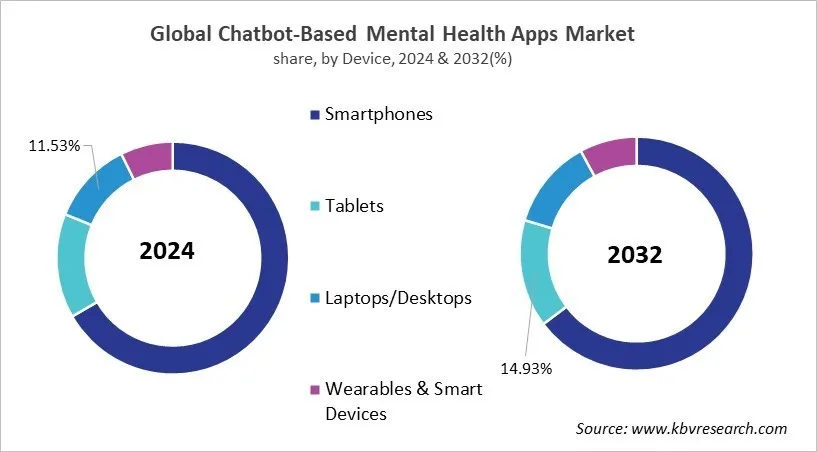
Based on Device, the market is segmented into Smartphones, Tablets, Laptops/Desktops, and Wearables & Smart Devices. This segment contributed meaningfully to the adoption of chatbot-driven mental health apps by providing larger screens and a more immersive user experience. These devices allowed for easier navigation, especially when accessing structured therapy modules, journaling features, or visual exercises.
Free Valuable Insights: Global Chatbot-Based Mental Health Apps Market size to reach USD 5.85 Billion by 2032
Region-wise, the Chatbot-Based Mental Health Apps Market is analyzed across North America, Europe, Asia Pacific, and LAMEA. The North America segment recorded 36% revenue share in the market in 2024. The chatbot-based mental health apps market in North America and Europe is being influenced by stringent regulatory frameworks, sophisticated healthcare infrastructures, and robust institutional support. Because of the high demand for easily accessible mental health care, the integration with insurers and employer programs, and the significant investment in generative AI technologies to improve conversational quality, North America—especially the U.S. and Canada—has seen very quick adoption. Europe places a strong emphasis on privacy, clinical validation, and integration into national health systems, as directed by GDPR and national digital health laws. Alongside the increasing need for evidence-based tools that show safety, efficacy, and compliance, both regions are clearly seeing a shift towards hybrid care models that combine chatbot automation with clinician support.
Growth in Asia-Pacific and LAMEA is driven by government-sponsored digital health initiatives, smartphone penetration, and growing mental health awareness, though market maturity varies. Asia-Pacific nations like China, Japan, Australia, and India are creating demand due to their sizable populations, digital-first healthcare approaches, and rising demand for multilingual, culturally sensitive solutions. Although adoption is still in its infancy in LAMEA, it is picking up steam in the Middle East and other regions of Latin America as employers and governments look for affordable ways to increase access to care. Vendors that combine cultural sensitivity, multilingual support, and turnkey compliance solutions are best positioned for long-term growth. Attractiveness, scalability, and localised adaptation are important differentiators in both regions.
| Report Attribute | Details |
|---|---|
| Market size value in 2025 | USD 2.01 Billion |
| Market size forecast in 2032 | USD 5.85 Billion |
| Base Year | 2024 |
| Historical Period | 2021 to 2023 |
| Forecast Period | 2025 to 2032 |
| Revenue Growth Rate | CAGR of 16.4% from 2025 to 2032 |
| Number of Pages | 532 |
| Number of Tables | 471 |
| Report coverage | Market Trends, Revenue Estimation and Forecast, Segmentation Analysis, Regional and Country Breakdown, Porter’s 5 Forces Analysis, Company Profiling, Companies Strategic Developments, SWOT Analysis, Winning Imperatives |
| Segments covered | Technology, Device, Application, Platform, Region |
| Country scope |
|
| Companies Included | Touchkin eServices Private Limited (Wysa), Woebot Labs, Inc. (Woebot Health), Youper Inc., Limbic Limited, Luka, Inc. (Replika), Hello Driven Pty Ltd, Matellio Inc., Headspace, Inc., BytePlus Pte Ltd., and Spring Care, Inc. (Spring Health) |
By Technology
By Device
By Application
By Platform
By Geography
This Market size is expected to reach USD 5.85 Billion billion by 2032.
The chatbot-based mental health apps market is projected to grow at a CAGR of 16.4% between 2025 and 2032.
Increasing prevalence of mental health disorders and rising awareness supported by technological advancements in artificial intelligence and natural language processing (NLP).
Touchkin eServices Private Limited (Wysa), Woebot Labs, Inc. (Woebot Health), Youper Inc., Limbic Limited, Luka, Inc. (Replika), Hello Driven Pty Ltd, Matellio Inc., Headspace, Inc., BytePlus Pte Ltd., and Spring Care, Inc. (Spring Health)
The Machine learning & Deep learning segment captured the maximum revenue in the Global Chatbot-Based Mental Health Apps Market by Technology in 2024, thereby, achieving a market value of USD 2.44 Billion by 2032.
The North America region dominated the Global Chatbot-Based Mental Health Apps Market by Region in 2024, thereby, achieving a market value of USD 2.07 Billion by 2032.
Our team of dedicated experts can provide you with attractive expansion opportunities for your business.







 Unique Offerings