“Global Causal AI Market to reach a market value of USD 526.76 Billion by 2032 growing at a CAGR of 37.4%”
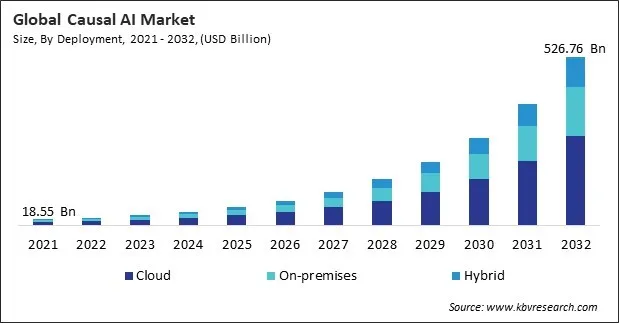
The Global Causal AI Market size is expected to reach $526.76 billion by 2032, rising at a market growth of 37.4% CAGR during the forecast period.
The healthcare and life sciences segment constitutes a major share of the causal AI market, driven by the growing need for accurate diagnostics, personalized medicine, and efficient clinical decision support systems. Causal AI enables researchers and clinicians to uncover complex cause-effect relationships in patient data, identify treatment pathways, and simulate intervention outcomes. This technology is increasingly used in epidemiological modeling, drug discovery, and healthcare operations management to improve outcomes and reduce costs. Thus, the healthcare & life sciences segment witnessed 25% revenue share in the causal AI market in 2024. By enhancing the ability to predict disease progression, evaluate treatment effectiveness, and optimize care pathways, causal AI is becoming an indispensable tool in both clinical and research settings.
The major strategies followed by the market participants are Product Launches as the key developmental strategy to keep pace with the changing demands of end users. For instance, Two news of any two random companies apart from leaders and key innovators. In September, 2024, causaLens unveiled a groundbreaking AI agent platform at the Causal AI Conference in London. Merging causal AI with LLMs and quantitative reasoning, the platform empowers users to make faster, more accurate business decisions. This innovation bridges AI reasoning gaps, marking a major leap in enterprise decision-making capabilities. Additionally, In April, IBM Corporation unveiled the Probable Root Cause feature in Instana’s Intelligent Incident Remediation, powered by Causal AI. It enables site reliability engineers to quickly identify application failure sources using partial data, call traces, and metrics, reducing resolution time, operational downtime, and business costs. It's currently in tech preview.

Based on the Analysis presented in the KBV Cardinal matrix; Google LLC, Microsoft Corporation, and Amazon Web Services, Inc. are the forerunners in the Causal AI Market. Companies such as IBM Corporation, Dynatrace, Inc., and causaLens are some of the key innovators in Causal AI Market. In August, 2024, Microsoft Corporation unveiled AI-based copilots to support causal analysis in healthcare. These copilots, using a human-in-the-loop approach and formal causal frameworks, assist in study design, analysis, and interpretation. The goal is to improve the speed, accuracy, and reliability of real-world evidence for personalized healthcare decisions.
The COVID-19 pandemic significantly accelerated the adoption of Causal AI technologies across industries. Faced with unprecedented uncertainty, organizations worldwide began to realize the limitations of traditional statistical and machine learning models, which often lacked explainability and adaptability in rapidly changing environments. In contrast, Causal AI, with its ability to model cause-and-effect relationships, provided a more robust foundation for scenario planning, resource allocation, and risk assessment. Thus, the COVID-19 pandemic had negative impact on the market.
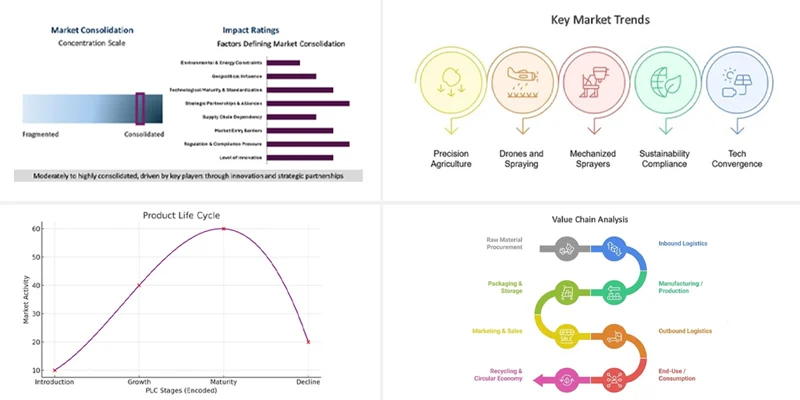

Causal AI is emerging as a critical solution in domains where decision transparency is not just preferable but mandatory. Traditional machine learning models—especially those based on deep learning—are often referred to as “black boxes” due to their lack of interpretability. While these models can yield highly accurate predictions, they rarely explain why a decision was made. In sectors like healthcare, finance, and criminal justice, this opacity can lead to problematic outcomes, both ethically and legally. In conclusion, the drive for explainability and regulatory compliance is strongly catalyzing the adoption of Causal AI in critical, high-stakes sectors.
Additionally, in a fast-paced business world, decision-makers constantly face “what-if” scenarios that require foresight and judgment. Traditional analytics and machine learning tools, while useful for prediction, often fall short when it comes to simulating alternative futures or testing hypothetical strategies. This is where Causal AI stands out—its foundation in counterfactual reasoning allows it to simulate outcomes of potential interventions in a business environment. In summary, the ability of Causal AI to simulate counterfactuals is transforming strategic business decision-making into a more precise and proactive discipline.
However, one of the foremost restraints hindering the broader adoption of Causal AI is the lack of standardization and poor interpretability of causal models across industries and use cases. While traditional AI methods such as deep learning or statistical machine learning have matured into standardized workflows and toolkits like TensorFlow, PyTorch, or scikit-learn, Causal AI still exists in a relatively nascent stage with fragmented methodologies. Researchers and practitioners employ a variety of modeling frameworks such as Structural Causal Models (SCMs), Potential Outcomes (Rubin Causal Model), or counterfactual reasoning, each of which has distinct assumptions and data requirements. In conclusion, without standardized modeling techniques and widely accepted interpretability protocols, Causal AI faces significant challenges in achieving scalable and trusted implementation across diverse industries.
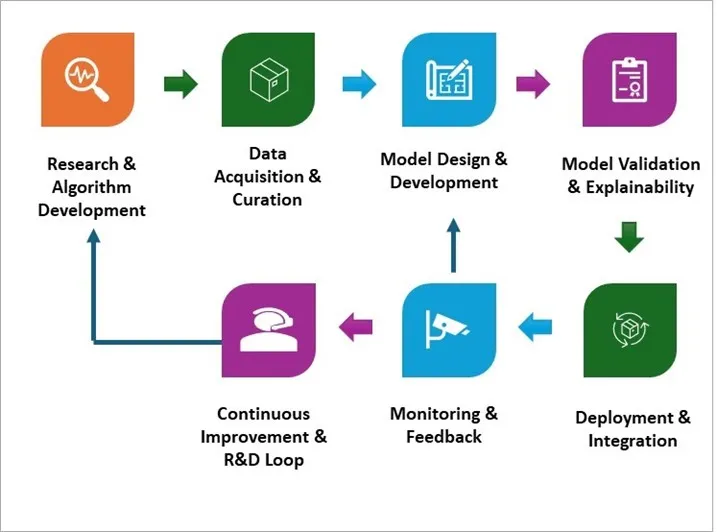
The value chain of the Causal AI Market begins with Research & Algorithm Development, where foundational causal inference models are created using domain-specific theories. Next, Data Acquisition & Curation involves gathering structured and unstructured data relevant to variables and outcomes. In Model Design & Development, these datasets feed into models built to identify cause-effect relationships. Model Validation & Explainability ensures transparency and regulatory compliance. After that, Deployment & Integration brings models into enterprise environments. Monitoring & Feedback helps assess real-world impact, while Continuous Improvement & R&D Loop refines models, completing the iterative cycle for high-performance causal systems.
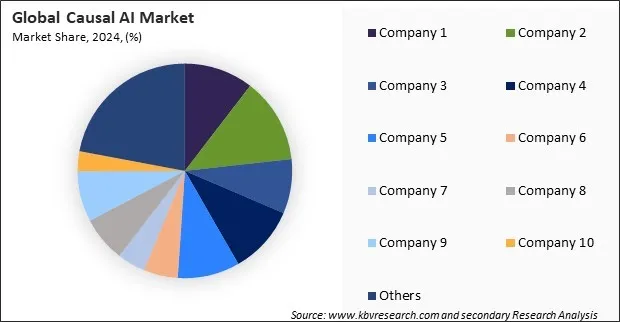
The leading players in the market are competing with diverse innovative offerings to remain competitive in the market. The above illustration shows the percentage of revenue shared by some of the leading companies in the market. The leading players of the market are adopting various strategies in order to cater demand coming from the different industries. The key developmental strategies in the market are Product Launches and Product Expansions.
Free Valuable Insights: Global Causal AI Market size to reach USD 526.76 Billion by 2032
Based on technology, the market is characterized into causal inference engines, structural causal Models (SCM), counterfactual simulation tools, graph-based causal modeling, and others. The causal inference engines segment garnered 34% revenue share in the causal AI market in 2024. This is reflecting the growing demand for tools capable of uncovering cause-and-effect relationships directly from observational data. These engines are foundational to many AI-driven decision systems, offering the ability to infer how variables influence one another without the need for randomized controlled trials.
| Category | Details |
|---|---|
| Use Case Title | Confidential |
| Date | 2025 |
| Entities Involved | Confidential |
| Objective | Improve clinical trial outcomes and pharmaceutical supply chain reliability using AI-powered causal inference to identify actionable drivers behind trial variability and supply chain disruptions. |
| Context and Background | Traditional statistical tools have long struggled to uncover the hidden causal dynamics within clinical trial datasets or across complex pharmaceutical logistics networks. As a result, many decisions are based on correlation rather than causation, often leading to inefficiencies, costly delays, or flawed trial designs. Causal inference engines—built upon advanced graph theory, probabilistic modeling, and machine learning—emerged in 2025 as critical enablers for pharmaceutical firms seeking deeper, explainable insights into both operational and clinical variability. |
| Description | In a joint initiative between IQVIA and MIT J-Clinic, Novartis implemented a causal inference engine to tackle two key challenges: optimizing clinical trial designs and pinpointing the root causes of supply chain disruptions. |
| Key Capabilities Deployed |
|
| Regions Covered |
|
| Benefits |
|
| Source | Confidential |
On the basis of deployment, the causal AI market is classified into cloud, on-premises, and hybrid. The on-premises segment recorded 28% revenue share in the causal AI market in 2024. The on-premises deployment segment maintains strong relevance in the causal AI landscape, particularly among enterprises that operate under stringent security, privacy, or compliance constraints. Industries such as defense, government, and highly regulated healthcare and financial services often require full control over their IT environments, prompting them to host AI systems within their own infrastructure.
By end use, the causal AI market is divided into healthcare & life sciences, financial services, retail & e-commerce, manufacturing, technology & IT services, government & public sector, and others. The manufacturing segment recorded 13% revenue share in the causal AI market in 2024. The manufacturing segment is adopting causal AI to improve quality control, predict equipment failures, and streamline production processes. Manufacturers use causal modeling to identify root causes of defects, optimize resource allocation, and reduce downtime. These insights help in maintaining lean operations, improving product reliability, and minimizing waste.
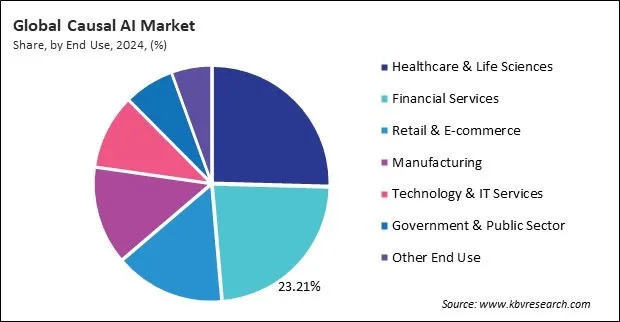
Region-wise, the causal AI market is analyzed across North America, Europe, Asia Pacific, and LAMEA. The North America segment recorded 40% revenue share in the causal AI market in 2024. The North America region holds the largest share of the causal AI market, supported by a strong foundation of technological innovation, advanced infrastructure, and high AI adoption across industries. Leading companies and research institutions in the U.S. and Canada are actively deploying causal AI in sectors such as healthcare, finance, and IT services to enhance decision-making and drive innovation.
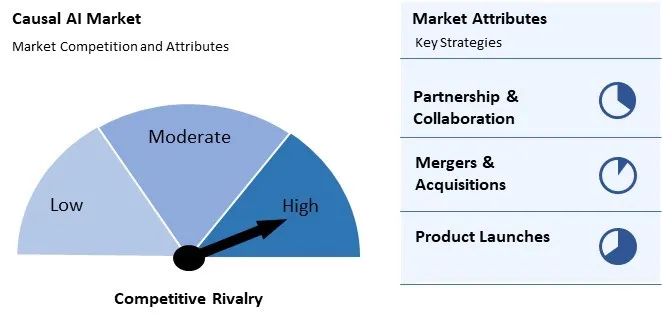
The Causal AI Market is witnessing growing competition as demand surges for explainable and decision-intelligent AI systems. Key players like IBM, Microsoft, and startups such as CausaLens are actively developing tools that go beyond correlation to infer causation. The market is driven by applications in finance, healthcare, and enterprise decision-making. Competitive intensity is fueled by innovation in causal inference algorithms, integration with traditional AI platforms, and rising interest from research institutions and enterprises seeking transparent, accountable, and outcome-driven AI solutions.
| Report Attribute | Details |
|---|---|
| Market size value in 2024 | USD 42.29 Billion |
| Market size forecast in 2032 | USD 526.76 Billion |
| Base Year | 2024 |
| Historical Period | 2021 to 2023 |
| Forecast Period | 2025 to 2032 |
| Revenue Growth Rate | CAGR of 37.4% from 2025 to 2032 |
| Number of Pages | 375 |
| Number of Tables | 422 |
| Report coverage | Market Trends, Revenue Estimation and Forecast, Segmentation Analysis, Regional and Country Breakdown, Competitive Landscape, Market Share Analysis, Porter’s 5 Forces Analysis, Company Profiling, Companies Strategic Developments, SWOT Analysis, Winning Imperatives |
| Segments covered | Technology, Deployment, End Use, Region |
| Country scope |
|
| Companies Included | IBM Corporation, Microsoft Corporation, OpenAI, LLC, Google LLC, Amazon Web Services, Inc. (Amazon.com, Inc.), Dynatrace, Inc., Anthropic PBC, DataRobot, Inc., Databricks, Inc. and causaLens |
By Technology
By Deployment
By End Use
By Geography
This Market size is expected to reach $526.76 billion by 2032.
Rising Demand for Explainable AI in Regulated and High-Stakes Domains are driving the Market in coming years, however, Lack of Standardization and Model Interpretability restraints the growth of the Market.
IBM Corporation, Microsoft Corporation, OpenAI, LLC, Google LLC, Amazon Web Services, Inc. (Amazon.com, Inc.), Dynatrace, Inc., Anthropic PBC, DataRobot, Inc., Databricks, Inc. and causaLens
The expected CAGR of this Market is 37.4% from 2023 to 2032.
The Cloud segment is leading the Market by Deployment in 2024, thereby, achieving a market value of $278.20 billion by 2032.
The North America region dominated the Market by Region in 2024, and would continue to be a dominant market till 2032; thereby, achieving a market value of $204.17 billion by 2032.
Our team of dedicated experts can provide you with attractive expansion opportunities for your business.








 Unique Offerings