“Global Capacitor Banks Market to reach a market value of USD 6.43 Billion by 2032 growing at a CAGR of 4.5%”
The Global Capacitor Banks Market size is expected to reach $6.43 billion by 2032, rising at a market growth of 4.5% CAGR during the forecast period.
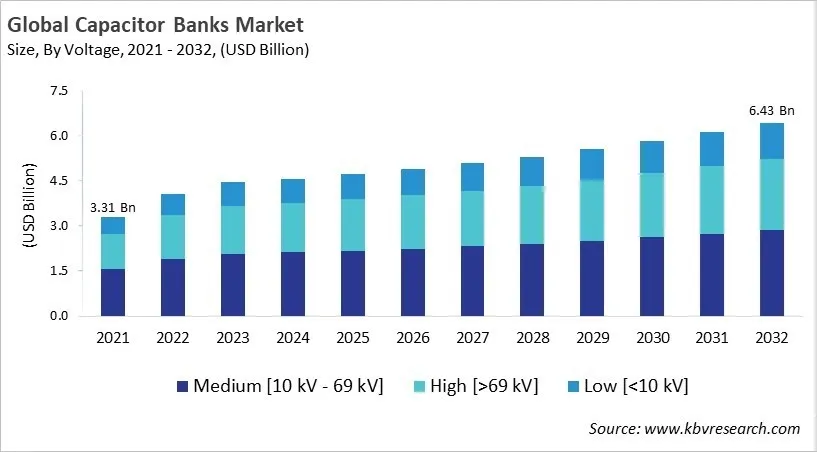
The capacitor banks market has transformed from basic shunt units for industrial-power factor correction to modern, digitally integrated systems. Furthermore, capacitor banks are important for advanced electricity grids. The growth of the capacitor banks is growing due to the rising regulatory requirements like the India’s Central Electricity Authority mandates and U.S. FERC Order 827 have fuelled demand for the dynamic reactive compensation, frequently incorporating capacitor banks into STATCOM and SNV configurations. This change facilitate renewable integration, harmonic damping, and voltage regulation. Gradually, innovations and R&D in the capacitor banks has developed tuned-filter designs, remote monitoring, modular enclosures, and self-healing capabilities–maintaining adherence to increasingly rigorous grid codes.
Major market trends are incorporation of the capacitor banks with renewable energy plans, rising digitalization for smart grid compatibility, and modular, personalised solutions for situation with limited spaces or requiring fast deployment. OEMs like Siemens, ABB, Hitachi, Eaton, Toshiba, and Powerside are using high-speed switching, IoT-enabled monitoring, and harmonic filtering to make their products more reliable and lower their operating costs. Common strategies include moving into high-growth areas, adding new products for the industrial and transportation sectors, and forming strategic partnerships with utilities. In the competitive landscape, multinational companies are the leaders. They offer advanced, grid-compliant solutions. Regional companies, on the other hand, focus on cost-effective, customized deployments, especially in Asia-Pacific, where infrastructure is growing quickly.
The COVID-19 epidemic hurt the worldwide capacitor banks industry by stopping factories and supply chains from working in important industrial areas, including China, India, and Southeast Asia. Lockdowns and a lack of workers made it harder for utility and industrial companies to get the raw materials they needed and finish projects on time. Utilities put off measures to modernize and electrify the system because they had to spend more money on emergencies. Industrial demand also fell since factories were closed for a long time and people used less energy, which put off expenditures in power factor correction. Travel restrictions and limited site access also made it harder to do engineering, testing, and commissioning work, which slowed down market progress and lowered total demand during the peak of the epidemic. Thus, the COVID-19 pandemic had a negative impact on the market.

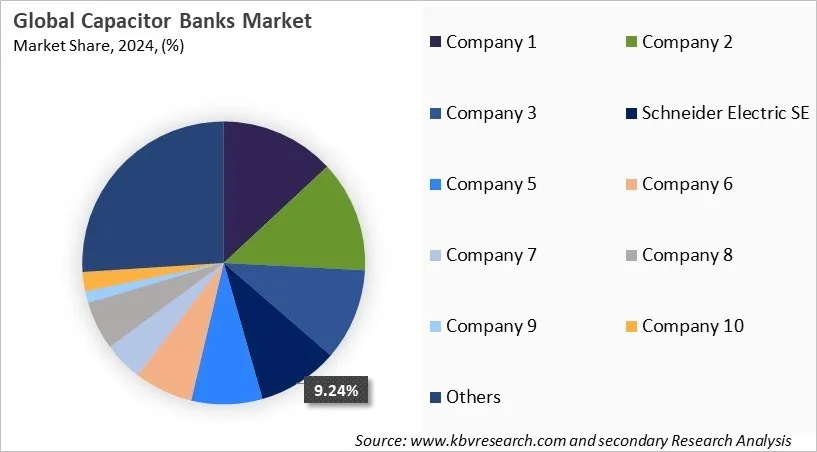
The leading players in the market are competing with diverse innovative offerings to remain competitive in the market. The above illustration shows the percentage of revenue shared by some of the leading companies in the market. The leading players of the market are adopting various strategies in order to cater demand coming from the different industries. The key developmental strategies in the market are Acquisitions, and Partnerships & Collaborations.
Based on Voltage, the market is segmented into Medium [10 kV - 69 kV], High [>69 kV], and Low [<10 kV]. The high [>69 KV] segment attained 36% revenue share in the capacitor banks market in 2024. This is driven by its importance in long-distance power transmission and large-scale grid operations. High voltage capacitor banks are essential for minimizing transmission losses, maintaining voltage levels, and supporting the stability of high-capacity power systems. They are commonly installed in substations and integrated with renewable energy sources, making them vital in the context of modern grid expansion and the shift toward clean energy.
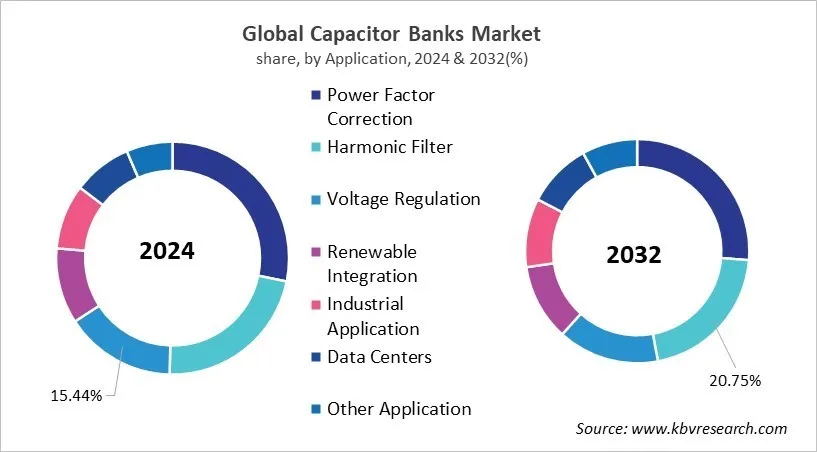
Based on Application, the market is segmented into Power Factor Correction, Harmonic Filter, Voltage Regulation, Renewable Integration, Industrial Application, Data Centers, and Other Application. The harmonic filter segment garnered 22% revenue share in the capacitor banks market in 2024. Harmonic filters are used to mitigate the effects of harmonic distortion caused by non-linear loads, such as variable frequency drives and electronic devices. Capacitor banks used in harmonic filtering help in maintaining power quality and protecting sensitive equipment from potential damage due to harmonics.
Free Valuable Insights: Global Capacitor Banks Market size to reach USD 6.43 Billion by 2032
Region-wise the market is segmented into North America, Europe, Asia-Pacific, and LAMEA. The North America segment recorded 33% revenue share in the capacitor banks market in 2024. In North America, the market is growing because of improvements to infrastructure, the use of renewable energy sources, and the modernization of the grid. The U.S. is in the lead because FERC rules require renewable generators to provide reactive power. This has made it easier to use smart capacitor banks that can be controlled remotely and work with STATCOMs and SVCs. Canada and Mexico are using it more and more to make industrial power better and keep distribution voltage steady. The need for tuned-filter and harmonic-compensated capacitor banks is growing in Europe, especially in Germany, the UK, and France. This is because of strict EU grid codes and more use of renewable energy. Modular, small, and IoT-enabled systems are becoming more popular in cities to make the most of limited space and improve real-time grid control.
The Asia-Pacific region is the largest market in the world. This is because of the rapid development of electricity, large-scale renewable energy projects, and government-supported initiatives to expand the grid. China's ultra-high-voltage transmission projects and India's RDSS/IPDS programs are using medium-voltage, modular capacitor banks to improve the efficiency of distribution and keep the voltage stable. Southeast Asian countries are using similar ways to improve their economies and bring electricity to rural areas. Brazil, Argentina, Saudi Arabia, the UAE, South Africa, and Nigeria are all investing in prefabricated and modular capacitor banks to reduce grid losses, make it easier to use renewable energy, and keep transmission corridors stable. OEMs and utilities need to work together to offer full reactive power solutions in these areas.
| Report Attribute | Details |
|---|---|
| Market size value in 2024 | USD 4.57 Billion |
| Market size forecast in 2032 | USD 6.43 Billion |
| Base Year | 2024 |
| Historical Period | 2021 to 2023 |
| Forecast Period | 2025 to 2032 |
| Revenue Growth Rate | CAGR of 4.5% from 2025 to 2032 |
| Number of Pages | 485 |
| Number of Tables | 308 |
| Report coverage | Market Trends, Revenue Estimation and Forecast, Segmentation Analysis, Regional and Country Breakdown, Market Share Analysis, Porter’s 5 Forces Analysis, Company Profiling, Companies Strategic Developments, SWOT Analysis, Winning Imperatives |
| Segments covered | Voltage, Application, Region |
| Country scope |
|
| Companies Included | Eaton Corporation plc, ABB Ltd., Siemens AG, Schneider Electric SE, General Electric Company, Hitachi Energy Ltd. (Hitachi, Ltd.), Bharat Heavy Electricals Ltd., Mitsubishi Electric Corporation, Powerside, and Larsen & Toubro Limited |
By Voltage
By Application
By Geography
This Market size is expected to reach $6.43 Billion by 2032.
Rising Demand For Power Quality And Grid Stability are driving the Market in coming years, however, High Initial Investment And Installation Costs restraints the growth of the Market.
Eaton Corporation plc, ABB Ltd., Siemens AG, Schneider Electric SE, General Electric Company, Hitachi Energy Ltd. (Hitachi, Ltd.), Bharat Heavy Electricals Ltd., Mitsubishi Electric Corporation, Powerside, and Larsen & Toubro Limited
The expected CAGR of this Market is 4.5% from 2023 to 2032.
The Medium [10 kV - 69 kV] segment led the maximum revenue in the Market by Voltage in 2024, thereby, achieving a market value of $2.9 billion by 2032.
The North America region dominated the Market by Region in 2024, thereby, achieving a market value of $2 billion by 2032.
Our team of dedicated experts can provide you with attractive expansion opportunities for your business.






 Unique Offerings