“Global C4ISR Market to reach a market value of USD 181.49 Billion by 2032 growing at a CAGR of 4.7%”
The Global C4ISR Market size is expected to reach $181.49 billion by 2032, rising at a market growth of 4.7% CAGR during the forecast period.
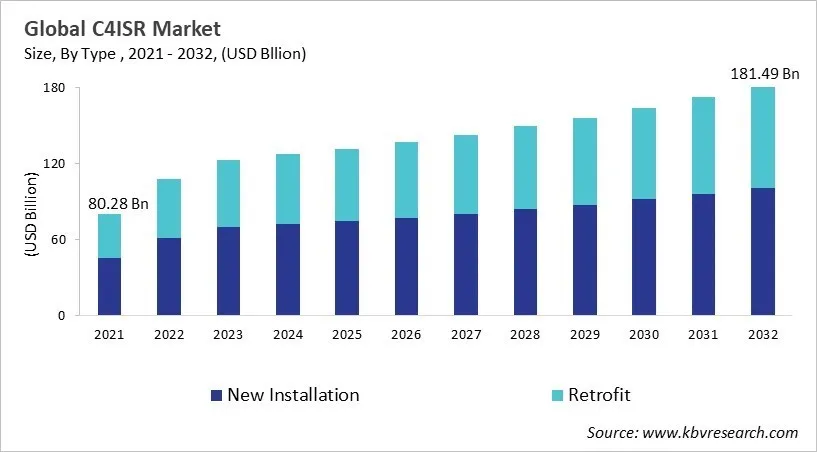
The market has experienced a significant change over these years influencing the modifications in the defense plan and on the technology fronts. Its inception dates way back to the cold war to improve communication and command systems. From the design point of view the early C4ISR systems were based on hardware and were quite separate from each other. As a fact these factors previously used radio communication along with simple data processing tools.
Consolidation among the leading defense giants and disruptive technologies from the entrants in this market makes the competition in this market intense in its nature. Companies such as Raytheon Technologies, Saab and Leonardo make endeavors not only on the technological prowess rather on interoperability, cost effectiveness and post-deployment support also. Though, the leading companies are having strong hold on the defense contracts however, various nations in Asia Pacific and Middle East are working through public-private partnerships for indigenous developments.
Among various strategic routes, the Partnerships deal as the key development strategy are shaping the market scenarios thereby catering to the dynamic demands from the end users. In May, 2025, L3Harris Technologies, Inc. partnered with Airbus for the integration of advanced systems from the former onto the MQ-72C unmanned logistics helicopter. This collaboration supports the adaptable command and control capabilities for the U.S Marines thereby enabling the readiness and enhancing the mission flexibility during the contests with the help of rapid prototyping under the Aerial Logistics connector program.
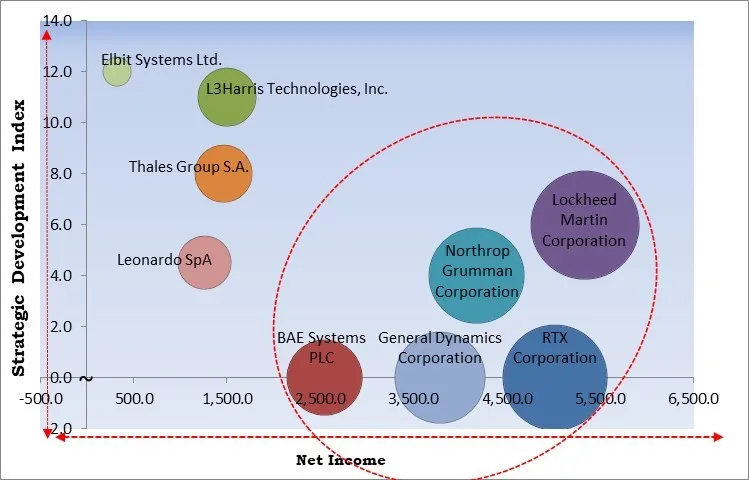
Based on the Analysis presented in the KBV Cardinal matrix; Lockheed Martin Corporation, RTX Corporation, Northrop Grumman Corporation, General Dynamics Corporation, and BAE Systems PLC are the forerunners in the C4ISR Market. In June, 2025, Northrop Grumman Corporation announced the partnership with Hanwha Systems, an Aerospace and defense company to enhance integrated air and missile defense (IAMD) command-and-control (C2) technologies. They will combine Northrop’s IBCS system with Hanwha’s Korean IAMD C2 solutions to improve sensor integration, threat engagement, and adaptable mission capabilities in South Korea. Companies such as L3Harris Technologies, Inc., Thales Group S.A., and Leonardo SpA are some of the key innovators in C4ISR Market.
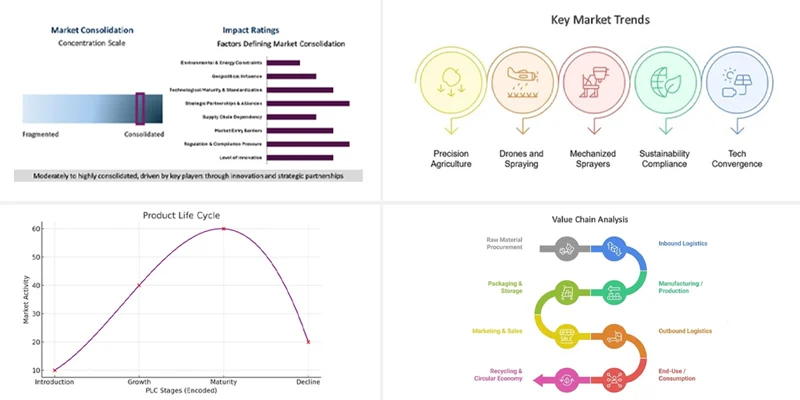
The C4ISR market worldwide holds a high importance in strengthening the modern defense and intelligence operations technologically. The deep government involvement, complex procurement cycles, high R&D investments and strict regulations shape the characteristics of the C4ISR market. The ecosystem is majorly dominated by the major defense contractors and system integrators via joint ventures including the international ones too, defense exclusive platforms and long-term military contracts. The C4ISR market experience a strong market consolidation owing to the high capital investment requirements and complex regulations. The market is dominated by few global leading players namely Lockheed Martin, Thales Group, Northrop Grumman, BAE Systems and Raytheon Technologies among others.
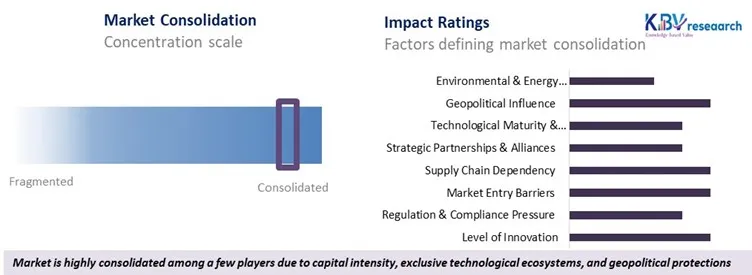
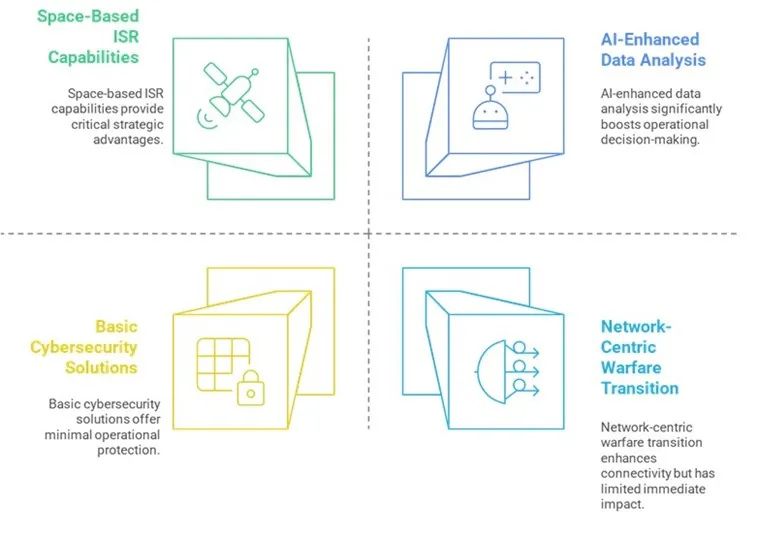
C4ISR space has innovation at its core especially in space-based surveillance, AI and ML-enabled ISR and strategic communication systems. The key companies are making big investments in the fields of autonomous systems, edge computing and multi-domain operations (MDO) integration. The innovation in C4ISR systems is directly linked with the defense contract from the countries, thereby leading to the closed ecosystems.
The funding from the governments across countries and the distinguished research projects influence and direct the related innovation cycles. Such innovations are centralized to the defense primes leading to the minimal intervention from smaller companies and startups.
Backed up on the technological advancements, OEM strategies, procurement patterns, and a number of digital initiatives, the global C4ISR market is presently experiencing the maturity stage of Product Life Cycle (PLC). The North America and Europe regions are witnessing the maturity stage of the adoption of C4ISR systems unlike the emerging regions such as Asia Pacific and parts of LAMEA, experiencing transitions between late growth to early maturity phase. Stable competition, regular innovation, high interoperability and transformation of legacy systems.
The Product Life Cycle Analysis of Global C4ISR market assists the stakeholders in understanding the prevailing lifecycle phase of the market thereby taking better decisions pertaining to the investments in R&D and other strategic moves. The chapter discussed various phases of the C4ISR market with timelines and real examples from the industry.
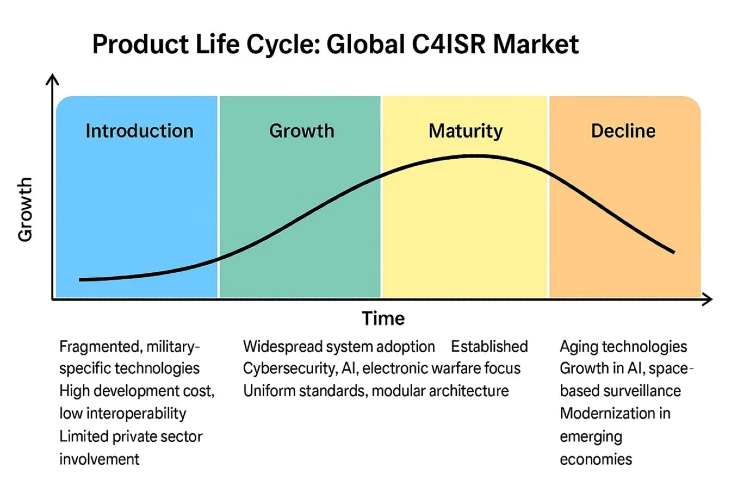
During the introduction phase, C4ISR systems were developed by military organizations across countries in-house during the Cold War. With the focus on the siloed command and control, such initial systems used rudimentary radar systems, analog radios and basic signal systems. This phase was characterized by limited interoperability and high R&D investments.
For e.g. Early C2 networks of U.S. military in 1960s and the first integrated air defense systems of NATO represented the technologies of this phase.
The period of COVID-19 pandemic posed difficult challenges across the world. It disturbed the supply chains and even suspended production in several places. Complete and partial lockdowns heavily restricted the supply of raw materials and finished products, also leading to numerous delivery issues. Further, with health concerns all over, the companies had a very limited workforce leading to the significant reduction in productivity. So, the COVID-19 had a negative influence on the market.

The key reason for the growth of the C4ISR market growth worldwide is that both the developed and developing nations are increasing their military budgets and transforming their defense systems. The governments are acknowledging the benefits and importance of modern age technologies in having an intelligent understanding of battlefield thereby enabling the military to take better and fast decisions while working in joint venture modes also. Conclusively, the requirement of stringer and intelligent security, government intentions for investment and mission to transform the defense forces are the fuel to the market growth.
In addition, the inclusion of AI and ML and its growing influence in military command and control systems marks a transformation in the global C4ISR market. Battles, in the current modern times, are getting more complex and faster, making it difficult for the people to manage the rush of information in an efficient manner.
The C4ISR is based on smart technologies including satellite communication, real time data management, advanced sensors and secure networks. The high cost involved in installations and maintaining the operations of C4ISR systems poses a major restraint to the market growth of C4ISR systems. Developing countries face huge investment challenges in procuring and maintaining the systems from the point of view of the expensive costs.
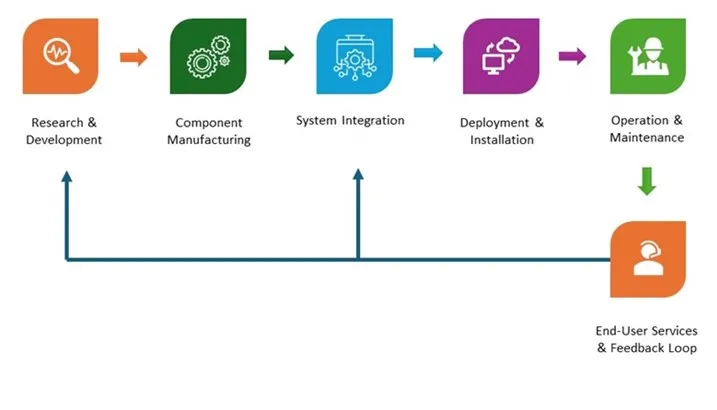
The image illustrates a typical value chain for technology or defense system development, depicting a clear progression from Research & Development to End-User Services & Feedback Loop. It begins with R&D, where new ideas and solutions are conceptualized and tested. Next, Component Manufacturing transforms these ideas into tangible parts. These components are brought together during System Integration, ensuring they work as a cohesive whole. The integrated system is then installed and made operational through Deployment & Installation. After deployment, the Operation & Maintenance phase ensures the system runs smoothly and efficiently over its lifecycle. Finally, End-User Services & Feedback Loop closes the chain by gathering user feedback, which informs further improvements, driving continuous innovation and refinement throughout the value chain.
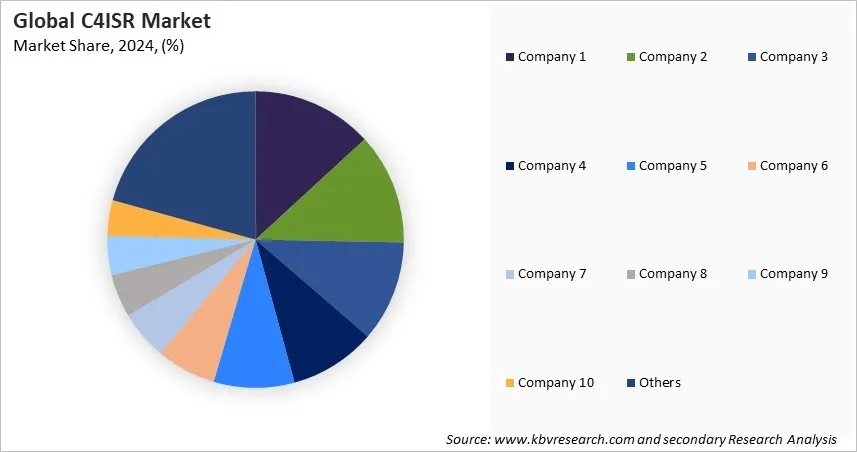
The leading players in the market are competing with diverse innovative offerings to remain competitive in the market. The above illustration shows the percentage of revenue shared by some of the leading companies in the market. The leading players of the market are adopting various strategies to cater to demand coming from the different industries. The key developmental strategies in the market are Partnerships & Collaborations.
Free Valuable Insights: Global C4ISR Market size to reach USD 181.49 Billion by 2032
Based on Type, the market is segmented into New Installation and Retrofit.
The New Installation segment garnered 56.57% revenue share in the market in 2024. The New installation segment revolves around the deployment of completely new systems and infrastructure for defense as well other security forces. Such deployment includes the installation of advanced command centers, communication networks and integrated surveillance systems from the start.
Under the U.S. Department of Defense’s Joint All-Domain Command and Control (JADC2) initiative, Lockheed Martin contribute a core role in delivering the integrated software-defined C4ISR ecosystems including service branches.
The Retrofit segment registered a considerable 43.43% revenue share in the market in 2024. This segment takes care of the upgradation and modernization of existing C4ISR systems which helps in enhancing longevity and its effectiveness. Globally, several armed forces get their C4ISR systems retrofitted to control costs and to get equipped with advanced technologies and capabilities.
BAE Systems is among the key players in this segment and is responsible for the British armored vehicles’ retrofitting with the advanced command and control components such as enhanced software defined radios and interfaces for digital networks.
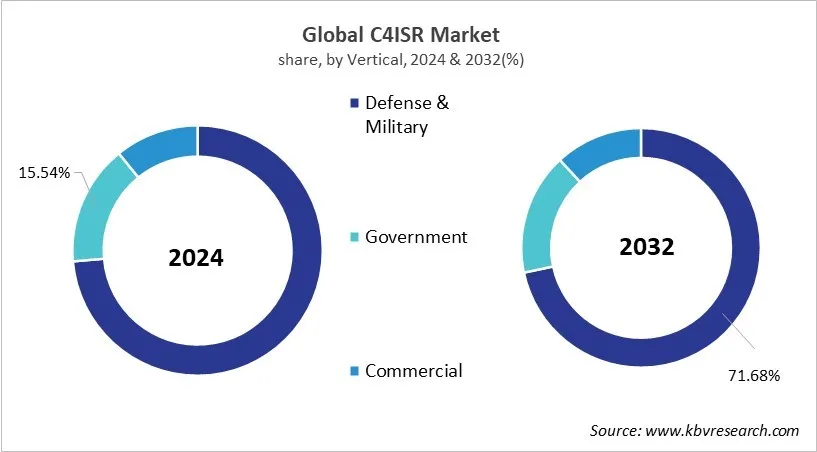
Based on Vertical, the market is segmented into Defense & Military, Government, and Commercial.
The Defense & Military segment acquired 73.61% revenue share in the market in 2024 and dominates the C4ISR market in this segment. It accounts for the largest revenue owing to the increased investments in modernization of forces and national security. It includes the real-time surveillance networks, advanced battlefield management solutions and strategic communications for the forces.
For instance, Lockheed Martin maintains its dominance in the supply of integrated C4ISR solutions to the U.S Department of Defense. The company further expanded footprints of its Tactical Intelligence Targeting Access Node (TITAN) program in 2024, to share the intelligence fast across the units via linking space-based and terrestrial sensors.
Region-wise, the market is segmented into North America, Europe, Asia Pacific, LAMEA.
The North America segment recorded 38% revenue share in the market in 2024. This segment holds a dominant position in the C4ISR market, driven by substantial defense budgets and continuous technological innovation. The United States invests heavily in modernizing its command, control, and surveillance capabilities to maintain global military superiority.
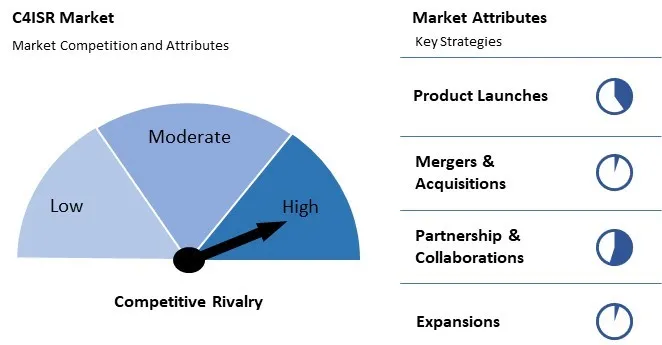
The competition in the C4ISR market remains high, driven by numerous regional and niche companies offering specialized solutions. Emerging defense contractors, local technology firms, and innovative startups constantly compete to fill capability gaps and secure government contracts. This dynamic landscape encourages rapid technological advancements, fostering strong rivalry and diverse offerings across intelligence, surveillance, and command systems.
| Report Attribute | Details |
|---|---|
| Market size value in 2024 | USD 127.18 Billion |
| Market size forecast in 2032 | USD 181.49 Billion |
| Base Year | 2024 |
| Historical Period | 2021 to 2023 |
| Forecast Period | 2025 to 2032 |
| Revenue Growth Rate | CAGR of 4.7% from 2025 to 2032 |
| Number of Pages | 567 |
| Number of Tables | 556 |
| Report coverage | Market Trends, Revenue Estimation and Forecast, Segmentation Analysis, Regional and Country Breakdown, Competitive Landscape, Market Share Analysis, Porter’s 5 Forces Analysis, Company Profiling, Companies Strategic Developments, SWOT Analysis, Winning Imperatives |
| Segments covered | Type, Vertical, End Use, Application, Component, Region |
| Country scope |
|
| Companies Included | Lockheed Martin Corporation, Northrop Grumman Corporation, RTX Corporation, BAE Systems PLC, General Dynamics Corporation, Thales Group S.A., The Boeing Company, Leonardo SpA (Leonardo DRS, Inc.), L3Harris Technologies, Inc., Elbit Systems Ltd. |
| Date | Strategy | News |
| May-2025 | Product Launch | Thales Group S.A. unveiled TRAC SIGMA, an L-band radar for military and civilian air traffic control and surveillance with 300 km range, 3D detection, and anti-jamming features, supporting dual-use data sharing. |
| May-2025 | Product Launch | Thales Group S.A. launched the Vehicle Mounted SquadNet Radio (VMSR) to expand secure communications for vehicles, integrating voice and data for dismounted troops and platforms, with MANET, anti-jamming, and dual voice nets. |
| May-2025 | Product Launch | L3Harris Technologies, Inc. introduced Amorphous, a scalable, open-architecture software for coordinating drone swarms autonomously across domains, supporting Pentagon programs like Replicator for resilient uncrewed operations. |
| May-2025 | Expansion | Leonardo SpA established a new facility at Aberdeen Proving Ground to support U.S. Army programs with labs and integration bays for C4ISR, electronic warfare, and force protection systems, strengthening Army collaboration. |
| Apr-2025 | Partnership | Northrop Grumman Corporation partnered with Terma to cooperate on advanced defense technologies including the F-35 fighter, UAVs, EW, radar, and missile defense, enhancing Denmark’s defense base and SME collaboration. |
| Apr-2025 | Partnership | Leonardo SpA partnered with BAE Systems to develop a demonstrator for the Future Combat Air System (FCAS), boosting UK–Italy ties and complementing ongoing next-gen fighter collaboration discussions with Japan. |
By Type
By Vertical
By End Use
By Application
By Component
By Geography
This Market size is expected to reach $181.49 billion by 2032.
Defense Modernization and Rising Military Expenditure are driving the Market in coming years, however, High Cost of C4ISR System Deployment and Maintenance restraints the growth of the Market.
Axis Communications AB (Canon, Inc.), Motorola Solutions, Inc., Hangzhou Hikvision Digital Technology Co., Ltd., Bosch Sicherheitssysteme GmbH (Robert Bosch GmbH), Zhejiang Dahua Technology Co., Ltd., Sony Semiconductor Solutions Corporation (Sony Corporation), Honeywell International Inc., Johnson Controls International PLC, OmniVision Technologies, Inc., and i-PRO Co., Ltd.
The expected CAGR of this Market is 4.7% from 2023 to 2032.
The Defense & Military segment captured the maximum revenue in the Market by Vertical in 2024, thereby, achieving a market value of $130.10 Billion by 2032.
The North America region dominated the Market by Region in 2024, thereby, achieving a market value of $66.35 Billion by 2032.
Our team of dedicated experts can provide you with attractive expansion opportunities for your business.












 Unique Offerings