“Global Building Information Modeling Market to reach a market value of USD 18.94 Billion by 2032 growing at a CAGR of 11.3%”
The Global Building Information Modeling Market size is expected to reach USD 18.94 billion by 2032, rising at a market growth of 11.3% CAGR during the forecast period.
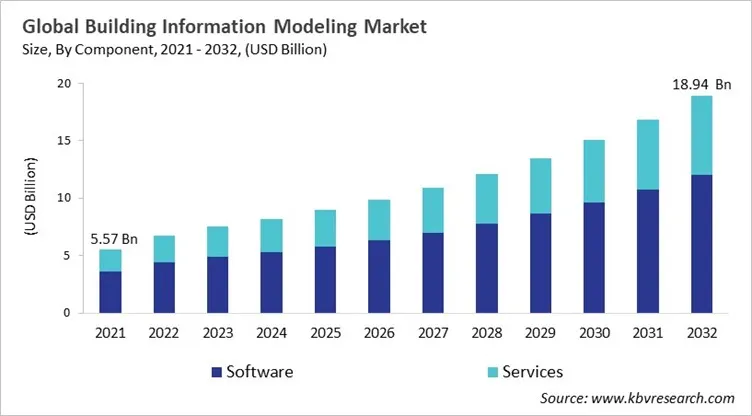
Building Information Modeling (BIM) has evolved from early CAD concepts in the 1960s–1990s into a comprehensive lifecycle approach for designing, constructing and managing built assets. After gaining momentum in the 2000s with government mandates—such as the UK’s BIM Level 2 requirement—BIM expanded from 3D modelling to multi-dimensional workflows incorporating time, cost and sustainability. Today, BIM is positioned as a connected, cloud-enabled ecosystem that integrates design, construction and operations. Major providers such as Autodesk emphasise BIM as a holistic, data-driven process supported by collaboration platforms, digital twins, sustainability analysis, and lifecycle asset management. This evolution reflects both technological advances (parametric modelling, cloud collaboration, IoT integration, AI analytics) and institutional shifts toward standardisation, open data formats (e.g., IFC), and global adoption across AECO sectors.
The Building Information Modeling Market is now shaped by strong trends including cloud-based coordination, lifecycle management, sustainability integration, and the adoption of advanced technologies such as AI, XR and IoT-enabled digital twins. Leading vendors are pursuing strategies centred on cloud platform expansion, end-to-end workflow integration, industry partnerships and alignment with global BIM standards. Competition involves large software platforms, niche BIM specialists and regional players—intensified by public-sector mandates, interoperability requirements and the shift toward outcome-based digital delivery. As BIM becomes foundational to digital transformation of the built environment, competitive advantage increasingly hinges on offering scalable lifecycle workflows, strong data ecosystems, interoperability, and integrated solutions spanning design through long-term operations.
The major strategies followed by the market participants are Partnerships as the key developmental strategy to keep pace with the changing demands of end users. For instance, In June, 2025, Nemetschek Group announced the partnership with Nesma Infrastructure & Technology to accelerate Saudi Arabia’s AEC/O sector digitalization. The partnership supports Vision 2030 by implementing advanced digital solutions like BIM and digital twins, enhancing project efficiency, sustainability, and innovation for large-scale infrastructure, smart cities, and workforce upskilling initiatives. Additionally, In April, 2025, Dassault Systemes SE teamed up with Airbus to use the 3DEXPERIENCE platform’s virtual twin technology for all future Airbus civil and military aircraft and helicopters. Over 20,000 users will collaborate to enhance efficiency, reduce development time and costs, and advance Airbus’ digital transformation goals.
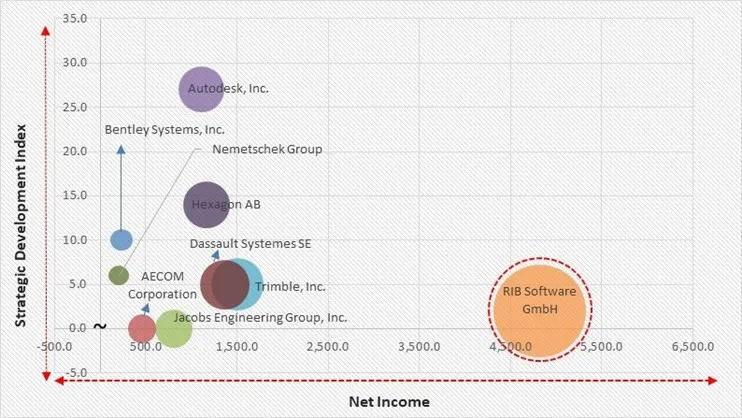
Based on the Analysis presented in the KBV Cardinal matrix; RIB Software GmbH is the forerunner in the Building Information Modeling Market. Companies such as Trimble, Inc., Dassault Systemes SE, and Hexagon AB are some of the key innovators in Building Information Modeling Market. In June 2024, RIB Software GmbH teamed up with 2050 Materials, a media company to integrate real-time carbon data into its CostX software, enabling quantity surveyors and estimators to assess embodied carbon alongside costs. This collaboration supports sustainable construction by providing accurate, up-to-date environmental data, helping professionals make informed, climate-conscious decisions throughout projects.
COVID-19 hurt the BIM market because lockdowns stopped construction work, pushed back projects that were already in progress, and made it harder to start new ones. Companies put off their plans to go digital because of problems with their supply chains and tight budgets. This made BIM adoption even slower. A lack of workers and limited access to sites made it harder for project stakeholders to work together, which made BIM less effective. It was harder for small and medium-sized businesses to keep things going. Overall, the market saw less demand, slower implementation, and fewer investments. Even though there were big problems in the short term, the crisis later showed how important it was to have digital tools for working together from a distance. Thus, the COVID-19 pandemic had a negative impact on the market.

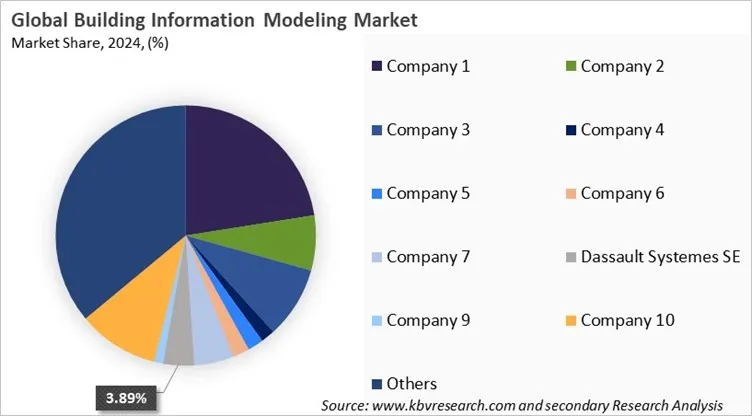
The leading players in the market are competing with diverse innovative offerings to remain competitive in the market. The above illustration shows the percentage of revenue shared by some of the leading companies in the market. The leading players of the market are adopting various strategies to cater demand coming from the different industries. The key developmental strategies in the market are Acquisitions, and Partnerships & Collaborations.
Free Valuable Insights: Building Information Modeling Market size to reach USD 18.94 Billion by 2032
Based on component, the building information modeling market is characterized into software and services. The services segment attained 35% revenue share in the building information modeling market in 2024. This is driven by the rising need for consulting, implementation, and lifecycle management services. As governments and private firms continue to expand BIM mandates, service providers are helping organizations establish effective BIM workflows, integrate data management systems, and provide training for skilled professionals.
On the basis of deployment, the building information modeling market is classified into on-premises and cloud. This is reflecting the region’s rapid transition toward digital collaboration and scalable IT infrastructure. Cloud-based BIM solutions enable real-time data sharing, remote project coordination, and lower upfront costs, making them increasingly popular among mid-sized firms and international contractors.
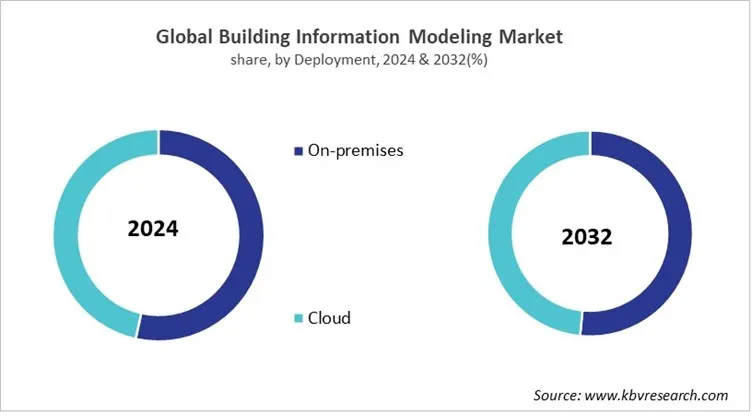
North America and Europe are among the most advanced BIM markets, driven by strong regulatory support, widespread digital-construction adoption, and mature AECO industries. Government mandates, strict documentation standards, and early integration of cloud-based collaboration tools have accelerated BIM uptake across infrastructure and commercial projects. Large engineering firms, contractors and public authorities in these regions increasingly rely on BIM for design coordination, construction management, sustainability modelling and lifecycle asset operations, making BIM a core pillar of digital transformation in the built environment.
Asia Pacific is experiencing rapid BIM growth fuelled by large-scale urban development, smart-city investments, and rising government mandates across China, India, Singapore, Australia and South Korea. Adoption is expanding beyond design firms to contractors and public agencies seeking productivity, cost control and digital-twin readiness. In LAMEA, BIM uptake is gaining traction as Gulf countries mandate BIM for major infrastructure projects and Latin America modernises its construction practices. Across both regions, growing infrastructure spending, increasing digital-skills investment and rising demand for lifecycle asset management are accelerating the expansion of BIM as a strategic construction and operations tool.
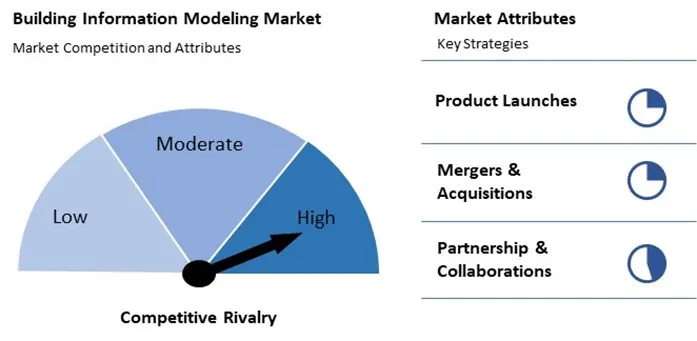
Competition in the Building Information Modeling (BIM) market is intensifying as digital construction practices become standard across architecture, engineering and construction sectors. Firms compete on advanced features, integration capabilities, cloud collaboration, and support for complex project workflows. Growing demand for improved productivity, cost efficiency and project transparency is pushing providers to innovate rapidly. Entry barriers remain moderate, attracting new technology-driven players. As adoption rises globally, differentiation increasingly depends on interoperability, scalability, user experience and alignment with evolving industry standards.
| Report Attribute | Details |
|---|---|
| Market size value in 2025 | USD 8.96 Billion |
| Market size forecast in 2032 | USD 18.94 Billion |
| Base Year | 2024 |
| Historical Period | 2021 to 2023 |
| Forecast Period | 2025 to 2032 |
| Revenue Growth Rate | CAGR of 11.3% from 2025 to 2032 |
| Number of Pages | 653 |
| Number of Tables | 614 |
| Report coverage | Market Trends, Revenue Estimation and Forecast, Segmentation Analysis, Regional and Country Breakdown, Competitive Landscape, Market Share Analysis, Porter’s 5 Forces Analysis, Company Profiling, Companies Strategic Developments, SWOT Analysis, Winning Imperatives |
| Segments covered | Component, Deployment, Services Type, Project Lifecycle, Building Type, Application, Region |
| Country scope |
|
| Companies Included | Autodesk, Inc., Trimble, Inc., Bentley Systems, Inc., AECOM Corporation, Procore Technologies, Inc., RIB Software GmbH (Schneider Electric Investment AG), Hexagon AB, Dassault Systemes SE, Jacobs Engineering Group, Inc. and Nemetschek Group |
By Component
By Deployment
By Project Lifecycle
By Building Type
By Application
By Geography
The market size is projected to reach USD 9.66 billion by 2032.
The building information modeling market is projected to grow at a CAGR of 11.5% between 2025 and 2032.
Growing global talent shortages and skill gaps, combined with the shift to remote, hybrid, and border-independent work models, are reshaping workforce demand dynamics.
Sirva Worldwide, Inc., Deel Inc., Papaya Global Ltd., Employment Conditions Abroad Limited, Weichert Workforce Mobility Inc., VFS Global Group, Topia Inc. (Bow River Capital), Equus Software, LLC, Deloitte Touche Tohmatsu Limited and Velocity Global Holdings, LLC (Pebl)
The Workforce Centralized Management Systems segment is leading the Global building information modeling Market by Vertical in 2024, growing at a CAGR of 9.4 % during the forecast period.
The North America region dominated the Global building information modeling Market by Region in 2024, and would continue to be a dominant market till 2032; thereby, achieving a market value of $182.7 billion by 2032.
Our team of dedicated experts can provide you with attractive expansion opportunities for your business.












 Unique Offerings