“Global Bot Services Market to reach a market value of USD 24.04 Billion by 2032 growing at a CAGR of 29.2%”
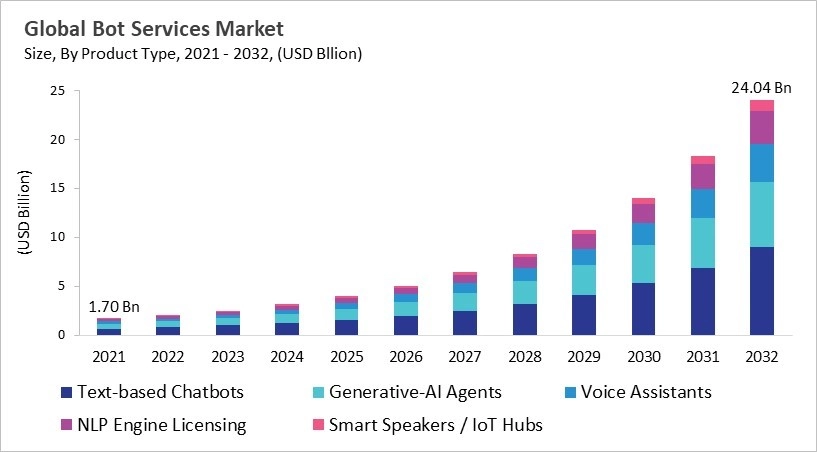
The Global Bot Services Market size is estimated at $3.99 billion in 2025 and is expected to reach $24.04 billion by 2032, rising at a market growth of 29.2% CAGR during the forecast period (2025-2032). The projected growth of this market is driven by rapid digital transformation, rising adoption of AI-powered customer support, expansion of e-commerce and fintech platforms, and increasing demand for automation across enterprises. Continuous improvements in natural language processing and cloud infrastructure further accelerate large-scale deployment and market revenue growth.
The bot services market has developed along with advances in AI-based automation, shifting from simple rule-based chat tools to smart, context-aware conversational systems powered by machine learning, natural language processing, cloud computing, and machine learning. Bots are now largely adopted across public and commercial sectors to support engagement, sales, HR functions, and IT help desks, and government services. Enterprises largely consider conversational AI as a core digital capability that improves customer experience, automates repetitive tasks, and reduces costs, while governments deploy chatbots to enhance service delivery, operational efficiency, and accessibility.
The bot services market is driven by key trends, including multi-channel and omnichannel deployment, the increasing sophistication of conversational AI, language inclusivity, enterprise-wide automation, and increasing public sector adoption. Key market players are positioning themselves ahead through scalable and customizable solutions, advanced AI integration, advanced AI integration, and a focus on data governance and ethical AI. Competition centers on ease of deployment, AI capabilities, developer ecosystems, and integration depth, with both large technology firms and specialized providers innovating rapidly. The bot services market landscape continues to develop as automation and generative AI expand the scope of bots, reshaping how enterprises optimize internal processes and interact with users.
The major strategies followed by the market participants are Partnership as the key developmental strategy to keep pace with the changing demands of end users. For instance, In May, 2025, Salesforce, Inc. and Informatica partnered to integrate its data platform with Agentforce, enhancing AI-driven customer intelligence. This collaboration enables personalized, autonomous agent interactions across sales and service, leveraging high-quality master data to boost engagement, satisfaction, and compliance across B2C and B2B environments.
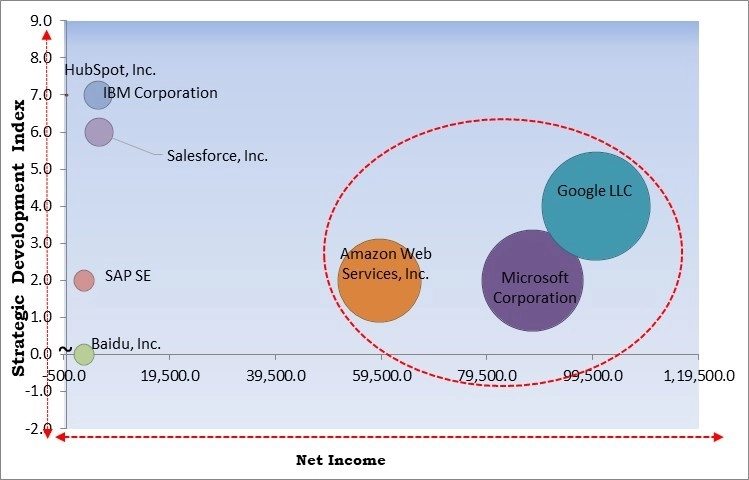
Based on the Analysis presented in the KBV Cardinal matrix; Google LLC, Microsoft Corporation and Amazon Web Services, Inc. are the forerunners in the Bot Services Market. Companies such as IBM Corporation and Salesforce, Inc. are some of the key innovators in Bot Services Market. In April, 2025, Google LLC came into partnership with Sutherland to deliver generative AI-powered solutions including conversational bots, smart assistants, and multilingual support. This collaboration leverages Google Cloud’s Vertex AI and Gemini models to enhance customer engagement and drive measurable AI value for enterprises.
The COVID-19 pandemic had a positive effect on the bot services market because businesses quickly moved to digital-first operations during lockdowns. Businesses in banking, healthcare, retail, and government all started using chatbots and virtual assistants to keep services going when physical service channels were disrupted. More people using the internet led to a strong need for automated customer engagement solutions that could handle a lot of interactions quickly. Bots helped with things like tracking orders, making appointments, answering frequently asked questions, and giving updates about COVID. Companies also used bots for IT support, HR services, and automating workflows so that people could work from home. Automation made things run more smoothly and lessened the need for human agents. The pandemic sped up the long-term use of bot services by showing how scalable, cost-effective, and available they are all the time. Thus, the COVID-19 pandemic had a positive impact on the market.

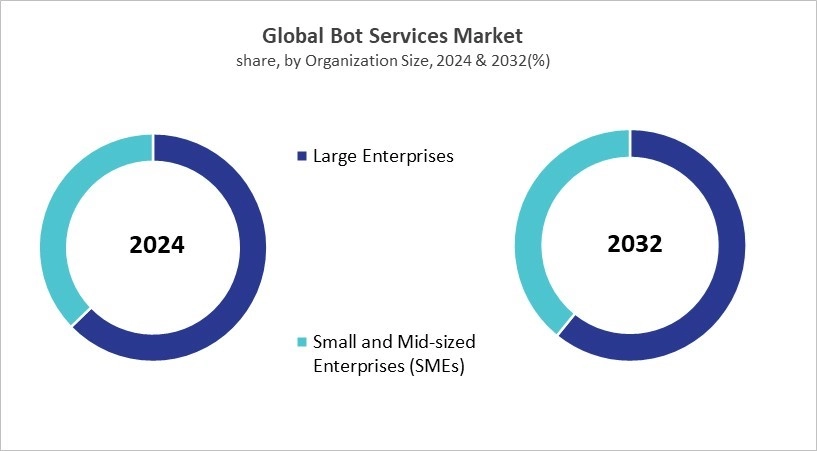
Based on Organisation Size, the Bot Services Market is segmented into Large Enterprises, and Small and Mid-sized Enterprises (SMEs). The Small and Mid-sized Enterprises (SMEs) segment acquired 37% revenue share in the market in 2024. The Small and Mid-sized Enterprises segment reflects growing adoption of bot services as SMEs increasingly focus on digital transformation and customer engagement efficiency. SMEs utilize both services to automate customer support, manage inquiries, assist with sales processes, and improve online presence without the need for large human support teams.
Based on Product Type, the Bot Services Market is segmented into Text-based Chatbots, Generative-AI Agents, Voice Assistants, NLP Engine Licensing, and Smart Speakers / IoT Hubs. The Generative-AI Agents segment attained 28% revenue share in the market in 2024. The Generative-AI Agents segment represents a more advanced and dynamic category within the Bot Services Market, characterized by the ability to generate context-aware, human-like responses across a wide range of interactions. These agents leverage large language models and deep learning architectures to handle complex conversations, multi-step reasoning, content generation, and personalized engagement.
Free Valuable Insights: Bot Services Market Size to reach $24.04 by 2032
Region-wise, the Bot Services Market is analyzed across North America, Europe, Asia Pacific, and LAMEA. The North America segment recorded 34% revenue share in the market in 2024. The bot services market is anticipated to grow at a significant rate in North America and Europe region. This is because of the robust digital infrastructure, advanced AI adoption, and strong enterprise investment in automation technologies. The US showcases significant demand across healthcare, retail, finance, and e-commerce, where bots are largely deployed for operational efficiency, and customer engagement. Also, Canada and Mexico showcase noticeable bot uptake in banking, telecom, and online service platforms. Moreover, Europe bot services market is further witnessing lucrative growth opportunities. The market is propelled by stringent data privacy standards, digital transformation efforts, and demand for multilingual and compliant conversational AI solutions across public services, banking, and retail industries. Nations like France, Germany, and the UK are key contributors, with accelerating adoption of bots for improved internal automation and customer support.
In Asia Pacific and LAMEA region, the bot services market is predicted to grow at a steady pace. This is because of expanding e-commerce ecosystem, and widespread smartphone penetration. South Korea, Japan, India, and China lead regional demanding, leveraging bot services for fintech interactions, mobile commerce, and large-scale customer service automation. Government-led AI initiatives and tech start-up environment also surges bot service usage across diverse industries. Furthermore, LAMEA is estimated to experience prominent growth in bot services market. The market is expanding as public sector bodies and organizations invest in conversational solutions to enhance service delivery and digital responsiveness. Additionally, the market is driven by digital transformation initiatives in government services, finance, and telecom sectors.
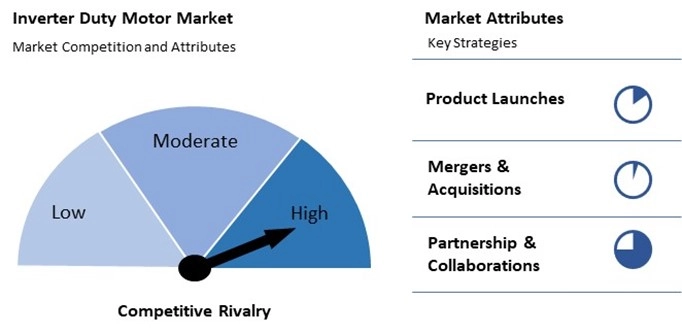
Market competition in the bot services market is highly dynamic and intensifying due to rapid digital transformation across industries. Numerous technology providers, startups, and platform vendors compete by offering AI-driven chatbots, virtual assistants, and automation tools with advanced natural language processing and analytics. Differentiation is based on accuracy, scalability, industry-specific solutions, and ease of integration with enterprise systems. Price competition remains strong as cloud-based delivery lowers entry barriers, while continuous innovation and partnerships shape competitive positioning.
| Report Attribute | Details |
|---|---|
| Market size value in 2025 | USD 3.99 Billion |
| Market size forecast in 2032 | USD 24.04 Billion |
| Base Year | 2024 |
| Historical period | 2021 to 2023 |
| Forecast Period | 2025 to 2032 |
| Revenue Growth Rate | CAGR of 29.2% from 2025 to 2032 |
| Number of Pages | 651 |
| Tables | 517 |
| Report Coverage | Market Trends, Revenue Estimation and Forecast, Segmentation Analysis, Regional and Country Breakdown, Competitive Landscape, Porter’s 5 Forces Analysis, Company Profiling, Companies Strategic Developments, SWOT Analysis, Winning Imperatives |
| Segments Covered | Deployment Channel, Organization Size, Product Type, End-User Industry, Region |
| Country Scope |
|
| Companies Included |
|
By Deployment Channel
By Organisation Size
By Product Type
By End-User Industry
By Geography
Our team of dedicated experts can provide you with attractive expansion opportunities for your business.







 Unique Offerings