Have you noticed how often we hear about data privacy, cybersecurity breaches, and government regulations in the news? Behind these concerns is one powerful trend: the rise of the sovereign cloud market. Simply put, sovereign clouds give nations, industries, and organizations control over where their data is stored and how it’s managed.
This concern has led to the rise of the Sovereign Cloud Market, a sector designed to address growing demands for data sovereignty solutions, GDPR compliance, and digital sovereignty strategies.
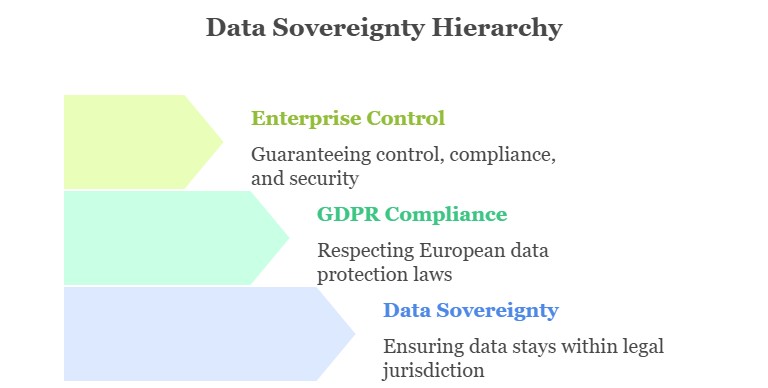
This growing market isn’t just about storing files—it’s about protecting sovereignty, meeting compliance standards like GDPR, and supporting industry-specific regulations.
In this article, we’ll explore what’s fueling this market, its regional impact, leading players, and why sovereign clouds are shaping the future of global digital strategies.
A sovereign cloud ensures that data remains under local jurisdiction, free from foreign interference. It’s a direct response to concerns about:
Think of it as a digital safe deposit box—where only the key holder’s local laws apply.
In today’s digital-first world, data isn’t just information—it’s power. But when that power crosses borders, it often comes under scrutiny.
Companies and governments are seeking cloud platforms that ensure data never leaves a country’s legal jurisdiction.
In Europe, GDPR has forced businesses to rethink storage, transfer, and processing rules. A sovereign cloud ensures these laws are respected.
From healthcare patient records to government defense data, organizations need a cloud that guarantees control, compliance, and security. Think of it as a digital passport for your data—ensuring it always resides in the right country, under the right laws.
Several global tech giants are steering innovation in this market:
AWS has partnered with government agencies worldwide to deliver compliance-focused cloud solutions, especially in public sector deployments.
A dominant player in Asia-Pacific, Alibaba Cloud enables compliance with China’s Cybersecurity Law and supports regional enterprises with localized data hosting.
With Google Cloud Sovereign Solutions, the company focuses on offering secure and compliant services, particularly in Europe.
IBM leverages its hybrid cloud expertise and partnerships to deliver custom sovereign cloud strategies tailored for industries like BFSI and healthcare.
Through Azure Sovereign Cloud, Microsoft provides dedicated, isolated cloud environments for governments and defense organizations.
These players are not just cloud providers—they are compliance enablers, ensuring organizations meet national and industry standards.
Several factors are fueling demand for sovereign cloud solutions:
Data breaches cost organizations millions of dollars on average each year, (IBM Security). Sovereign cloud solutions reduce risk by ensuring data is not subject to foreign subpoenas or surveillance.
Frameworks like GDPR, HIPAA, and industry-specific rules require organizations to store and process data locally.
Nations are increasingly pushing for digital independence. For example:
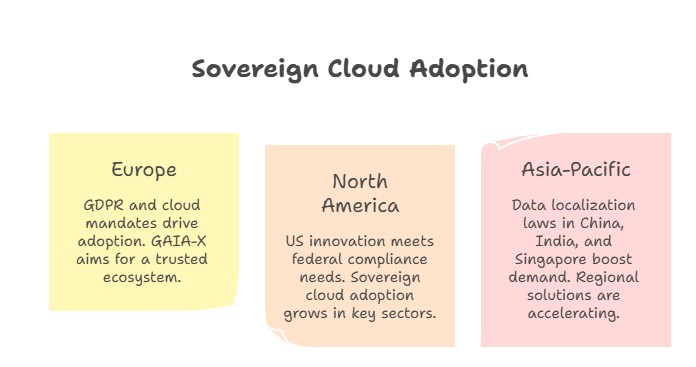
Europe leads due to GDPR and cloud computing mandates. Initiatives like GAIA-X aim to build a trusted, European-led cloud ecosystem.
While the US leads in cloud innovation, growing government focus on federal cloud compliance is driving sovereign cloud adoption in defense and healthcare.
With data localization laws in China, India, and Singapore, demand for regional sovereign cloud solutions is accelerating.
The Sovereign Cloud Market is only just beginning. Here’s what lies ahead:
AI-powered compliance monitoring will simplify governance in sovereign environments.
Organizations will increasingly adopt hybrid and multi-cloud models, combining flexibility with compliance.
Countries will demand stronger digital sovereignty strategies, leading to localized data centers and stricter cloud policies.
Healthcare, BFSI, and defense will remain the strongest adopters due to sensitive data requirements.
The future is clear—data sovereignty is no longer a regulatory checkbox, but a strategic imperative.
The Sovereign Cloud Market is reshaping how data is stored, managed, and protected across industries and nations. With compliance-driven adoption, hybrid models for governments, and leading innovators like AWS, Alibaba, Google, IBM, and Microsoft at the forefront, the market is poised for significant growth.The sovereign cloud isn’t just another IT trend—it’s the backbone of digital sovereignty strategies in the modern world.
As the demand for data sovereignty solutions intensifies, organizations that prioritize compliance and trust will gain a competitive edge.