Payment Security: Best Practices, Standards & 2026 Guide
Payment Security: Best Practices, Standards & 2026 Guide
If payments aren’t secure, nothing else converts. In 2026, “payment security” means protecting the entire journey—how you collect credentials, authenticate the payer, move money in real time, and store as little sensitive data as possible.
Why this matters now
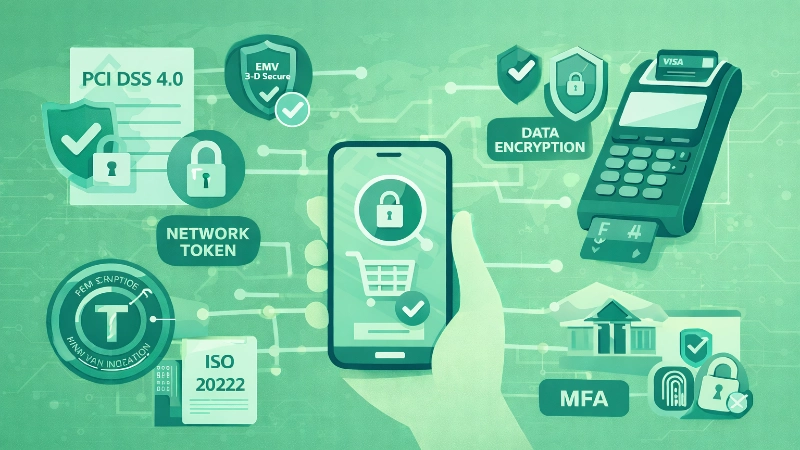
- New rules & deadlines: PCI DSS 4.0 is fully in force (v3.2.1 retired on 31 Mar 2024; future-dated controls became mandatory 31 Mar 2025).
- Better authentication: EMV® 3-D Secure 2.3.1 improves data sharing and reduces unnecessary challenges in card-not-present (CNP) flows.
- Identity guidance updated: NIST SP 800-63-4 (final, July 2025) recommends phishing-resistant MFA where risk warrants it.
- Real-time rails need real-time controls: US FedNow® and RTP® include built-in fraud-management features and self-audits that institutions should actively use.
- Data standards changed: Cross-border FI-to-FI payments switched to ISO 20022-only from 22 Nov 2025, enabling richer data for screening and analytics.
Market snapshot
According to KBV Research, the Payment Security market is set to rise strongly through 2032, led by tokenization, encryption, and regulatory adoption across regions.
The US Payment Security market is expected to continue its dominance in North America region thereby reaching a market size of 25.11 billion by 2032.
The Europe region is experiencing a CAGR of 16.5% during (2025 - 2032). Additionally, The Asia Pacific region would exhibit a CAGR of 17.5% during (2025 - 2032).
What “good” looks like in 2026
- Stop storing raw card numbers
Use network tokenization (from card networks) plus your own internal (vault) tokens. Visa reports tokenized transactions show ~30% lower online fraud and ~3–4% higher approval rates versus PANs.
- Make authentication smart, not hard
Turn on 3-D Secure 2.3.1 with risk-based flows—challenge only when needed—and offer low-friction MFA (including passkeys) for high-risk actions, in line with NIST 800-63-4.
- Encrypt from the point of capture
Use P2PE/E2EE so sensitive data is unreadable from the device/browser onward. (This also helps reduce PCI scope under DSS 4.0.)
- Use the rails’ own defenses
On FedNow/RTP, enable velocity and amount limits, first-time-payee checks, and real-time review queues; follow RTP’s annual self-audit.
- Keep rich data—use it for defense
Don’t drop ISO 20022 fields; the extra structure improves sanctions screening and anomaly detection.
The standards & regulations you’ll hear about
PCI DSS 4.0 (global)
- What changed: stronger MFA, logging/monitoring, software lifecycle controls; more flexibility via “customized approaches.”
- Action: map gaps now; many issues are process/monitoring rather than tools.
EMV® 3-D Secure 2.3.1 (cards online)
- What changed: more data elements and improved UX → fewer false declines, better issuer decisions.
- Action: send accurate device/merchant data; only step-up when risk is high.
NIST SP 800-63-4 (identity, especially for gov/regulated sectors)
- What changed: modern view of MFA and federation; encourages phishing-resistant authenticators for risky flows.
- Action: add passkeys/biometrics as step-up factors for high-risk actions (change payout account, first-time large transfers).
EU Instant Payments Regulation (IPR)
- What changed: instant euro credit transfers become standard; verification of payee (name-check) is required and free to the payer; staged deadlines (e.g., VoP and sending in the euro area by 9 Oct 2025; receiving by 9 Jan 2025).
- Action: turn on VoP and explain mismatches clearly in the UI.
India, RBI Authentication Directions (effective 1 Apr 2026)
- What changed: formal 2-factor authentication framework for digital payments, with flexibility beyond SMS OTP and risk-based step-ups.
- Action: keep 2FA baseline; adopt device-bound/biometric factors where appropriate; align issuer/acquirer handling of cross-border CNP timelines.
Privacy laws
- EU GDPR sets consent, minimization, and user-rights obligations—core to payment-data handling.
- China PIPL applies even to foreign firms offering services in China; require clear purpose and consent.
- India DPDP Act, 2023 governs digital personal data processing and user rights.
Real-world threats
- Card testing & bot attacks: add rate-limits, device signals, and bot defenses at payment, login, and OTP endpoints; prefer tokens so leaked PANs have limited value. (PCI 4.0 logging helps investigations.)
- Authorised push-payment (APP) scams on instant rails: require name-check, warn on mismatches, add first-payee cooldowns and per-day caps; use FedNow/RTP controls.
- Growth in online fraud overall: US agencies report record consumer losses in 2024—a reminder to tune controls proactively.
Implementation blueprint (90-day plan)
Days 1–30
- Turn on network tokenization for stored credentials, subscriptions, and wallets; measure approval uplift.
- Review PCI DSS 4.0 gaps (MFA, logging, inventories); fix “easy wins” first.
Days 31–60
- Roll out 3-D Secure 2.3.1 with risk-based challenges; add passkeys as a step-up for risky actions.
- On instant rails, enable velocity/amount rules and first-payee holds; document RTP self-audit responsibilities.
Days 61–90
- Preserve ISO 20022 rich fields end-to-end and feed them to screening/analytics.
- Run a red-team or pen-test on payment APIs and webhooks; close obvious findings before peak season. (Good hygiene; complements PCI.)
Country quick notes for readers
- United States: use FedNow/RTP features; track PCI 4.0 and NIST guidance; fraud losses reported by FBI/FTC underscore the need for real-time defenses.
- European Union/Germany: meet IPR deadlines (receive instant by 9 Jan 2025, send by 9 Oct 2025 in euro area; verification-of-payee required). Keep SCA journeys smooth.
- India: plan for RBI Authentication Directions by 1 Apr 2026; align with DPDP Act for notices and data rights.
- China: comply with PIPL (clear purpose/consent; cross-border rules) and use local rails/wallets through approved partners.
FAQ
Do tokens replace PCI?
No—tokens reduce exposure and help approvals, but you still need PCI controls for the systems that touch payment data.
Do instant payments mean instant fraud?
They can—unless you switch on name-check (EU), caps and first-payee rules (US rails), and educate customers about “confirm the payee.”
Will 3-D Secure annoy customers?
Used well, 2.3.1 reduces friction by sharing more data with issuers so many low-risk transactions are approved without a challenge.
Reader takeaway
Focus on four levers this quarter: tokens, 3-D Secure 2.3.1, real-time rail controls, and PCI 4.0 hygiene. They deliver fewer chargebacks, fewer false declines, and a smoother checkout—without scaring good customers away.