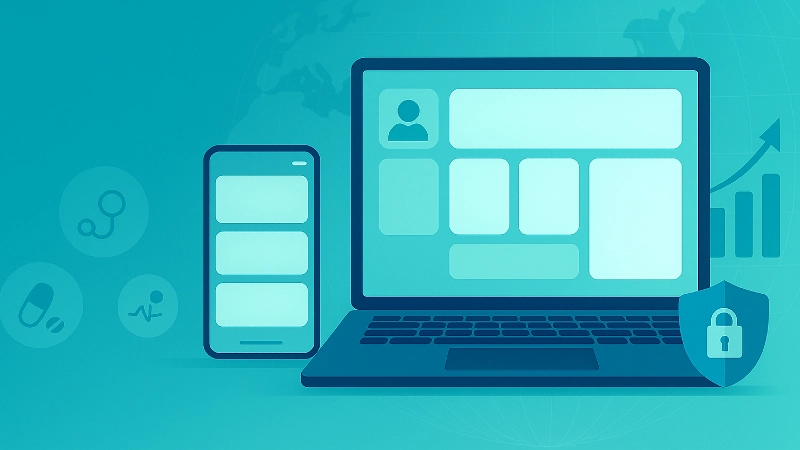
Patient portals are moving beyond lab-results and appointment reminders. Backed by interoperability rules and massive app adoption, they’re becoming the front door for care coordination, payments, pharmacy, remote monitoring—and soon, AI-assisted self-service. The global market is projected to grow from USD 4.31B (2025) to USD 14.37B (2032) at 18.7% CAGR.
FHIR APIs and payer/provider access rules shift portals from closed inboxes to data liquidity endpoints. Expect cleaner import of outside records, labs, imaging, and claims.
TEFCA’s QHINs are making cross-network exchange routine—an antidote to the “five portals per patient” problem. Vendors are consolidating multiple patient accounts into one view.
Beyond results and messages: bill-pay, price estimates, telehealth, e-prescriptions, and remote monitoring. NHS App’s prescription flows show how mainstream these are becoming.
Ambient scribing, smart replies, triage, and proactive nudges reduce admin burden while keeping clinicians in the loop. (Recent vendor announcements reflect this direction.)
Interoperability: Certified FHIR R4 APIs, bulk data, SMART-on-FHIR app support; roadmap for TEFCA/QHIN connectivity.
Multi-provider experience: Single sign-on aggregation; record-linking across systems to cut duplicate logins. (A key pain point with 59% of users having multiple portals.)
Messaging governance: Tools for triage, autosuggestions, and configurable SLAs to curb message overload.
Medication & labs: End-to-end prescription workflows and near-real-time lab/result notifications (with clear release rules). NHS usage data validates demand.
Security & privacy: Role-based controls, audit trails, and consent consistent with HIPAA/Cures, GDPR/EHDS, and ABDM.
Equity & accessibility: Multilingual UI, low-bandwidth modes, proxy access, and accessibility compliance—critical to close the digital divide flagged by policymakers.
North America: Policy-driven demand (CMS APIs) + TEFCA connectivity. Health-system consolidation favors integrated portals tied to EHR cores.
Europe: EHDS will catalyze cross-border access and secondary-use ecosystems; vendors must align with GDPR-grade consent and data minimization.
Asia Pacific: Government digital-health programs (e.g., ABDM) and mobile-first adoption underpin growth; expect rapid supplier onboarding and pharmacy/workflow digitization.
Our full report breaks down opportunity sizing by type (Integrated vs Standalone), delivery mode (Web-based vs Cloud), end-use (Providers, Payers, Others), plus regional/country cuts and a detailed vendor landscape—so you can prioritize your pipeline and product roadmap with confidence.