“Global Biohacking Market to reach a market value of USD 93.34 Billion by 2032 growing at a CAGR of 18.3%”
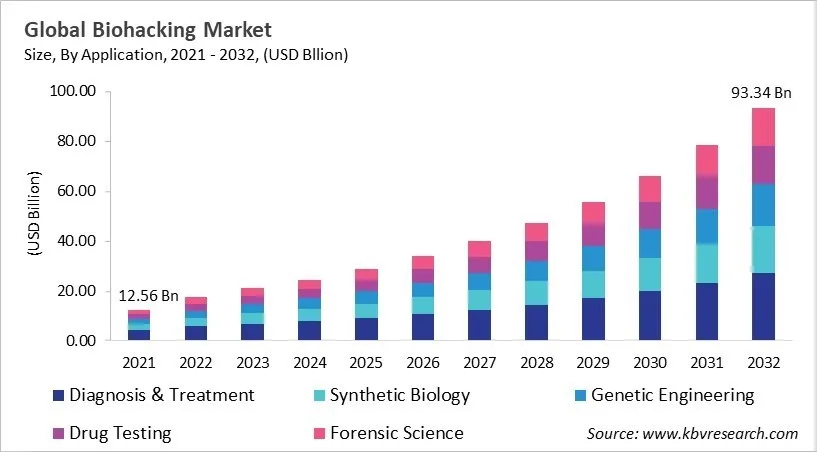
The Global Biohacking Market size is expected to reach $93.34 billion by 2032, rising at a market growth of 18.3% CAGR during the forecast period.
The biohacking market has developed from a fringe DIY biology movement to a sophisticated ecosystem spanning health-tech, consumer wellness, and performance optimisation. The field has expanded rapidly with affordable genetic testing, the growth of wearables, and continued biometric monitoring. Rising lifestyle-related diseases and a transition towards data-driven, preventive health further increase adoption, not only in consumers but also clinical stakeholders, regulators, and enterprises. Nowadays, biohacking encompasses a broad spectrum-from metabolic and sleep tracking to personalised neuromodulation, genomics, nootropics, and augmentation-representing society’s desire for proactive control over longevity, health, and cognitive performance.
The biohacking market is anticipated to grow at a substantial rate supported by trends including the widening use of lifestyle, and longevity optimisation methods, the growth of wearable and biometric devices allowing Three core trends underpin this transformation: the surge in wearable and biometric devices enabling real-time self-quantification; the widening use of lifestyle, cognitive and longevity optimisation methods; and the mainstream commercialisation of biohacking across consumer, corporate and clinical domains. Companies are responding through ecosystem-based strategies, vertically integrated partnerships, and premium performance offerings targeted at executives, athletes and longevity seekers. Competition is increasingly intense, involving major wearable brands, specialised wellness tech firms, synthetic biology start-ups and supplement providers—all innovating around sensors, analytics, user experience and regulated health-adjacent solutions. As the market matures, consolidation and clinically validated models are expected, marking a transition from experimental self-hacking to a structured, scalable health-performance industry.
The COVID-19 pandemic first messed up the global biohacking market by stopping community labs from working, slowing down product development, and breaking up supply and manufacturing chains. Lockdowns and limited access to labs slowed down DIY biology spaces and grassroots innovation a lot. People spent less money on biohacking devices and supplements that weren't necessary and more on healthcare needs that were. Startups had trouble getting funding because investors were more interested in important medical technologies. Corporate wellness programs came to a halt, regulatory scrutiny increased—especially on claims related to the immune system—and many research and development projects were put on hold as resources were moved to COVID-related research. Also, problems with transportation and a lack of materials made production more expensive and made wearable sensors and implants harder to find. Thus, the COVID -19 pandemic had a Negative impact on the market.

Based on Application, the market is segmented into Diagnosis & Treatment, Synthetic Biology, Genetic Engineering, Drug Testing, and Forensic Science. The Synthetic Biology segment attained 20% revenue share in the market in 2024 This component of the biohacking market is centered on the manipulation and reengineering of biological systems to create new materials, organisms, or applications that enhance human performance and well-being. This field combines principles of molecular biology, biotechnology, and computational design to develop biological circuits, engineered cells, and novel biomolecules.
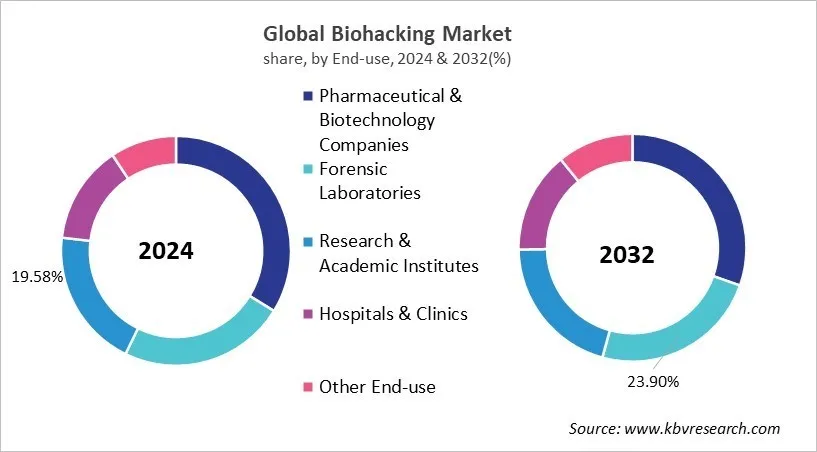
Based on End Use, the market is segmented into Pharmaceutical & Biotechnology Companies, Forensic Laboratories, Research & Academic Institutes, Hospitals & Clinics, and Other End-use. The Forensic Laboratories segment attained 23% revenue share in the market in 2024. This segment in the biohacking market is characterized by the use of advanced biological and molecular techniques to enhance investigative and analytical capabilities. Biohacking tools such as portable DNA sequencers, biosensors, and rapid detection kits are being adopted to improve accuracy and reduce turnaround times in forensic testing.
Free Valuable Insights: Biohacking Market size to reach USD 93.34 Billion by 2032
Region-wise, the Biohacking Market is analyzed across North America, Europe, Asia Pacific, and LAMEA. The North America segment recorded 39% revenue share in the market in 2024. The biohacking market is predicted to grow at a significant rate in North America and Europe. The growth is driven by strong consumer spending on wellness technologies, high adoption of wearables, and advanced health-tech ecosystems. In North America, particularly the US, biohacking has surged among executive-performance users, a large base of early adopters, leading wearable and biotech firms, and fitness/wellness communities. The region gets advantage from corporate wellness integration, robust startup activity, personalised genomics, cognitive optimization technologies, and strong investment in longevity. Moreover, Europe witnesses rapid growth driven by increasing interest in preventive health, strong research ecosystems in life sciences and biotechnology, and regulatory support for digital health solutions.
In the Asia Pacific and LAMEA regions, the biohacking market is anticipated to witness prominent expansion. This is due to rising health awareness, a growing middle-class population, rapid adoption of digital technologies are surging biohacking uptake. In the Asia Pacific, nations like Japan, South Korea, Singapore, Australia, and China are experiencing strong momentum because of government-backed digital health initiatives, rising interest in longevity, high penetration of wearable, high-performance lifestyle tools, and nutrition optimisation. The region also benefits from strong manufacturing capabilities for consumer electronics and sensors, making devices more accessible. Furthermore, the LAMEA biohacking market is also representing growth opportunities, backed by the adoption of wellness technologies, rising urbanization, and growing interest in preventive health. The LAMEA region is also expecting growth with a strengthening digital health ecosystem.
| Report Attribute | Details |
|---|---|
| Market size value in 2025 | USD 28.81 Billion |
| Market size forecast in 2032 | USD 93.34 Billion |
| Base Year | 2024 |
| Historical Period | 2021 to 2023 |
| Forecast Period | 2025 to 2032 |
| Revenue Growth Rate | CAGR of 18.3% from 2025 to 2032 |
| Number of Pages | 514 |
| Number of Tables | 431 |
| Report coverage | Market Trends, Revenue Estimation and Forecast, Segmentation Analysis, Regional and Country Breakdown, Porter’s 5 Forces Analysis, Company Profiling, Companies Strategic Developments, SWOT Analysis, Winning Imperatives |
| Segments covered | Application, End-use, Product, Region |
| Country scope |
|
| Companies Included | Garmin Ltd., WHOOP, INC, Oura Health Ltd., HVMN Inc., OsteoStrong, Apple, Inc., Fitbit, Inc. (Google LLC), Muse (Interaxon Inc.), NeuroSky, Inc., and Synthego Corporation |
By Application
By End Use
By Product
By Geography
This Market size is expected to reach USD 93.3 billion by 2032.
The biohacking market is projected to grow at a CAGR of 18.3% between 2025 and 2032.
Rising focus on health optimization and preventive wellness, paired with rapid technological advancements in wearables and biosensors, is fueling strong market growth.
Garmin Ltd., WHOOP, INC, Oura Health Ltd., HVMN Inc., OsteoStrong, Apple, Inc., Fitbit, Inc. (Google LLC), Muse (Interaxon Inc.), NeuroSky, Inc., and Synthego Corporation
The Pharmaceutical & Biotechnology Companies segment led the maximum revenue in the Global Biohacking Market by End-use in 2024, thereby, achieving a market value of $28.4 billion by 2032.
The North America region dominated the Global Biohacking Market by Region in 2024, and would continue to be a dominant market till 2032; thereby, achieving a market value of $35 billion by 2032.
Our team of dedicated experts can provide you with attractive expansion opportunities for your business.







 Unique Offerings