“Global Beet Sugar Market to reach a market value of USD 21.58 Billion by 2032 growing at a CAGR of 6.9%”
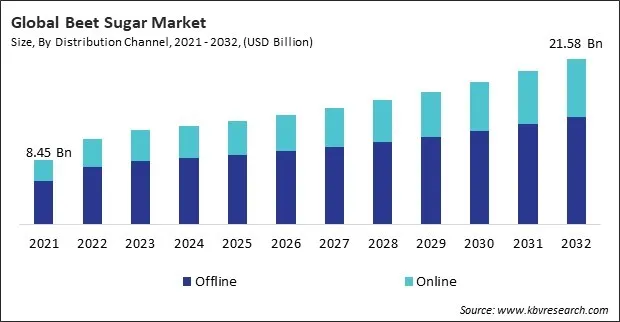
The Global Beet Sugar Market size is expected to reach $21.58 billion by 2032, rising at a market growth of 6.9% CAGR during the forecast period.
The bakery segment represents one of the primary applications of beet sugar, driven by the widespread use of sugar in baked goods for flavor, texture, and preservation. Beet sugar is a key ingredient in a variety of bakery products including breads, cakes, pastries, muffins, and cookies. It not only adds sweetness but also plays a crucial role in browning through the Maillard reaction, enhancing visual appeal and flavor depth. Moreover, sugar helps retain moisture, contributing to longer shelf life and better mouthfeel. Thus, the bakery segment witnessed 36% revenue share in the beet sugar market in 2024. With increasing consumer demand for indulgent, artisanal, and functional baked items, beet sugar continues to hold significant value in this category.
The COVID-19 pandemic severely disrupted agricultural operations across major beet-producing regions. Labor shortages, caused by lockdown restrictions and health concerns, hindered planting, harvesting, and processing activities. Seasonal workers, who were critical to beet cultivation, could not travel due to international and inter-regional movement restrictions. As a result, several farms faced delays or reductions in beet sugar output, directly impacting supply chains and market stability. The beet sugar market also suffered from significant supply chain disruptions. Thus, the COVID-19 pandemic had a negative impact on the market.
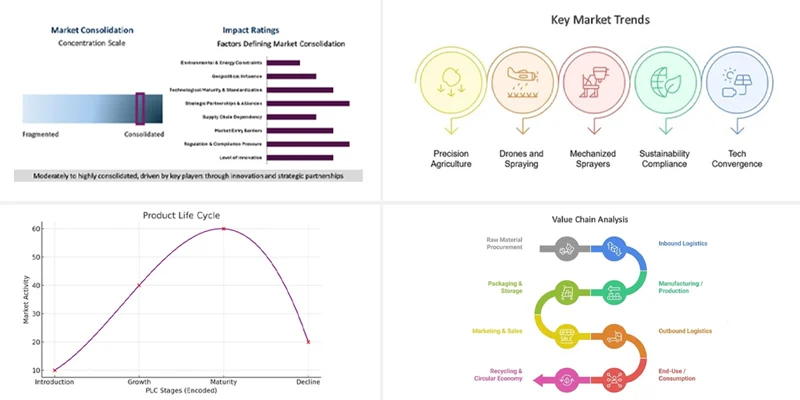

The growing consumer inclination towards natural and minimally processed food products has significantly boosted the demand for plant-based sweeteners, among which beet sugar stands as a major beneficiary. With increasing awareness about the adverse health effects of artificial sweeteners and high-fructose corn syrup, many consumers are opting for more wholesome and organic alternatives. Therefore, the rising consumer demand for natural, plant-based, and ethically sourced sweeteners is a powerful catalyst propelling the beet sugar market forward.
Additionally, recent advancements in agricultural biotechnology and sugar processing techniques have significantly improved the efficiency and profitability of beet sugar production. Sugar beet cultivation has evolved through innovations such as genetically improved beet varieties, precision farming, automated irrigation systems, and data-driven pest management strategies. Hence, technological advancements across the cultivation and processing value chain have significantly strengthened the economic and functional attractiveness of beet sugar in the global market.
However, one of the most pressing restraints on the beet sugar market is the high sensitivity of sugar beet cultivation to climatic conditions. Unlike sugarcane, which is cultivated in tropical zones, sugar beet is grown in temperate climates and requires specific seasonal patterns to ensure optimal yields. The crop thrives in cool and moist conditions, with significant daylight hours, and any deviation from these ideal conditions—whether in the form of unseasonal rainfall, drought, frost, or extreme heat—can severely hinder growth. Thus, volatile weather conditions and long-term climate change significantly undermine the predictability, profitability, and geographic stability of beet sugar production, making it a formidable restraint for market growth.
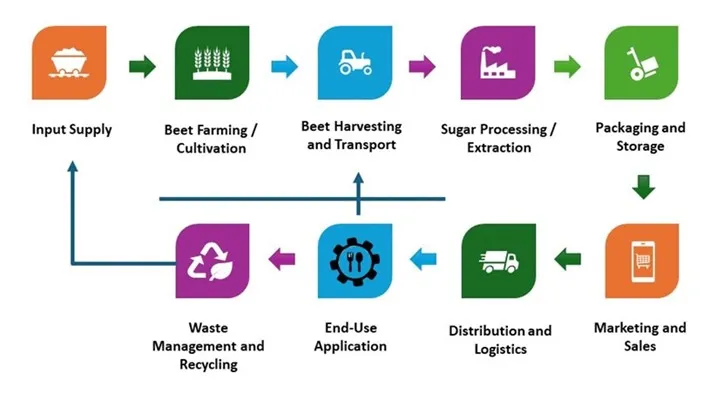
The Beet Sugar Market value chain begins with Input Supply, involving seeds, fertilizers, and agrochemicals. This supports Beet Farming / Cultivation, where sugar beets are grown. Following growth, Beet Harvesting and Transport ensures timely movement to factories. At the Sugar Processing / Extraction stage, sugar is refined from beets. The product is prepared in Packaging and Storage before moving to Marketing and Sales. Goods are then moved through Distribution and Logistics to reach consumers. The End-Use Application includes food and beverage industries. Finally, Waste Management and Recycling ensures sustainability and feeds back into the Input Supply cycle.
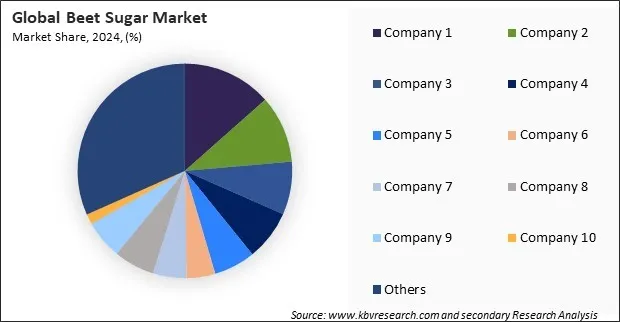
The leading players in the market are competing with diverse innovative offerings to remain competitive in the market. The above illustration shows the percentage of revenue shared by some of the leading companies in the market. The leading players of the market are adopting various strategies in order to cater demand coming from the different industries. The key developmental strategies in the market are Acquisitions, and Partnerships & Collaborations.
Based on distribution channel, the beet sugar market is characterized into offline and online. The online segment procured 31% revenue share in the beet sugar market in 2024. The online distribution channel comprises e-commerce platforms, brand-owned websites, and online grocery delivery services. This channel has gained traction due to the increasing use of smartphones, internet accessibility, and convenience of home delivery. Consumers appreciate the ease of comparing multiple brands, accessing discounts, and placing repeat orders efficiently.
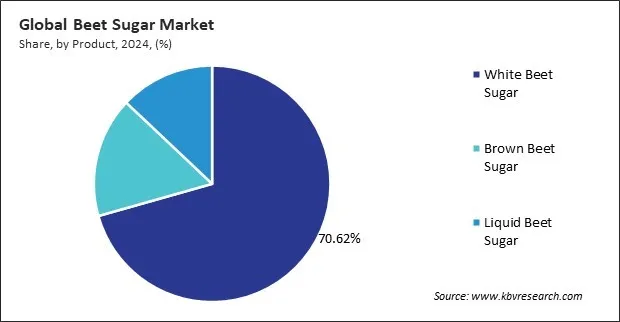
On the basis of product, the beet sugar market is classified into white beet sugar, brown beet sugar, and liquid beet sugar. The white beet sugar segment acquired 71% revenue share in the beet sugar market in 2024. White beet sugar is the most extensively used variant in the beet sugar market. It undergoes a thorough refining process to remove impurities and colour, resulting in a pure, white crystalline product. This type of sugar is favoured for its clean sweetness, high solubility, and consistent quality, making it ideal for both household and industrial use.
By application, the beet sugar market is divided into bakery, beverages, confectionary, and others. The confectionary segment acquired 22% revenue share in the beet sugar market in 2024. The confectionery segment utilizes beet sugar extensively in the production of sweets, candies, chocolates, and other sugary treats. Sugar serves not only as a sweetening agent but also as a crucial structural component that influences the texture, hardness, and mouthfeel of various confections. Beet sugar is particularly valued for its purity and consistency, which are essential for achieving the precise formulations required in candy-making.
Free Valuable Insights: Global Beet Sugar Market size to reach USD 21.58 Billion by 2032
Region-wise, the beet sugar market is analyzed across North America, Europe, Asia Pacific, and LAMEA. The Europe segment recorded 50% revenue share in the beet sugar market in 2024. Europe represents a dominant region in the beet sugar market, owing to its long-established sugar beet cultivation and advanced processing infrastructure. Countries such as France, Germany, the United Kingdom, and Poland have strong agricultural frameworks and favorable climatic conditions for beet farming. Additionally, supportive policies from the European Union, including subsidies and technological innovation in sustainable agriculture, have bolstered local production.
| Report Attribute | Details |
|---|---|
| Market size value in 2024 | USD 12.88 Billion |
| Market size forecast in 2032 | USD 21.58 Billion |
| Base Year | 2024 |
| Historical Period | 2021 to 2023 |
| Forecast Period | 2025 to 2032 |
| Revenue Growth Rate | CAGR of 6.9% from 2025 to 2032 |
| Number of Pages | 310 |
| Number of Tables | 360 |
| Report coverage | Market Trends, Revenue Estimation and Forecast, Segmentation Analysis, Regional and Country Breakdown, Market Share Analysis, Porter’s 5 Forces Analysis, Company Profiling, Companies Strategic Developments, SWOT Analysis, Winning Imperatives |
| Segments covered | Distribution Channel, Product, Application, Region |
| Country scope |
|
| Companies Included | Südzucker AG, Tereos S.A., AGRANA Beteiligungs-AG, Nordzucker AG (Nordzucker Holding AG), Pfeifer & Langen GmbH & Co. KG, Michigan Sugar Company, Louis Dreyfus Company B.V., Cooperatie Koninklijke Cosun U.A. (Royal Cosun), Associated British Foods PLC (Wittington Investments Limited), and Ragus Sugars Manufacturing limited |
By Distribution Channel
By Product
By Application
By Geography
This Market size is expected to reach $21.58 billion by 2032.
Rising Demand for Natural and Plant-Based Sweeteners are driving the Market in coming years, however, Volatile Weather Conditions and Climate Change Impacts restraints the growth of the Market.
Südzucker AG, Tereos S.A., AGRANA Beteiligungs-AG, Nordzucker AG (Nordzucker Holding AG), Pfeifer & Langen GmbH & Co. KG, Michigan Sugar Company, Louis Dreyfus Company B.V., Cooperatie Koninklijke Cosun U.A. (Royal Cosun), Associated British Foods PLC (Wittington Investments Limited), and Ragus Sugars Manufacturing limited
The expected CAGR of this Market is 6.9% from 2023 to 2032.
The Offline segment dominated the Market by Distribution Channel in 2024; thereby, achieving a market value of $14.07 billion by 2032.
The Europe region dominated the Market by Region in 2024, and would continue to be a dominant market till 2032; thereby, achieving a market value of $10.39 billion by 2032.
Our team of dedicated experts can provide you with attractive expansion opportunities for your business.







 Unique Offerings