“Global Automotive Predictive Analytics Market to reach a market value of USD 10.62 Billion by 2032 growing at a CAGR of 27.5%”
The Global Automotive Predictive Analytics Market size is expected to reach $10.62 billion by 2032, rising at a market growth of 27.5% CAGR during the forecast period.
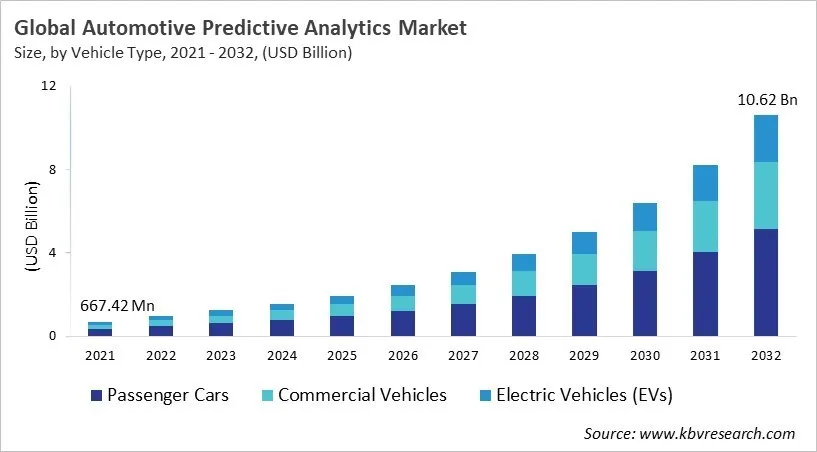
The automotive predictive analytics market is developed recently through the integration of telematics, connected vehicles, AI-driven automotive engineering, and data science. The technology has expanded its usage to encompass warranty management, supply chain forecasting, and vehicle safety. The rising popularity of autonomous and connected vehicles is generating large data streams, and predictive analytics supports functions like route optimization, fuel efficiency, and behaviour analysis. Insurers and the government have further supported the larger adoption through emissions, smart mobility, and safety regulations. With the digitalization of automotive industries, predictive analytics has become important to improving reliability, customization, and safety across the mobility ecosystem, transforming vehicles into self-learning, smart systems.
The automotive predictive analytics market is predicted to grow backed by trends including vehicle health management and predictive maintenance, applications in mobility service, insurance, supply chain optimization, and integrated with autonomous and connected vehicles. Fleet operators and automakers use predictive models to manage EV battery life, reduce downtime, and component failures. Predictive systems also allow autonomous vehicles to predict risks and customize in-car experiences. Furthermore, Mobility-as-a-Service, and insurance providers leverage analytics for demand forecasting, operational efficiency, and dynamic pricing. Key market players compete through embedded predictive features, data partnerships, and monetized insights. With increasing focus on personalized innovation, ethical data use, and cybersecurity, predictive analytics has become an essential part of the automotive sector’s transformation toward data-driven, proactive, and sustainable mobility.
The COVID-19 pandemic made it much harder for the automotive predictive analytics market to grow. Lockdowns around the world, problems with the supply chain, and a lack of semiconductors caused a big drop in vehicle production and sales. This made automakers shift their focus from digital investments to keeping their businesses running and managing their finances. Data collection was slowed down by less mobility and uncertain consumer demand. Analytics projects and research and development (R&D) activities were also delayed by budget limits and workforce limits. Collaboration between manufacturers, technology providers, and analytics firms was also affected, which made it harder to use solutions for predictive maintenance, demand forecasting, and customer behavior analysis. Because of this, the market temporarily stopped growing, with adoption rates and technological progress slowing until the recovery after the pandemic. Thus, the COVID-19 pandemic had a negative impact on the market.

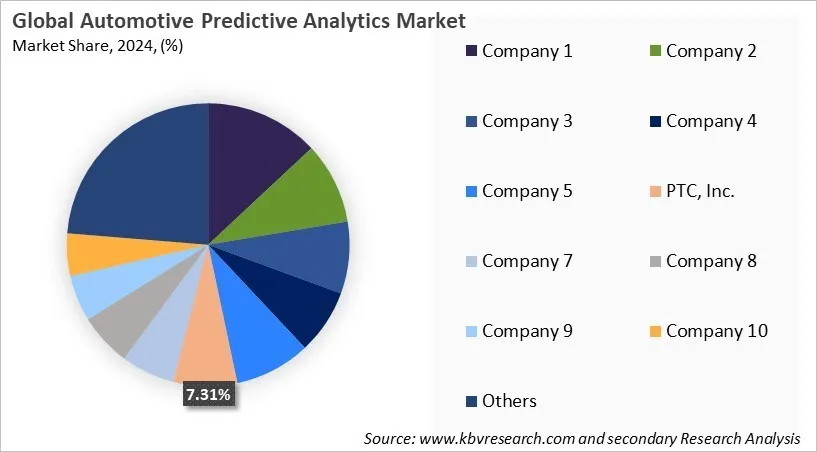
The leading players in the market are competing with diverse innovative offerings to remain competitive in the market. The above illustration shows the percentage of revenue shared by some of the leading companies in the market. The leading players of the market are adopting various strategies in order to cater demand coming from the different industries. The key developmental strategies in the market are Acquisitions, and Partnerships & Collaborations.
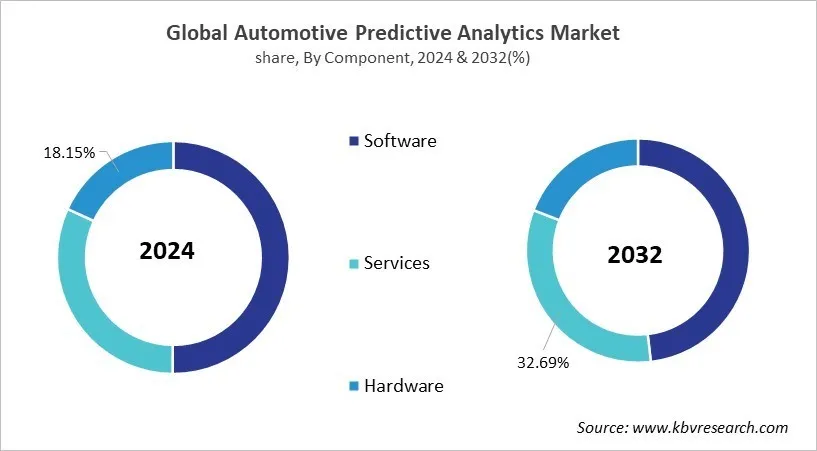
Based on Component, the market is segmented into Software, Services, and Hardware. The services segment attained 32% revenue share in the Automotive Predictive Analytics Market in 2024. The services segment forms an integral part of the automotive predictive analytics market, providing essential support for the deployment, maintenance, and optimization of analytical solutions. It includes consulting, implementation, system integration, and ongoing support services that ensure seamless operation and efficient utilization of predictive analytics tools.
Based on Vehicle Type, the market is segmented into Passenger Cars, Commercial Vehicles, and Electric Vehicles (EVs). The commercial vehicles segment recorded 29% revenue share in the Automotive Predictive Analytics Market in 2024. The commercial vehicles segment plays a significant role in the automotive predictive analytics market by leveraging data to enhance operational efficiency and reduce downtime. Predictive analytics assists fleet operators in monitoring vehicle health, predicting maintenance requirements, and optimizing route management. It also contributes to lowering fuel consumption, improving driver safety, and managing large fleets more effectively.
Free Valuable Insights: Global Automotive Predictive Analytics Market size to reach USD 10.62 Billion by 2032
Region-wise, the Automotive Predictive Analytics Market is analyzed across North America, Europe, Asia Pacific, and LAMEA. The North America segment recorded 34% revenue share in the Automotive Predictive Analytics Market in 2024. The automotive predictive analytics market is estimated to experience growth in North America and Europe. The market is supported by strong regulatory frameworks, advanced automotive infrastructure, and early adoption of autonomous and connected vehicle technologies. In North America, major automakers, fleet operators, and technology companies are investing heavily in AI-based maintenance and predictive telematics to reduce operational costs and improve vehicle performance. The market’s expansion is supported by a well-established ecosystem of cloud providers and data analytics. Moreover, the European region benefits from strict emission and safety regulations, along with the EU’s push for sustainable and smart mobility. Automobile providers in the UK, France, and Germany are deploying predictive analytics into production and vehicle design to enhance efficiency, improve user experience, and comply with standards.
In the Asia Pacific and LAMEA, the automotive predictive analytics market is predicted to expand at a prominent rate. This is due to the expanding automotive production, rising acceptance of electric and connected vehicles, and rapid digitalization. Furthermore, in the Asia Pacific, nations like Japan, South Korea, India, and China are leveraging predictive analytics to enhance manufacturing, EV batter optimization, and fleet management. The region is also witnessing positive opportunities due to strong support from governments for IoT infrastructure and smart transformation. In addition, the LAMEA region is expected to have surged adoption, especially among logistics companies and fleet operators looking for cost-efficient predictive maintenance solutions. Also, with the improvements in connectivity and data infrastructure, the market is anticipated to grow at a steady pace.
| Report Attribute | Details |
|---|---|
| Market size value in 2025 | USD 1.93 Billion |
| Market size forecast in 2032 | USD 10.62 Billion |
| Base Year | 2024 |
| Historical Period | 2021 to 2023 |
| Forecast Period | 2025 to 2032 |
| Revenue Growth Rate | CAGR of 27.5% from 2025 to 2032 |
| Number of Pages | 564 |
| Number of Tables | 471 |
| Report coverage | Market Trends, Revenue Estimation and Forecast, Segmentation Analysis, Regional and Country Breakdown, Market Share Analysis, Porter’s 5 Forces Analysis, Company Profiling, Companies Strategic Developments, SWOT Analysis, Winning Imperatives |
| Segments covered | Component, Vehicle Type, End User, Application, Region |
| Country scope |
|
| Companies Included | IBM Corporation, SAS Institute Inc., Oracle Corporation, SAP SE, Microsoft Corporation, PTC, Inc., Continental AG, Robert Bosch GmbH, ZF Friedrichshafen AG, and Aptiv PLC |
By Component
By Vehicle Type
By End User
By Application
By Geography
This Market size is expected to reach USD 10.62 Billion by 2032.
The automotive predictive analytics market is projected to grow at a CAGR of 27.5% between 2025 and 2032.
Rising demand for connected and smart vehicles is accelerating the focus on predictive maintenance and enhanced safety.
IBM Corporation, SAS Institute Inc., Oracle Corporation, SAP SE, Microsoft Corporation, PTC, Inc., Continental AG, Robert Bosch GmbH, ZF Friedrichshafen AG, and Aptiv PLC
The OEMs segment led the maximum revenue in the Global Automotive Predictive Analytics Market by End User in 2024, thereby, achieving a market value of $4.0 billion by 2032.
The North America region dominated the Global Automotive Predictive Analytics Market by Region in 2024, and would continue to be a dominant market till 2032; thereby, achieving a market value of $3.4 billion by 2032.
Our team of dedicated experts can provide you with attractive expansion opportunities for your business.








 Unique Offerings