“Global Automotive Powertrain Sensors Market to reach a market value of USD 38.75 Billion by 2032 growing at a CAGR of 7.9%”
The Global Automotive Powertrain Sensors Market size is expected to reach $38.75 billion by 2032, rising at a market growth of 7.9% CAGR during the forecast period.
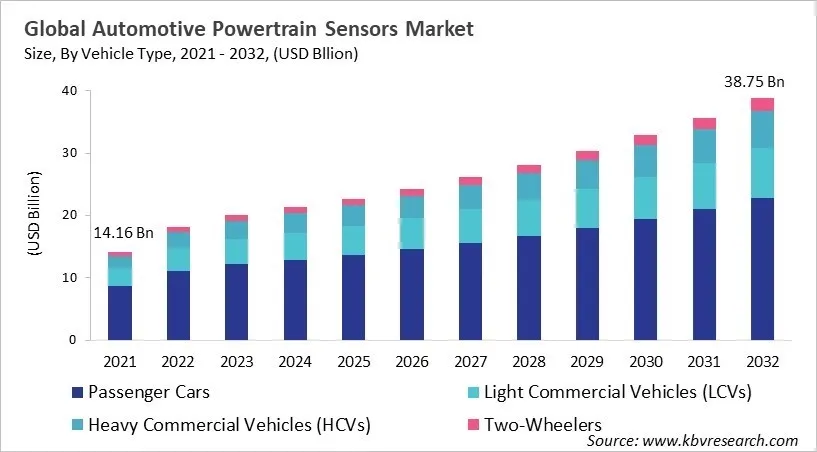
The changes in automotive powertrain sensors show the bigger trend of moving from mechanical systems to electronic control units (ECUs), smart mobility, and connected vehicles. At first, sensors made fuel injection, ignition timing, engine efficiency, and transmission performance better. This was mostly because of emissions rules, fuel economy standards, and vehicle safety rules. Over time, technologies like oxygen sensors, knock sensors, and mass air flow (MAF) sensors became standard. This was made possible by improvements in semiconductors, MEMS technology, and IoT-enabledautomotive electronics. These new technologies made it possible to make things smaller, save money, process data in real time, and adapt control. Sensors are essential for optimizing performance, meeting emissions standards, and onboard diagnostics (OBD).
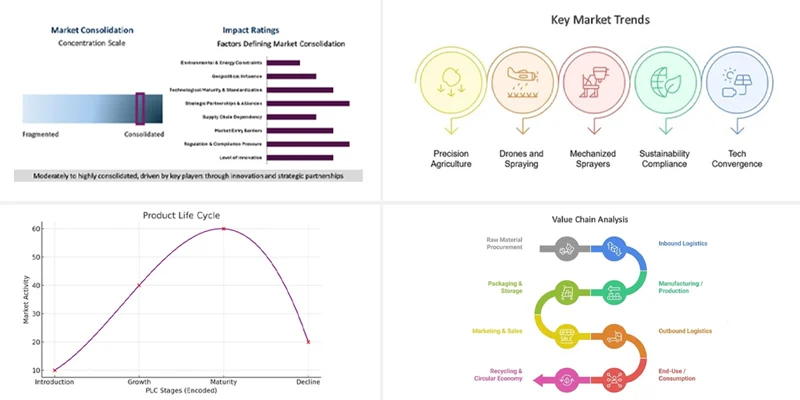
Trends like electrification, hybrid vehicles, hydrogen powertrains, MEMS sensors, predictive maintenance, and onboard diagnostics are changing how companies compete and grow in today's market. Sensors now do more than just monitor combustion; they also manage high-voltage batteries, control motors, and make sure charging is safe. This shows how important they are for clean mobility. Top OEMs and suppliers are putting money into system integration, miniaturizing sensors, advanced diagnostics, and EV battery sensors. Their strategies are based on partnerships and diversification. Electrification, regulatory compliance, miniaturized sensor solutions, and integrated control systems shape the competitive landscape. This makes sensors not just parts, but also the building blocks of smart mobility, eco-friendly vehicles, and the next generation automotive innovation.

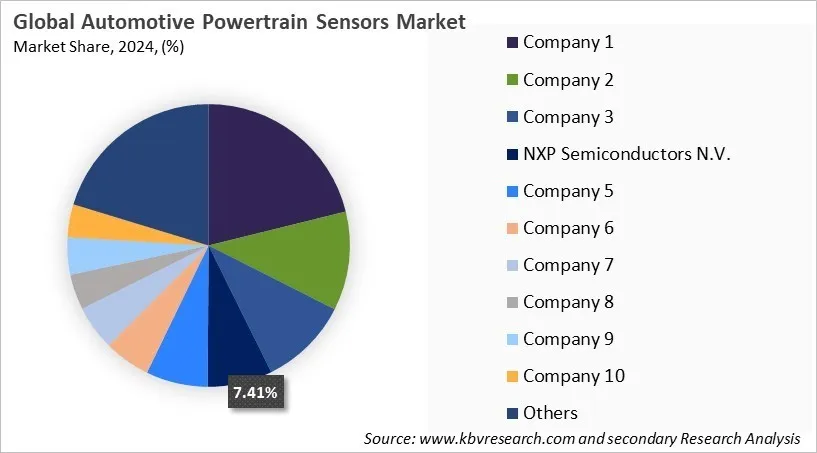
The leading players in the market are competing with diverse innovative offerings to remain competitive in the market. The above illustration shows the percentage of revenue shared by some of the leading companies in the market. The leading players of the market are adopting various strategies in order to cater demand coming from the different industries. The key developmental strategies in the market are Acquisitions, and Partnerships & Collaborations.
The market for automotive powertrain sensors was severely impacted by the COVID-19 pandemic, mostly as a result of manufacturing closures, global supply chain disruptions, and shortages of vital electronic components. Delays in procurement caused sensor manufacturers to cut back on deliveries to automakers, and a decline in vehicle production and a decline in consumer demand further restrained market expansion. Sales of passenger cars fell precipitously in several important areas, which in turn caused sensor orders to decline. Furthermore, economic uncertainty slowed innovation in the industry by forcing automakers to reduce expenses, postpone R&D projects, and postpone investments in cutting-edge technologies. Prolonged restrictions and uneven regional recovery further postponed stabilization, resulting in long-lasting negative effects on the market that extend beyond the initial outbreak. Thus, the COVID-19 pandemic had negative impact on the market.
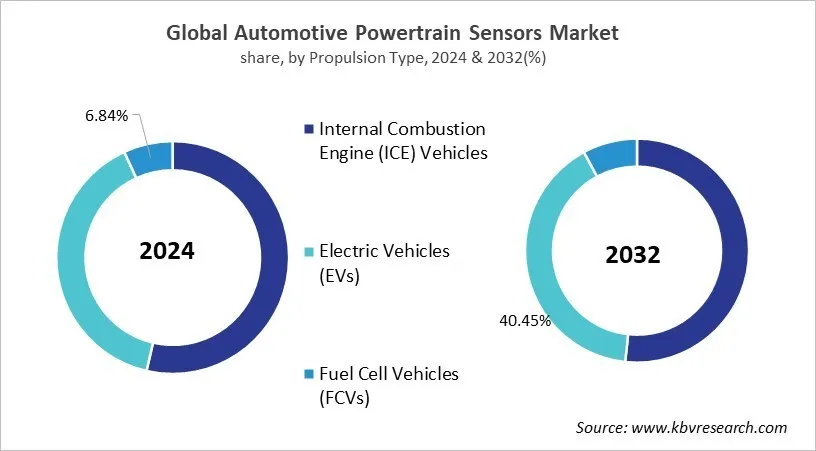
Based on Propulsion Type, the market is segmented into Internal Combustion Engine (ICE) Vehicles, Electric Vehicles (EVs), and Fuel Cell Vehicles (FCVs). The electric vehicles (EVs) segment attained 40% revenue share in the automotive powertrain sensors market in 2024. Powertrain sensors are crucial here, as they help regulate battery systems, motor functions, energy usage, and temperature management. They provide the accuracy needed to optimize driving range, charging, and overall performance while also ensuring safety during vehicle operation.
Based on Vehicle Type, the market is segmented into Passenger Cars, Light Commercial Vehicles (LCVs), Heavy Commercial Vehicles (HCVs), and Two-Wheelers. The light commercial vehicles (LCVs) segment recorded 20% revenue share in the automotive powertrain sensors market in 2024. This is supported by their extensive use in logistics, goods transportation, and small-scale commercial activities. In this segment, powertrain sensors are essential for monitoring and enhancing engine efficiency, fuel management, and load-handling performance, ensuring that these vehicles remain reliable under frequent and demanding operating conditions.
Free Valuable Insights: Global Automotive Powertrain Sensors Market size to reach USD 38.75 Billion by 2032
Region-wise, the automotive powertrain sensors market is analyzed across North America, Europe, Asia Pacific, and LAMEA. The Asia Pacific segment gained 48% revenue share in the automotive powertrain sensors market in 2024. Factors Such as, strict emission rules, fuel efficiency requirements, and the quick rise in popularity of electric vehicles (EVs) and hybrid powertrains are all driving the powertrain sensor market in North America. The U.S. market benefits from strong investments in automotive research and development, self-driving technologies, and onboard diagnostics (OBD) systems. Major OEMs and Tier-1 suppliers are adding advanced MEMS sensors, EV battery monitoring solutions, and real-time data processing systems to their products. The European Union's goals for carbon neutrality, Euro 6/7 emission standards, and aggressive electrification policies have a big impact on Europe. Germany, France, and the UK are leaders in sustainable automotive technologies because they are home to sensor innovation, EV battery management systems, hydrogen fuel cell sensors, and smart mobility platforms.
The Asia-Pacific region has the most demand in the world because it makes so many cars, especially in China, Japan, South Korea, and India. The need for battery sensors, torque monitoring, and thermal management sensors is growing because cities are growing quickly, the government is encouraging people to buy electric vehicles, smart mobility infrastructure is being built, and vehicles are becoming more connected. As per the UN-Habitat, Urbanization continues to be a defining megatrend in the Asia-Pacific region. 54% of the global urban population, more than 2.2 billion people, live in Asia. By 2050, the urban population in Asia is expected to grow by 50% - an additional 1.2 billion people. Also, China is ahead in EV sensor technologies, battery monitoring systems, and low-cost mass production. Japan and South Korea are working on improving hybrid powertrain sensors and ADAS integration. Meanwhile, LAMEA are starting to see growth opportunities, mostly because more people are buying cars, emissions regulations are slowly being adopted, and people are becoming more interested in hybrid and electric vehicles. LAMEA is expected to see more investments in aftermarket sensors, cost-effective solutions, and localization of automotive manufacturing, even though it is slower to adopt them than developed markets.
| Report Attribute | Details |
|---|---|
| Market size value in 2025 | USD 22.69 Billion |
| Market size forecast in 2032 | USD 38.75 Billion |
| Base Year | 2024 |
| Historical Period | 2021 to 2023 |
| Forecast Period | 2025 to 2032 |
| Revenue Growth Rate | CAGR of 7.9% from 2025 to 2032 |
| Number of Pages | 493 |
| Number of Tables | 381 |
| Report coverage | Market Trends, Revenue Estimation and Forecast, Segmentation Analysis, Regional and Country Breakdown, Market Share Analysis, Porter’s 5 Forces Analysis, Company Profiling, Companies Strategic Developments, SWOT Analysis, Winning Imperatives |
| Segments covered | Propulsion Type, Vehicle Type, Sensor Type, Region |
| Country scope |
|
| Companies Included | Robert Bosch GmbH, Continental AG, Denso Corporation, NXP Semiconductors N.V., Infineon Technologies AG, Texas Instruments, Inc., Valeo SA, Mitsubishi Electric Corporation, TE Connectivity Ltd., and Renesas Electronics Corporation |
By Propulsion Type
By Vehicle Type
By Sensor Type
By Geography
This Market size is expected to reach USD 41.02 Billion billion by 2032.
The automotive powertrain sensors market is projected to grow at a CAGR of 7.9% between 2025 and 2032.
Rising demand for fuel efficiency and emission control, accelerated by rapid electrification of vehicles and the growth of hybrid architectures.
Robert Bosch GmbH, Continental AG, Denso Corporation, NXP Semiconductors N.V., Infineon Technologies AG, Texas Instruments, Inc., Valeo SA, Mitsubishi Electric Corporation, TE Connectivity Ltd., and Renesas Electronics Corporation
The Passenger Cars segment led the maximum revenue in the Global Automotive Powertrain Sensors Market by Vehicle Type in 2024, thereby, achieving a market value of $22.8 billion by 2032.
The Asia Pacific region dominated the Global Automotive Powertrain Sensors Market by Region in 2024, and would continue to be a dominant market till 2032; thereby, achieving a market value of $18.9 billion by 2032.
Our team of dedicated experts can provide you with attractive expansion opportunities for your business.







 Unique Offerings