“Global Automatic Content Recognition Market to reach a market value of USD 19.32 Billion by 2032 growing at a CAGR of 23.1%”
The Global Automatic Content Recognition Market size is estimated at $4.51 billion in 2025 and is expected to reach $19.32 billion by 2032, rising at a market growth of 23.1% CAGR during the forecast period. The market is growing rapidly due to increasing adoption of smart TVs, OTT platforms, and interactive advertising. Rising demand for real-time content identification, enhanced user engagement, and targeted marketing, combined with advancements in AI and cloud-based technologies.
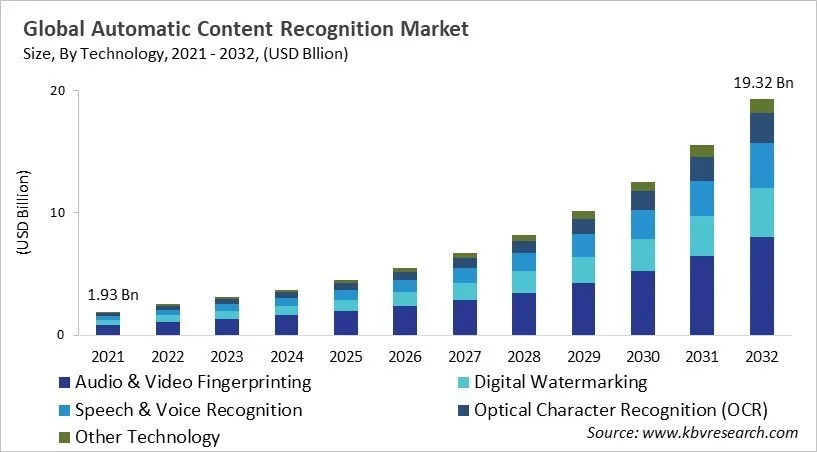
Automatic content recognition is a technology that allow connected devices like streaming boxes, smart TVs, and mobile devices to automatically identify video and audio content being played, capturing small media samples and matching them against large databases using watermarking, pattern recognition, and fingerprinting. Originating from early music recognition services such as Shazam, ACR has developed into a core capability embedded directly into connected entertainment ecosystems and smart TVs globally. With increasing streaming and OTT consumption, automatic content recognition has become crucial to how media is measured, delivered, and monetized, while also prompting large regulatory and public scrutiny over privacy.
Recent development in the automatic content recognition market is supported by the integration of machine learning and artificial intelligence, rising use in data-driven advertising, and cross-device deployment. AI-powered automatic content recognition enhances recognition accuracy, allows predictive viewer insights, and supports dynamic personalization across multiple platforms. Leading analytics providers and OEMs embed ACR at the system level with advertisers to convert recognition data into anonymized audience intelligence, transitioning automatic content recognition to comprehensive media analytics. Competition in the market largely hinges on recognition performance, privacy compliance, and scalability.
The COVID-19 pandemic made it much harder for the Automatic Content Recognition (ACR) market to grow. This is because economic uncertainty and widespread lockdowns messed up investment cycles in the media, entertainment, and advertising industries. Organizations put off upgrading their technology and implementing ACR to save money as their revenues fell. At the same time, problems with the supply chain and a lack of workers slowed down the production of hardware and the integration of software for smart TVs and other connected devices. Smaller and mid-sized businesses cut back on advertising budgets, which made fewer people want ACR solutions for audience measurement and targeted advertising. Also, the pandemic made it hard to trust historical data because people's viewing habits and platform use changed quickly. This made people less sure of ACR-driven insights. So, these factors together slowed down the market and made it harder for people to adopt new technologies in the early stages of the pandemic. Thus, the COVID-19 pandemic had a negative impact on the market.

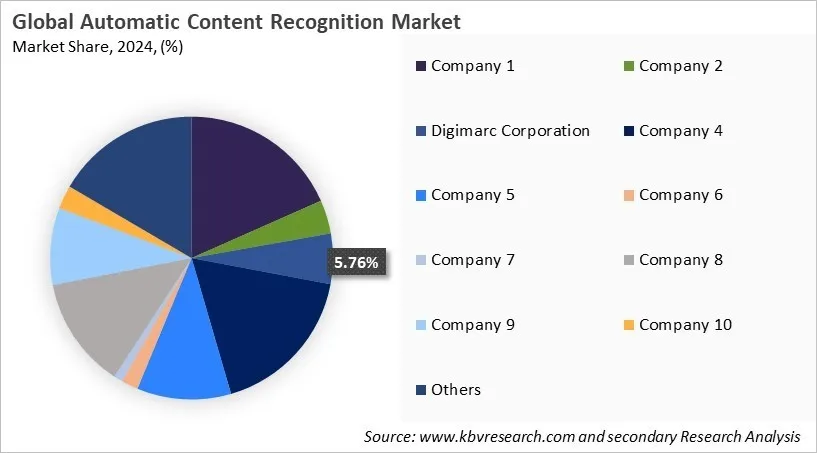
The leading players in the market are competing with diverse innovative offerings to remain competitive in the market. The above illustration shows the percentage of revenue shared by some of the leading companies in the market. The leading players of the market are adopting various strategies in order to cater demand coming from the different industries. The key developmental strategies in the market are Acquisitions, and Partnerships & Collaborations.
Based on Solution, the market is segmented into Security & Copyright Management, Real-time Content Analytics, Voice & Speech Interfaces, Data Management & Metadata and Other Solution. The Real-time Content Analytics segment attained 26.31% revenue share in the market in 2024. The Real-time Content Analytics solution segment addresses the growing need for instant insights derived from live and on-demand media streams. This segment enables broadcasters, advertisers, and media platforms to analyze content as it is consumed, capturing audience behavior, contextual relevance, and engagement signals.
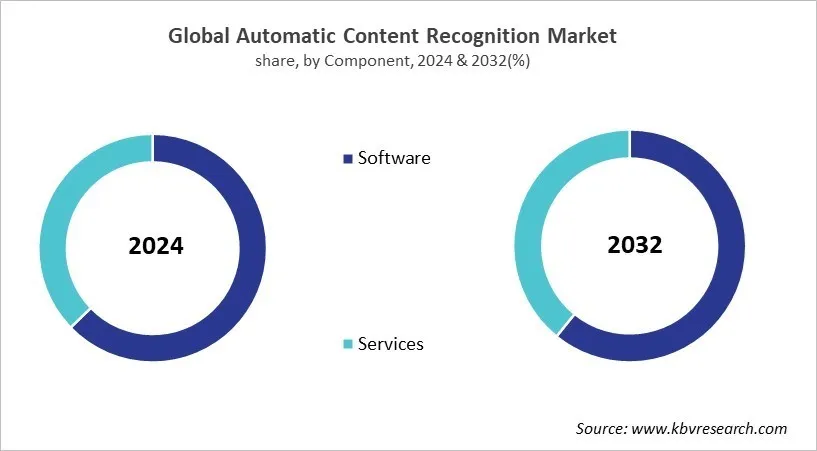
Based on Component, the market is segmented into Software and Services. The Services segment acquired 37.23% revenue share in the market in 2024. The Services component supports the implementation, optimization, and ongoing management of Automatic Content Recognition solutions across various end-user environments. This segment includes consulting, system integration, customization, maintenance, and technical support services that ensure seamless deployment and effective utilization of recognition technologies.
Free Valuable Insights: Automatic Content Recognition Market size to reach USD 19.32 Billion by 2032
Region-wise, the Automatic Content Recognition Market is analyzed across North America, Europe, Asia Pacific, and LAMEA. The North America segment recorded 38.90% revenue share in the market in 2024. The automatic content recognition market is predicted to grow at a substantial rate in North America because of the large adoption of connected devices, heavy investment from tech giants and streaming services, and well-established digital infrastructure. The region further experience growth because of personalized content delivery, advanced audience measurement, and robust advertising ecosystems that usage for ACR for targeted campaigns and analytics. Regulatory frameworks and strategic collaborations between technology vendors and media companies further support growth. Moreover, Europe automatic content recognition market is expanding. This is because of widespread smart TV penetration and adoption of ACR solutions among OTT providers, advertisers, and broadcasters. Further, growth is supported by strong compliance with data protection regulations, which have encouraged privacy-focused ACR deployments.
In the Asia Pacific region, the automatic content recognition market is projected to capture a prominent market share. The market is propelled by massive smartphone penetration, rapid digitalization, and expanding consumption of OTT in India, China, Southeast Asia, and Japan. Regional streaming giants and mobile-first consumer behavior drive significant demand for personalization, real-time content recognition, and analytics. Rising use cases beyond entertainment like retail, gaming, and smart home ecosystem also raise adoption. Furthermore, the LAMEA automatic content recognition market is expected to grow at a steady pace as smart device deployment surges and digital connectivity rises. Latin American nations are largely integrating ACR into OTT workflows and broadcasting to enhance engagement insights. Growth in these regions is further backed by increasing demand for regional content experiences, expanding internet access and ongoing adoption of streaming services.
| Report Attribute | Details |
|---|---|
| Market size value in 2025 | USD 4.51 Billion |
| Market size forecast in 2032 | USD 19.32 Billion |
| Base Year | 2024 |
| Historical Period | 2021 to 2023 |
| Forecast Period | 2025 to 2032 |
| Revenue Growth Rate | CAGR of 23.1% from 2025 to 2032 |
| Number of Pages | 638 |
| Number of Tables | 515 |
| Report coverage | Market Trends, Revenue Estimation and Forecast, Segmentation Analysis, Regional and Country Breakdown, Market Share Analysis, Porter’s 5 Forces Analysis, Company Profiling, Companies Strategic Developments, SWOT Analysis, Winning Imperatives |
| Segments covered | Solution, Component, Technology, End-User Industry, Region |
| Country scope |
|
| Companies Included | Apple, Inc., Clarifai, Inc., Digimarc Corporation, Google LLC (Alphabet Inc.), IBM Corporation, KT Corporation, Kudelski Group, Microsoft Corporation, Samsung Electronics Co., Ltd. (Samsung Health), and Harmonic Inc. |
By Solution
By Component
By Technology
By End-User Industry
By Geography
The market size is projected to reach USD 19.32 Billion by 2032.
The automatic content recognition market is projected to grow at a CAGR of 19.32% between 2025 and 2032.
Proliferation of OEM-integrated smart devices, combined with demand for data-driven personalization and audience measurement, is driving market growth.
Apple, Inc., Clarifai, Inc., Digimarc Corporation, Google LLC (Alphabet Inc.), IBM Corporation, KT Corporation, Kudelski Group, Microsoft Corporation, Samsung Electronics Co., Ltd. (Samsung Health), and Harmonic Inc.
The Security & Copyright Management segment captured the maximum revenue in the Global Automatic Content Recognition Market by Solution in 2024, thereby, achieving a market value of $5.2 billion by 2032.
The North America region dominated the Global Automatic Content Recognition Market by Region in 2024, and would continue to be a dominant market till 2032; thereby, achieving a market value of $7.2 billion by 2032.
Our team of dedicated experts can provide you with attractive expansion opportunities for your business.







 Unique Offerings