“Global Audio Codec Market to reach a market value of USD 10.42 Billion by 2032 growing at a CAGR of 6.2%”
The Global Audio Codec Market size is expected to reach USD 10.42 billion by 2032, rising at a market growth of 6.2% CAGR during the forecast period.
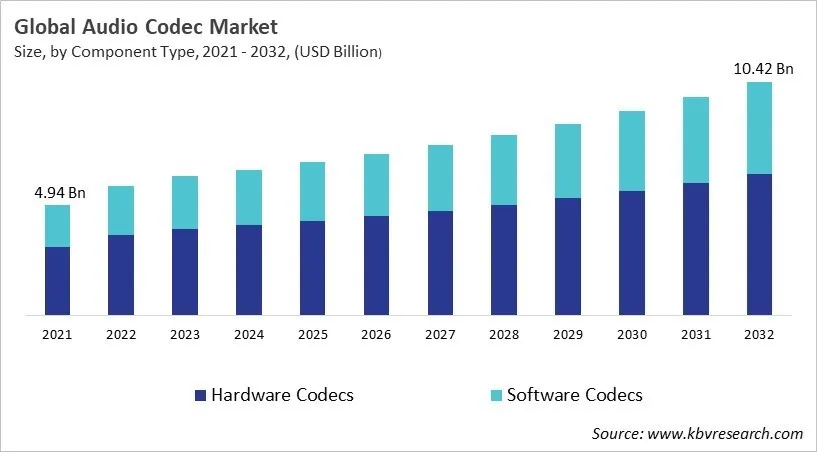
The global audio codec market has undergone significant change. From its telephony-based origins to advanced, AI-enhanced technologies. Digital voice transmission was made possible by early codecs like ITU-T G.711. Still, more sophisticated options like AMR and AMR-WB were introduced in the 1990s, improving mobile voice quality over GSM and UMTS networks. Opus, a flexible, royalty-free codec ideal for VoIP, streaming, and conferencing, was created in 2012 in response to the growth of internet communication. With Enhanced Voice Services (EVS), which improves voice clarity over 4G and 5G networks and supports full-band audio up to 20 kHz, this trend continued. Neural network-based codecs, such as SoundStream and TF-Codec, are at the forefront of innovation today because they use deep learning to provide high-fidelity audio at lower bitrates.
The main market trends are the increasing use of wideband/full-band codecs in consumer electronics and telecommunications; the growing trend toward open, royalty-free codecs like Opus due to their affordability and flexibility; and the introduction of AI-driven neural codecs, which promise improved quality and compression. Through standardization, hardware integration, and research and development into neural audio technologies, major players like Qualcomm, Ericsson, and Fraunhofer are propelling innovation. Legacy systems, open-source projects, and new AI solutions are competing more fiercely as businesses try to satisfy consumer demands for HD audio and economic data use across an expanding range of gadgets and apps.
The COVID-19 pandemic had a big effect on the global audio codec market, changing both supply and demand in both hardware and software. Because of lockdowns, remote work, online education, telehealth, and digital entertainment became very popular. This made the need for clear and reliable audio solutions in video conferencing, streaming, and voice-over-IP applications grow even more. Because of this need, more people started using advanced codecs like Opus, AMR-WB, AMR-WB+, and Enhanced Voice Services (EVS) on communication platforms, smartphones, and audio peripherals. In conclusion, COVID-19 pandemic had a negative impact on the market.

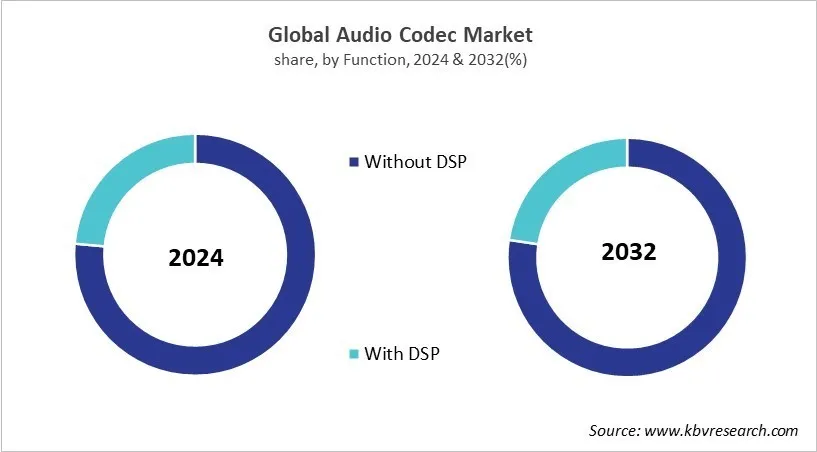
Based on Function, the market is segmented into Without DSP and With DSP. This segment benefits from growing demand for advanced audio features, such as noise suppression, voice enhancement, and real-time audio signal processing. Devices like smartphones, smart speakers, and automotive infotainment systems increasingly require integrated DSP capabilities, supporting the notable presence of this segment within the market.
Based on Component Type, the market is segmented into Hardware Codecs and Software Codecs. The software codecs segment garnered a remarkable revenue share in the market in 2024. Growing demand for flexible, upgradable, and cost-effective audio solutions in mobile applications, streaming platforms, and cloud-based services has driven the adoption of software-based codecs, especially where hardware constraints are minimal.
Free Valuable Insights: Global Audio Codec Market size to reach USD 10.42 Billion by 2032
Region-wise the market is segmented into North America, Europe, Asia-Pacific, and LAMEA. The North America region witnessed the maximum revenue share in the market in 2024. The demand for high-quality, low-power audio across regions is fuelling the rapid expansion of the global audio codec market. FCC rules are speeding up the adoption of Bluetooth LE Audio and LC3 in North America, particularly in smartphones and devices that work with hearing aids. With chipsets that support LE Audio, companies like Qualcomm are in the lead, and public spaces are testing AuracastTM. European nations like Germany, France, and the UK are concentrating on energy-efficient, inclusive audio solutions. With the help of ETSI standards and hearing-aid accessibility initiatives, LE Audio and HE-AAC v2 are being used in consumer electronics and public broadcasting.
Asia Pacific's top codec innovation markets include China, Japan, South Korea, and India. Due to robust OEM activity from companies like Sony, Samsung, and Xiaomi, with the help of digital infrastructure programs, LE Audio and high-resolution codecs like LDAC and aptX Lossless are frequently used. Through improvements in public broadcasting and smart city projects, adoption is increasing throughout LAMEA, which includes Brazil, the United Arab Emirates, and South Africa. Reach expansion is being aided by OTA updates and reasonably priced LE Audio-enabled devices, particularly in remote and cost-sensitive areas.
| Report Attribute | Details |
|---|---|
| Market size value in 2024 | USD 6.50 Billion |
| Market size forecast in 2032 | USD 10.42 Billion |
| Base Year | 2024 |
| Historical Period | 2021 to 2023 |
| Forecast Period | 2025 to 2032 |
| Revenue Growth Rate | CAGR of 6.2% from 2025 to 2032 |
| Number of Pages | 425 |
| Number of Tables | 382 |
| Report coverage | Market Trends, Revenue Estimation and Forecast, Segmentation Analysis, Regional and Country Breakdown, Competitive Landscape, Porter’s 5 Forces Analysis, Company Profiling, Companies Strategic Developments, SWOT Analysis, Winning Imperatives |
| Segments covered | Function, Component Type, Application, Region |
| Country scope |
|
| Companies Included | Analog Devices, Inc., Barix AG, Cirrus Logic, Inc., Qualcomm Incorporated (Qualcomm Technologies, Inc.), Rohm Co., Ltd., Sony Corporation, STMicroelectronics N.V., Synopsys, Inc., Texas Instruments, Inc., and Dolby Laboratories Inc. |
By Function
By Component Type
By Application
By Geography
This Market size is expected to reach $10.42 Billion by 2032.
Growth in Demand for High-Quality Audio in Communication and Media Devices are driving the Market in coming years, however, Dependency on Semiconductor Supply Chains restraints the growth of the Market.
Analog Devices, Inc., Barix AG, Cirrus Logic, Inc., Qualcomm Incorporated (Qualcomm Technologies, Inc.), Rohm Co., Ltd., Sony Corporation, STMicroelectronics N.V., Synopsys, Inc., Texas Instruments, Inc., and Dolby Laboratories Inc.
The expected CAGR of this Market is 6.2% from 2023 to 2032.
The Hardware Codecs segment dominated the Market by Component Type in 2024, thereby, achieving a market value of USD 6.31 billion by 2032.
The North America region dominated the Market by Region in 2024, achieving a market value of USD 3.51 billion by 2032.
Our team of dedicated experts can provide you with attractive expansion opportunities for your business.







 Unique Offerings