The Asia Pacific Web Application Firewall Market would witness market growth of 15.5% CAGR during the forecast period (2025-2032).
The China market dominated the Asia Pacific Web Application Firewall Market by Country in 2024, and would continue to be a dominant market till 2032; thereby, achieving a market value of $2,211.7 million by 2032. The Japan market is registering a CAGR of 14.6% during (2025 - 2032). Additionally, The India market would showcase a CAGR of 16.3% during (2025 - 2032). The China and Japan led the Asia Pacific Web Application Firewall Market by Country with a market share of 29.9% and 16.2% in 2024. The Malaysia market is expected to witness a CAGR of 18.2% during throughout the forecast period.
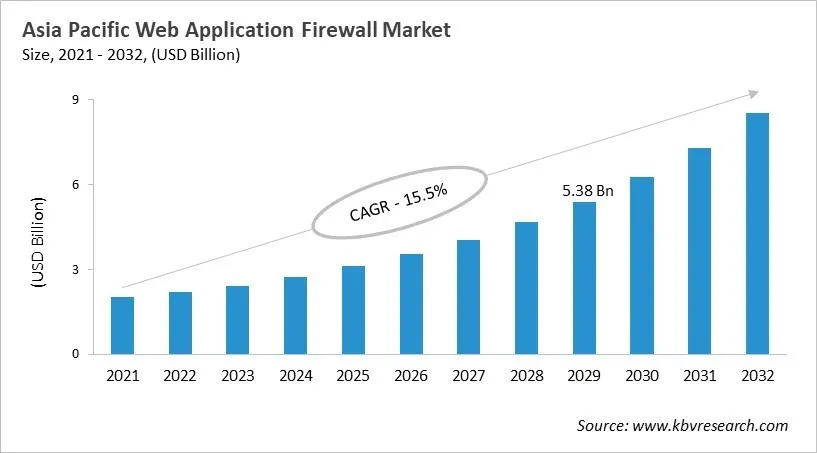
The Asia Pacific web application firewall market has changed along with the region's quick shift to digital technology, greater reliance on web-based services, and greater awareness of cybersecurity. More and more, governments and businesses see web apps as critical infrastructure and a main attack surface. This has led to early WAF adoption by banks, telecom companies, and public sector platforms. Over time, the market changed from on-premises deployments to cloud-native and hybrid WAF models. This was made possible by national cybersecurity frameworks that encouraged the use of secure cloud services. WAFs are now an important part of keeping cloud, mobile, and cross-border digital services safe in the region's growing digital economy.
Cloud-delivered and managed WAF services, better protection for APIs and mobile apps, and stricter rules and data protection requirements are all changing the way the market works right now. Vendors focus on platforms that are scalable, use intelligence to automate threat detection, and meet compliance needs. Cloud-based subscription models, regional partnerships, and localization to meet different regulatory environments are all important strategic priorities. Competition is based on new ideas, and success depends on being able to deploy solutions in a flexible way, follow the rules, and provide smart, easy-to-manage security solutions for complex application ecosystems.
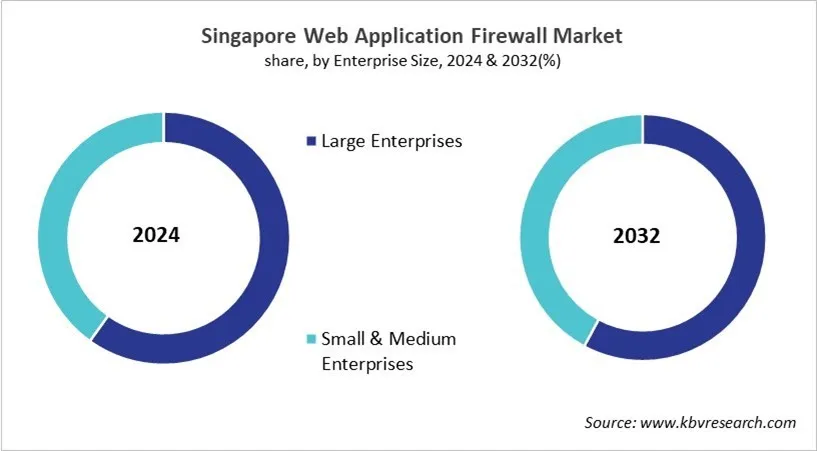
Based on Enterprise Size, the market is segmented into Large Enterprises and Small & Medium Enterprises. With a compound annual growth rate (CAGR) of 16.6% over the projection period, the Large Enterprises Market, dominate the Singapore Web Application Firewall Market by Enterprise Size in 2024 and would be a prominent market until 2032. The Small & Medium Enterprises market is expected to witness a CAGR of 17.8% during (2025 - 2032).
Based on Deployment Mode, the market is segmented into Cloud-based, Hybrid and On-premises. The Cloud-based market segment dominated the China Web Application Firewall Market by Deployment Mode is expected to grow at a CAGR of 12.9 % during the forecast period thereby continuing its dominance until 2032. Also, The On-premises market is anticipated to grow as a CAGR of 14.1 % during the forecast period during (2025 - 2032).
Free Valuable Insights: The Web Application Firewall Market is Predicted to reach USD 28.28 Billion by 2032, at a CAGR of 14.7%
China's Web Application Firewall (WAF) market is growing quickly because of the country's rapid digitalization, widespread use of the internet, and strict cybersecurity laws that make application security a national priority. WAF solutions are very important for keeping e-commerce sites, cloud services, and government portals safe from threats at the application layer. They also help businesses follow China's Cybersecurity Law and other rules. Government-led cybersecurity oversight and coordinated incident response systems make it more likely that people will use preventive security measures like WAFs. Market trends show that more and more people are moving toward cloud-native and hybrid deployments to protect large-scale microservices and API-based architectures. Strong domestic vendors that meet policy requirements and global providers that offer advanced threat intelligence and automation are part of the competitive landscape. Regulatory enforcement, changing threats, and modern IT architectures all work together to keep demand for WAF solutions strong in Chinese industries.

By Enterprise Size
By Deployment Mode
By Component
By End-User Industry
By Country
Our team of dedicated experts can provide you with attractive expansion opportunities for your business.



 Unique Offerings