The Asia Pacific Warehouse Management Systems Market would witness market growth of 19.9% CAGR during the forecast period (2025-2032).
The China market dominated the Asia Pacific Warehouse Management Systems Market by Country in 2024, and would continue to be a dominant market till 2032; thereby, achieving a market value of $955.6 million by 2032. The Japan market is showcasing a CAGR of 19% during (2025 - 2032). Additionally, The India market would register a CAGR of 20.8% during (2025 - 2032). The China and Japan led the Asia Pacific Warehouse Management Systems Market by Country with a market share of 33.9% and 15.9% in 2024.The Singapore market is expected to witness a CAGR of 21.9% during throughout the forecast period.
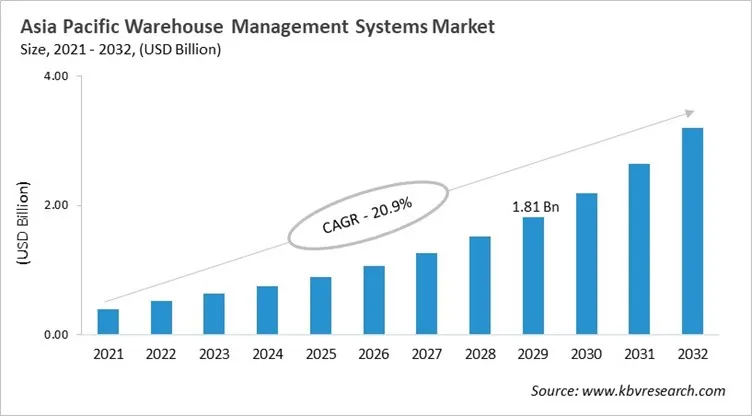
The Asia-Pacific WMS market has quickly changed from basic warehouse software to advanced platforms that are cloud-based and driven by automation. This is because e-commerce, manufacturing, and large-scale logistics have all grown quickly. Adoption has come in stages, starting with early on-premise systems and moving on to modern AI, robotics, IoT, and omnichannel fulfillment capabilities. Some of the most important trends are strong growth in SaaS/cloud deployment, more automation and robotics integration, and a growing need for real-time visibility across multi-channel distribution networks. WMS has gone from being an optional technology to a mission-critical part of the infrastructure as warehouses become strategic fulfillment hubs.
There is a lot of competition in the region, with global enterprise vendors competing with fast-growing regional and niche players. Vendors set themselves apart by being ready for automation, being able to grow, having mature cloud services, being able to integrate robotics, and being able to optimize fulfillment. Localization, partnerships with other businesses, service quality, and the ability to adapt to different regulatory and operational environments are all very important for competitive positioning. As the market grows, the best vendors are those that offer integrated supply-chain platforms, strong local execution, and capabilities that are ready for the future and fit with the fast changes in logistics in the Asia-Pacific region.
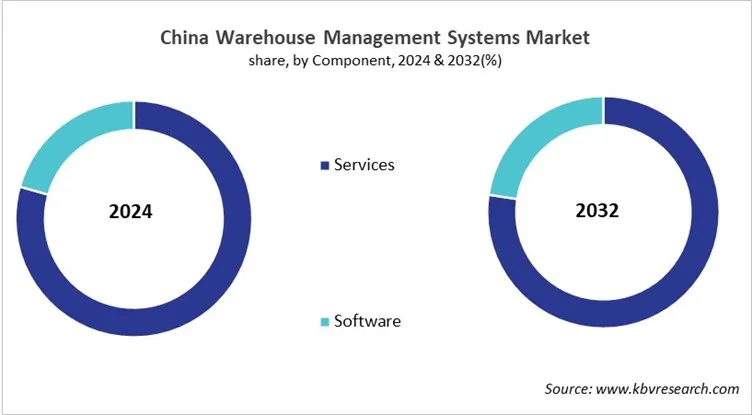
Based on Component, the market is segmented into Services, and Software. Based on Application, the market is segmented into Manufacturing, Transportation & Logistics, Healthcare, Retail, Food & Beverage, and Other Application. With a compound annual growth rate (CAGR) of 17.7% over the projection period, the Services Market, dominate the China Warehouse Management Systems Market by Component in 2024 and would be a prominent market until 2032. The Software market is expected to witness a CAGR of 19.4% during (2025 - 2032).
Based on Function, the market is segmented into Analytics & Optimization, Systems Integration & Maintenance, Labor Management System, Consulting Services, and Billing & Yard Management. Among various Japan Warehouse Management Systems Market by Function; The Analytics & Optimization market achieved a market size of USD $28 Million in 2024 and is expected to grow at a CAGR of 17.7 % during the forecast period. The Consulting Services market is predicted to experience a CAGR of 19.7% throughout the forecast period from (2025 - 2032).
Free Valuable Insights: The Warehouse Management System Market is Predicted to reach USD 10.70 Billion by 2032, at a CAGR of 19.3%
The market for Warehouse Management Systems in China is growing quickly because of the rise of e-commerce, large-scale manufacturing, and a strong logistics infrastructure. Companies are switching to advanced, cloud-based, and AI-enabled systems because they need things done faster, see what's going on in real time, and automate more. The market is moving beyond just using e-commerce for basic tasks and into more complex areas like manufacturing, cold chain, pharmaceuticals, and 3PL operations. More smart warehouses are being built with robots, IoT connectivity, and digital twins. There is a lot of competition because both local and global vendors offer platforms that can be scaled, customized, and set up for automation. Partnerships between software, logistics, and robotics ecosystems are speeding up both innovation and deployment even more.

By Deployment
By Function
By Component
By Application
By Country
Our team of dedicated experts can provide you with attractive expansion opportunities for your business.



 Unique Offerings