The Asia Pacific Virtualized Evolved Packet Core (vEPC) Market would witness market growth of 26.2% CAGR during the forecast period (2025-2032).
The China market dominated the Asia Pacific Virtualized Evolved Packet Core (vEPC) Market by Country in 2024, and would continue to be a dominant market till 2032; thereby, achieving a market value of $5,223.9 million by 2032. The Japan market is registering a CAGR of 25.2% during (2025 - 2032). Additionally, The India market would showcase a CAGR of 27.1% during (2025 - 2032). The China and Japan led the Asia Pacific Virtualized Evolved Packet Core (vEPC) Market by Country with a market share of 34.4% and 15.4% in 2024. The Malaysia market is expected to witness a CAGR of 29.5% during throughout the forecast period.
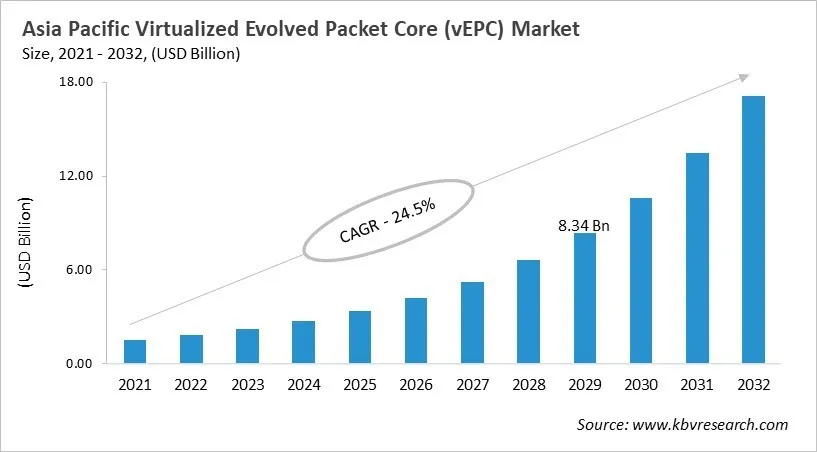
The Asia Pacific vEPC market has grown quickly because of the widespread use of 4G, LTE-Advanced, and 5G networks. This growth has been helped by strong government-led policies to modernize digital infrastructure and networks. Operators had to move from hardware-based EPC to virtualized, software-driven core networks using NFV and cloud technologies because of early LTE deployments and rising mobile data traffic. Major telecom companies in China, Japan, South Korea, India, and Australia used vEPC to make their networks more flexible, scalable, and cost-effective. Partnerships with OEMs sped up the move to cloud-native technology. As time went on, vEPC became a key part of distributed architectures, edge computing, and enterprise connectivity. It fit in well with Industry 4.0, smart-city, and IoT projects all over the region.
Some important trends in the market are the move toward containerized, cloud-native packet cores, the fast growth of private LTE and private 5G networks, and the use of low-latency, edge-enabled core architectures. To support a wide range of consumer and industrial use cases, operators and vendors are focusing on automation, microservices, and orchestration based on Kubernetes. Global and regional OEMs and big telecom companies are still competing hard by offering solutions that are focused on performance, scalability, and business. Overall, the Asia Pacific is one of the most advanced and cutting-edge markets for virtualized mobile core networks. vEPC is the basis for the growth of 5G and other digital ecosystems in the future.
Based on End User, the market is segmented into Telecom Operators, Enterprises & Industrial Applications, MVNE / MVNOs, Government & Public Safety, and Cloud Service Providers. The Telecom Operators market segment dominated the China Virtualized Evolved Packet Core (vEPC) Market by End User is expected to grow at a CAGR of 23.3 % during the forecast period thereby continuing its dominance until 2032. Also, The Cloud Service Providers market is anticipated to grow as a CAGR of 28.3 % during the forecast period during (2025 - 2032).
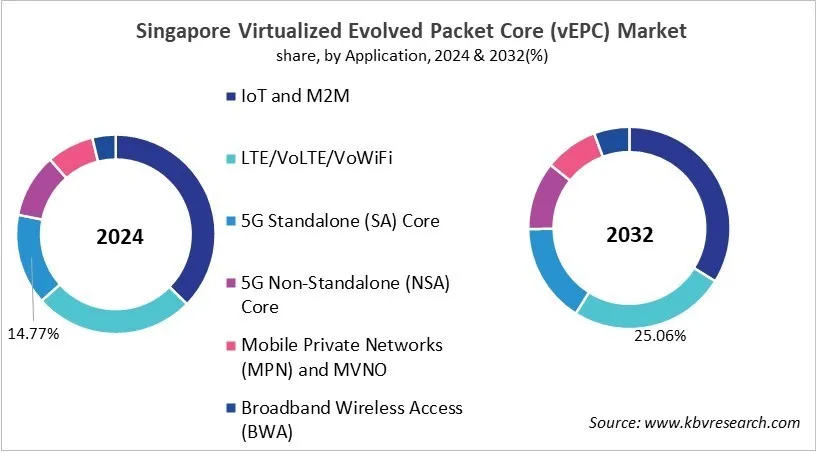
Based on Application, the market is segmented into IoT and M2M, LTE/VoLTE/VoWiFi, 5G Standalone (SA) Core, 5G Non-Standalone (NSA) Core, Mobile Private Networks (MPN) and MVNO, and Broadband Wireless Access (BWA). Among various Singapore Virtualized Evolved Packet Core (vEPC) Market by Application; The LTE/VoLTE/VoWiFi market achieved a market size of USD $36.5 Million in 2024 and is expected to grow at a CAGR of 27.8 % during the forecast period. The Mobile Private Networks (MPN) and MVNO market is predicted to experience a CAGR of 30.3% throughout the forecast period from (2025 - 2032).
Free Valuable Insights: The Virtualized Evolved Packet Core (vEPC) Market is Predicted to reach USD 45.29 Billion by 2032, at a CAGR of 25.7%
China's virtualized evolved packet core (vEPC) market is one of the most advanced and fastest growing in the Asia Pacific region. This is because of the country's rapid digitalization, large-scale 4G and 5G deployments, and the fact that it has the world's largest mobile subscriber base. To handle heavy data traffic, the rollout of 5G standalone networks, and new consumer and industrial use cases, operators put cloud-ready and highly scalable core architectures at the top of their lists. Key factors that are driving adoption are strong government support from MIIT, rising demand from businesses for private networks, and a rapidly growing IoT ecosystem. Some big changes are the move from VNFs to cloud-native CNFs, the growth of mobile edge computing, network automation powered by AI, and faster network slicing for vertical industries. The market is mostly led by domestic vendors who offer end-to-end solutions that meet national standards and are supported by major cloud platforms. This will keep the market growing as China moves forward with industrial digitalization and 5G SA adoption.

By End User
By Deployment Mode
By Application
By Country
Our team of dedicated experts can provide you with attractive expansion opportunities for your business.



 Unique Offerings