The Asia Pacific User Provisioning Market is expected to reach $7.94 billion by 2032 and would witness market growth of 15.6% CAGR during the forecast period (2025-2032).
The China market dominated the Asia Pacific User Provisioning Market by Country in 2024, and would continue to be a dominant market till 2032; thereby, achieving a market value of $1,983.3 million by 2032. The Japan market is registering a CAGR of 14.8% during (2025 - 2032). Additionally, The India market would showcase a CAGR of 16.4% during (2025 - 2032). The China and Japan led the Asia Pacific User Provisioning Market by Country with a market share of 28.9% and 18.2% in 2024. The Singapore market is expected to witness a CAGR of 17.3% during throughout the forecast period.
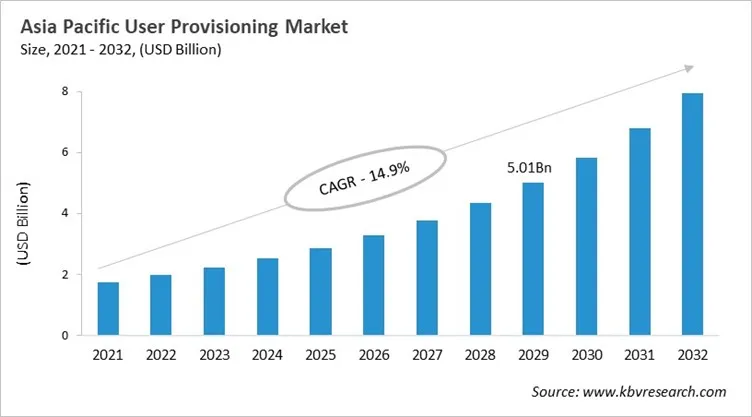
The Asia Pacific user provisioning market has changed as digital transformation, cloud adoption, and government-led digital identity programs have all happened quickly. As companies grew across platforms and borders, early manual and decentralized provisioning models stopped working well. The use of centralized directories and later cloud-based identity platforms made it possible to automate identity lifecycle management based on standards. Countries like Singapore, Australia, and Japan have government cybersecurity and digital identity frameworks that made secure provisioning practices even stronger. Automation that was connected to trusted sources like HR systems made things more consistent and secure. Provisioning systems now work with a wide range of users in both cloud and hybrid environments. The market shows that it is in line with regional goals for cybersecurity and data protection.
Trends right now focus on strong government control, cloud and hybrid IT integration, and security models that focus on identity. Provisioning tools are becoming more compatible with each other, follow national standards, and follow the Zero Trust principles. Vendors are focusing on automating identity workflows, using open standards, and designing with security in mind. Integration depth, scalability, and compliance with regulations, not basic functionality, drive competition. Leading platforms include provisioning as part of larger IAM and cloud security systems. In the Asia Pacific user provisioning market, trust, compliance, and long-term scalability are the most important factors for success.
Based on Vertical, the market is segmented into Banking, Financial Services, and Insurance (BFSI), Telecom & IT, Healthcare, Government, Manufacturing, Retail and Other Verticals. The Banking, Financial Services, and Insurance (BFSI) market dominated the Japan User Provisioning Market by Vertical in 2024 and would continue to be a dominant market till 2032; thereby, achieving a market value of $241.6 million by 2032, growing at a CAGR of 12.3 % during the forecast period. The Government market is expected to witness a CAGR of 15.4% during (2025 - 2032).
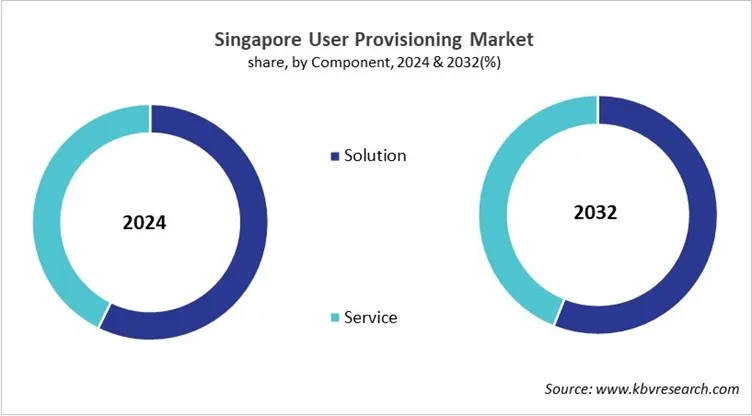
Based on Component, the market is segmented into Solution and Service. The Solution market segment dominated the Singapore User Provisioning Market by Component is expected to grow at a CAGR of 17 % during the forecast period thereby continuing its dominance until 2032. Also, The Service market is anticipated to grow as a CAGR of 17.7 % during the forecast period during (2025 - 2032).
Free Valuable Insights: The User Provisioning Market is Predicted to reach USD 30.95 Billion by 2032, at a CAGR of 15.0%
China has one of the biggest and most complicated user provisioning markets in Asia Pacific. This is because of the digitization of big businesses, the use of cloud computing, and the growth of the country's digital infrastructure. Companies in technology, manufacturing, finance, and government all must deal with large numbers of users in both hybrid and cloud environments. User provisioning is not a separate function; instead, it is tightly linked to enterprise security and cloud management frameworks. The need for scalable and automated identity management is growing because of quick cloud migration and centralized IT control. Cloud-native provisioning, access governance, and security analytics are all important trends in the market. To keep up with growth and stay compliant, it's important to automate onboarding, role changes, and revoking access. Domestic cloud providers that focus on ecosystem integration, scalability, and alignment with national digital priorities are the most competitive.

By Organization Size
By Deployment Model
By Component
By Vertical
By Country
Our team of dedicated experts can provide you with attractive expansion opportunities for your business.



 Unique Offerings