The Asia Pacific Unified Endpoint Management Market would witness market growth of 22.7% CAGR during the forecast period (2025-2032).
The China market dominated the Asia Pacific Unified Endpoint Management Market by Country in 2024, and would continue to be a dominant market till 2032; thereby, achieving a market value of $2,082.4 million by 2032. The Japan market is registering a CAGR of 22% during (2025 - 2032). Additionally, The India market would showcase a CAGR of 23.5% during (2025 - 2032).
The utility of UEM extends to the management of specialized devices, such as rugged handhelds used in logistics or field service, as well as emerging endpoints like IoT sensors and smart devices. The ability to unify management under a single console not only reduces operational overhead but also mitigates risks associated with disparate device landscapes. In this manner, UEM platforms facilitate both the expansion of digital initiatives and the safeguarding of sensitive assets. The adoption of UEM solutions is propelled by multiple compelling factors that resonate across organizations of different sizes and sectors.
The shift towards remote and hybrid work models, accelerated by events and changing workforce preferences, has highlighted the necessity for seamless device provisioning, monitoring, and support—irrespective of employee location. Similarly, the widespread embrace of Bring Your Own Device (BYOD) policies has introduced greater flexibility but also heightened security concerns, necessitating more nuanced and holistic management approaches that only UEM can provide.
Unified Endpoint Management (UEM) has emerged as a pivotal solution in the Asia Pacific (APAC) region, addressing the complexities of managing diverse endpoints such as desktops, laptops, smartphones, and tablets from a single platform. The evolution of UEM in APAC is closely tied to the region's rapid digital transformation, increased mobile device usage, and the growing need for robust cybersecurity measures. In the early stages, organizations in APAC relied on disparate tools for managing various devices, leading to inefficiencies and security vulnerabilities. The proliferation of mobile devices and the Bring Your Own Device (BYOD) trend further complicated endpoint management.
Recognizing these challenges, enterprises began adopting UEM solutions that offered centralized management, streamlined operations, and enhanced security protocols. Government initiatives across APAC have significantly influenced the adoption of UEM. For instance, India's Digital India campaign and similar digitization efforts in countries like Singapore and South Korea have propelled organizations to modernize their IT infrastructures, including endpoint management systems. These initiatives aim to enhance digital services, necessitating secure and efficient management of endpoints.
Original Equipment Manufacturers (OEMs) have also played a crucial role in the UEM landscape. Companies like Samsung and Huawei have integrated UEM capabilities into their devices, offering enterprises built-in management features that align with organizational policies and compliance requirements. The adoption of Zero Trust security frameworks is gaining traction in APAC, driven by the need to secure remote work environments and protect against sophisticated cyber threats. UEM solutions are evolving to support Zero Trust principles by continuously verifying user identities, assessing device compliance, and enforcing strict access controls. This approach minimizes the risk of unauthorized access and data breaches. There is a notable shift from traditional on-premises UEM deployments to cloud-based solutions.
Cloud-based UEM offers scalability, flexibility, and cost-effectiveness, making it attractive to organizations of all sizes. Leading players in the Asia Pacific UEM market are implementing strategic initiatives to strengthen their market positions and address the evolving needs of organizations: Companies are investing in research and development to introduce advanced features in their UEM offerings. This includes integrating AI-driven analytics, enhancing user interfaces, and expanding support for a broader range of devices and operating systems. By continuously improving their products, these leaders aim to deliver comprehensive solutions that meet the diverse requirements of enterprises. Hence, as digital transformation accelerates across the region, and regulatory and security demands intensify, the UEM market in Asia Pacific is set for sustained growth.
Free Valuable Insights: The Global Unified Endpoint Management Market is Predict to reach USD 30.73 Billion by 2032, at a CAGR of 22.0%
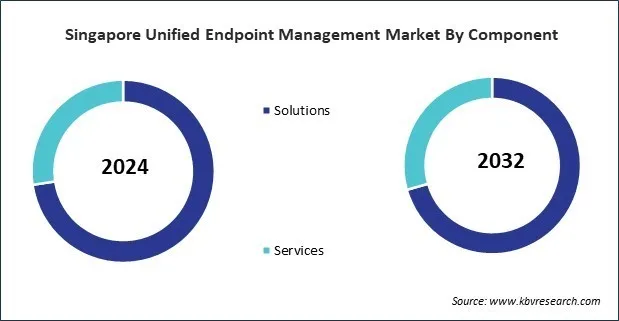
Based on Organization Size, the market is segmented into Large Enterprise, and Small & Medium Enterprise (SME). Based on Component, the market is segmented into Solutions, and Services (Professional Service, and Managed Services). Based on Vertical, the market is segmented into Telecom & IT, BFSI, Government/Defense, Healthcare, Manufacturing, Retail, Media & Entertainment, and Other Vertical. Based on countries, the market is segmented into China, Japan, India, South Korea, Singapore, Malaysia, and Rest of Asia Pacific.

By Organization Size
By Component
By Vertical
By Country
Our team of dedicated experts can provide you with attractive expansion opportunities for your business.



 Unique Offerings