The Asia Pacific Stemware Market would witness market growth of 5.8% CAGR during the forecast period (2025-2032).
The China market dominated the Asia Pacific Stemware Market by Country in 2024, and would continue to be a dominant market till 2032; thereby, achieving a market value of $770.6 million by 2032. The Japan market is registering a CAGR of 4.8% during (2025 - 2032). Additionally, The India market would showcase a CAGR of 6.5% during (2025 - 2032). The China and Japan led the Asia Pacific Stemware Market by Country with a market share of 36.5% and 14.2% in 2024.
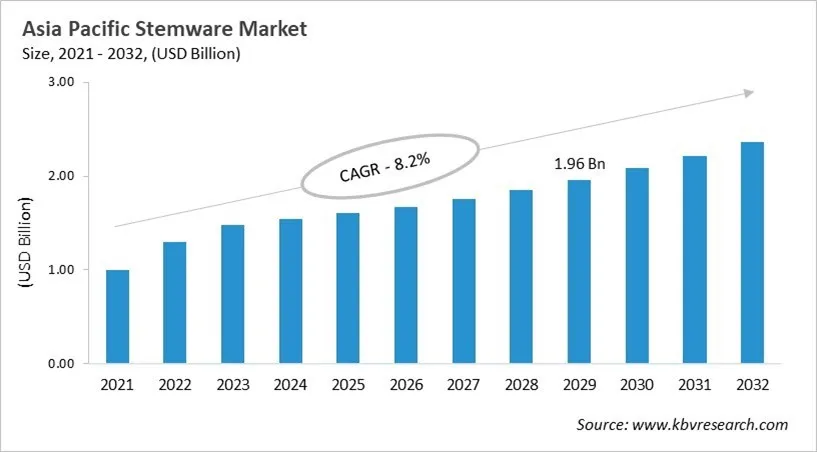
Over the past few decades, the Asia Pacific stemware market has grown a lot. This is because more people are moving to cities, incomes are rising, and people are becoming more familiar with global wine and spirits culture. In the past, traditional drinkware was the most common type in the region. But as countries like China, Japan, and South Korea became more industrialized and their economies grew, Western-style stemware became more popular. Global OEMs like RIEDEL, Libbey, and Arc took advantage of this trend by teaming up with high-end hotels, restaurants, and educational campaigns. At the same time, local manufacturers in China, Thailand, and other countries invested in precision glassmaking and lead-free crystal production, making both high-end and affordable stemware widely available in stores and online. The growth of online platforms made more people aware of designer and specialty glassware and made it easier for them to buy it.
Some of the most important trends in the market are the rise of premium drinkware, which is driven by lifestyle changes and the growing wine and mixology culture; the growing demand from the hospitality and tourism industries for durable, high-volume glassware; and the growing importance of sustainability and new materials. To stay competitive, the biggest companies in the market use strategies like customizing products for different regions, making them in those regions, distributing them through all channels, and making them in a way that is good for the environment. There is a lot of competition. Global OEMs focus on quality and performance, while new Asian brands use low prices and a wide reach to their advantage. Overall, the stemware market in Asia and the Pacific is a dynamic mix of cultural change, more sophisticated consumers, and new strategies from both global and regional players.
Based on Product, the market is segmented into Wine Glasses, Cocktail Glasses, Champagne Glasses, Martini Glasses, and Other Product. Among various Japan Stemware Market by Product; The Wine Glasses market achieved a market size of USD $111.6 Million in 2024 and is expected to grow at a CAGR of 4.3 % during the forecast period. The Martini Glasses market is predicted to experience a CAGR of 5.9% throughout the forecast period from (2025 - 2032).
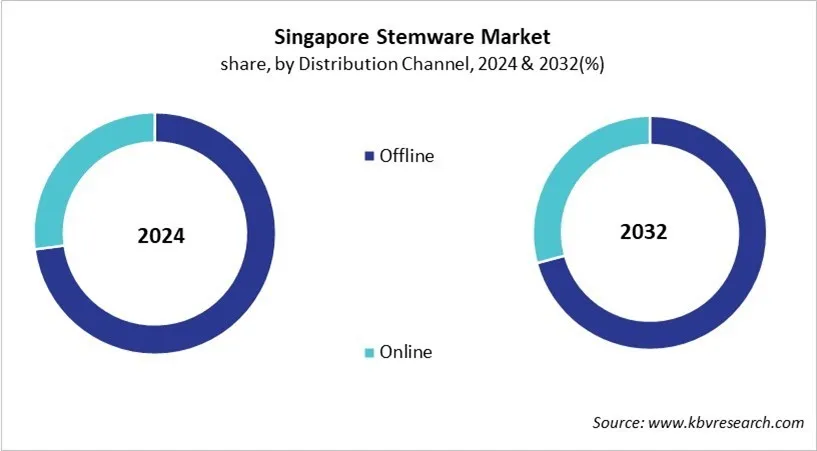
Based on Distribution Channel, the market is segmented into Offline, and Online. With a compound annual growth rate (CAGR) of 7.1% over the projection period, the Offline Market, dominate the Singapore Stemware Market by Distribution Channel in 2024 and would be a prominent market until 2032. The Online market is expected to witness a CAGR of 8.5% during (2025 - 2032).
Free Valuable Insights: The Stemware Market is Predicted to reach USD 6.34 Billion by 2032, at a CAGR of 5.3%
Over the past 20 years, China's stemware market has grown quickly. This is because of higher urban incomes, globalization, and the modernization of dining culture. Western-style glassware is slowly replacing traditional ceramic and metal drinkware. This is because more people are drinking imported wines and spirits, and the hospitality industry is growing in big cities like Shanghai, Beijing, and Guangzhou. Key factors driving the market are rapid urbanization, a growing middle- and high-income consumer base, and the rise of e-commerce platforms that make it easier to find international brands. Some of the biggest trends are the rise of high-end products, the mass premiumization of cost-effective crystalline glassware, and the rise of products that focus on sustainability. There is a lot of competition. International OEMs control high-end hotels, domestic manufacturers control mass retail and online channels, and boutique foreign brands enter through e-commerce. Price, looks, durability, and brand prestige are the main areas of competition.

By Product
By Application
By Distribution Channel
By Country
Our team of dedicated experts can provide you with attractive expansion opportunities for your business.








 Unique Offerings