The Asia Pacific Software Defined Data Center Market would witness market growth of 30.1% CAGR during the forecast period (2025-2032).
The China market dominated the Asia Pacific Software Defined Data Center Market by Country in 2024, and would continue to be a dominant market till 2032; thereby, achieving a market value of $36,795.4 million by 2032. The Japan market is showcasing a CAGR of 29.2% during (2025 - 2032). Additionally, The India market would register a CAGR of 31% during (2025 - 2032). The China and Japan led the Asia Pacific Software Defined Data Center Market by Country with a market share of 30.9% and 18.2% in 2024. The Singapore market is expected to witness a CAGR of 31.9% during throughout the forecast period.
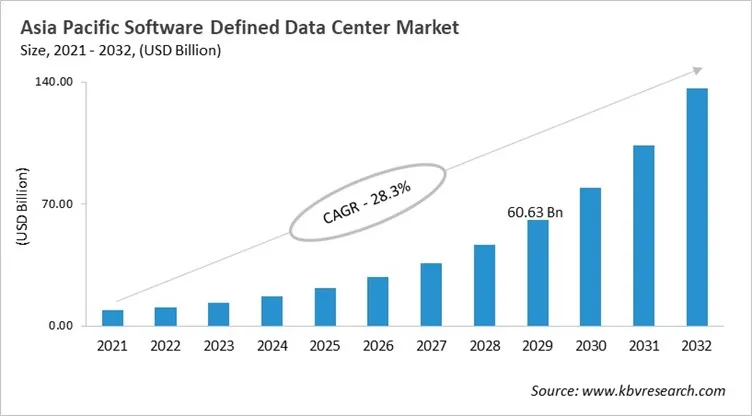
The Asia Pacific Software Defined Data Center market has grown quickly because of faster digital transformation, government cloud programs, and more data being generated in all sectors. In advanced markets like Japan, Singapore, South Korea, and Australia, early adopters started using virtualization and cloud modernization as part of national digital initiatives. As hybrid and multi-cloud ecosystems grew in developing countries like India, Indonesia, and Malaysia, SDDC became necessary for managing everything in one place and having infrastructure that could grow. Telecom, BFSI, healthcare, and e-commerce are some of the industries that pushed for adoption to handle large amounts of data, automate processes, and keep businesses running. The growth of AI, IoT, and 5G made the need for software-defined environments in core and edge infrastructure even stronger.
Some of the most important trends that are shaping the market are the rapid growth of hybrid and multi-cloud deployment, the use of AI-driven management and Infrastructure-as-Code to automate tasks, and the integration of SDDC with edge computing to support smart cities, Industry 4.0, and real-time data processing. Data localization rules in many countries also make it more important to have centralized, policy-driven governance in distributed environments. Vendors are concentrating on unified management platforms, automation capabilities, compliance preparedness, and ecosystem integration with hyperscale cloud providers. As businesses put more emphasis on flexibility, safety, and operational efficiency, SDDC is becoming a key part of the infrastructure for both established and developing economies in the region.
Based on End Use, the market is segmented into IT & Telecom, BFSI, Government & Defense, Healthcare, Manufacturing, Retail & eCommerce and Other End Use. Among various China Software Defined Data Center Market by End Use; The IT & Telecom market achieved a market size of USD $1425.9 Million in 2024 and is expected to grow at a CAGR of 25.7 % during the forecast period. The Retail & eCommerce market is predicted to experience a CAGR of 30.1% throughout the forecast period from (2025 - 2032).
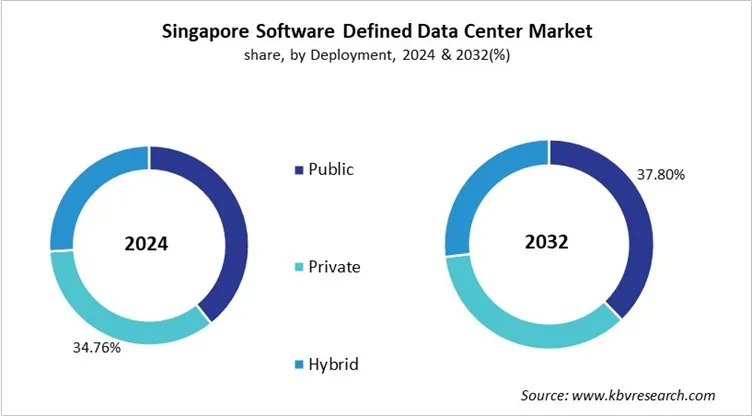
Based on Deployment, the market is segmented into Public, Private and Hybrid. Based on Type, the market is segmented into Software-Defined Networking (SDN), Software-Defined Storage (SDS), Software-Defined Compute (SDC) and Other Type. The Public market segment dominated the Singapore Software Defined Data Center Market by Deployment is expected to grow at a CAGR of 31.2 % during the forecast period thereby continuing its dominance until 2032. Also, The Hybrid market is anticipated to grow as a CAGR of 32.5 % during the forecast period during (2025 - 2032).
Free Valuable Insights: The Software Defined Data Center Market is Predicted to reach USD 534.75 Billion by 2032, at a CAGR of 29.3%
The Software Defined Data Center market in China is growing quickly because of the country's plans for digital transformation, the widespread use of cloud computing, and big investments in AI, 5G, and data-heavy apps. The move to software-defined infrastructure is speeding up because of government policies, the need for industries to modernize, and strict rules about where data can be stored. Combining SDDC with 5G-enabled edge computing to support smart cities, self-driving cars, and industrial automation is a big trend. Cloud-native adoption is also on the rise, thanks to Kubernetes and microservices, as well as strong automation and AI-driven operations. There are a lot of major domestic tech companies, global vendors, and telecom operators in the competitive landscape. They all offer solutions that stand out because of their automation features, security, and ability to work with national cloud ecosystems.

By Organization Size
By Component
By Deployment
By Type
By End Use
By Country
Our team of dedicated experts can provide you with attractive expansion opportunities for your business.



 Unique Offerings