The Asia Pacific Situation Awareness Systems Market would witness market growth of 7.5% CAGR during the forecast period (2025-2032).
The China market dominated the Asia Pacific Situation Awareness Systems Market by Country in 2024, and would continue to be a dominant market till 2032; thereby, achieving a market value of $3,807.9 million by 2032. The Japan market is registering a CAGR of 6.5% during (2025 - 2032). Additionally, The India market would showcase a CAGR of 8.1% during (2025 - 2032). The China and India led the Asia Pacific Situation Awareness Systems Market by Country with a market share of 29.4% and 18.6% in 2024.The Malaysia market is expected to witness a CAGR of 10.1% during throughout the forecast period.
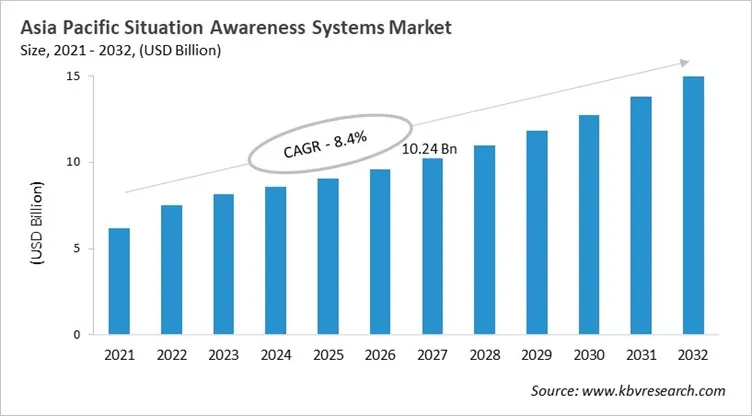
In the Asia Pacific region, situational awareness systems have changed from tools for surveillance and command that were only used for defense to platforms that work across land, air, sea, cyber, and space. Major regional powers' defense modernization programs are pushing investments in networked C2, ISR, and sensor fusion technologies. More advanced technologies like AI, machine learning, autonomous sensors, and real-time analytics are being built in to help find threats and make decisions faster. Regional security dynamics and maritime challenges further increase the need for a full understanding of the situation. Interoperability through joint exercises and frameworks based on alliances is still a top priority. These changes make SAS a key part of how modern militaries work.
Situational awareness systems are being used for more than just military purposes. They are also being used for homeland security, smart cities, disaster response, and protecting critical infrastructure. To help the country be more resilient, governments stress secure data sharing, cybersecurity standards, and integration across domains. To meet changing needs, OEMs and defense integrators focus on open architectures, edge computing, and lifecycle support. Increasingly, companies are using local manufacturing, technology transfer, and partnerships with other businesses in their own countries as part of their competitive strategies. Suppliers also branch out into civil security applications to make more money. Overall, the Asia Pacific SAS market shows that technology is being adopted quickly, governments are supporting it strongly, and regional cooperation is growing.
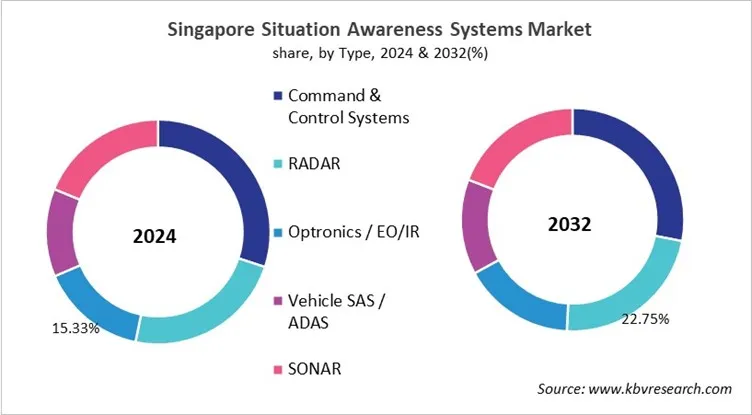
Based on Type, the market is segmented into Command & Control Systems, RADAR, Optronics / EO/IR, Vehicle SAS / ADAS, and SONAR. The Command & Control Systems market segment dominated the Singapore Situation Awareness Systems Market by Type is expected to grow at a CAGR of 8 % during the forecast period thereby continuing its dominance until 2032. Also, The Vehicle SAS / ADAS market is anticipated to grow as a CAGR of 10.1 % during the forecast period during (2025 - 2032).
Based on End-User Industry, the market is segmented into Defense & Military, Homeland Security & Public Safety, Aviation & Aerospace, Maritime, and Other End-User Industry. Among various South Korea Situation Awareness Systems Market by End-User Industry; The Defense & Military market achieved a market size of USD $477.2 Million in 2024 and is expected to grow at a CAGR of 7.9 % during the forecast period. The Other End-User Industry market is predicted to experience a CAGR of 11.5% throughout the forecast period from (2025 - 2032).
Based on Application, the market is segmented into C4ISR / Battle Management, Security & Surveillance, Disaster Response & Emergency Management, Navigation & Traffic Control, Environmental / Weather Monitoring, and Other Application. With a compound annual growth rate (CAGR) of 8.7% over the projection period, the C4ISR / Battle Management Market, dominate the Malaysia Situation Awareness Systems Market by Application in 2024 and would be a prominent market until 2032. From 2025 to 2032 The Environmental / Weather Monitoring market is expected to witness a CAGR of 11.3% during (2025 - 2032).
Free Valuable Insights: The Situation Awareness Systems Market is Predicted to reach USD 44.44 Billion by 2032, at a CAGR of 6.8%
Long-term strategies for modernizing and informatizing China's defense systems that put a high priority on joint, multi-domain operations are what drive the country's situational awareness systems market. People think that situational awareness is a key part of command and control in land, air, sea, space, and cyber environments. Investments are focused on integrated ISR, radar, satellite monitoring, and sensor fusion to help with continuous surveillance and early warning. A lot of focus is on AI, big data analytics, and automation to make it possible to process data in real time and figure out what threats might happen. Autonomous platforms and space-based assets make it even easier to see what's going on. State-owned defense and electronics companies that follow centralized policy are the biggest players in the market. In general, indigenous development and information dominance are still very important to China's situational awareness ecosystem.

By Type
By Component
By Platform
By End-User Industry
By Application
By Country
Our team of dedicated experts can provide you with attractive expansion opportunities for your business.



 Unique Offerings