The Asia Pacific Sensing Cable Market would witness market growth of 7.1% CAGR during the forecast period (2025-2032).
The China market dominated the Asia Pacific Sensing Cable Market by Country in 2024, and would continue to be a dominant market till 2032; thereby, achieving a market value of $185.9 million by 2032. The Japan market is registering a CAGR of 6.1% during (2025 - 2032). Additionally, The India market would showcase a CAGR of 7.7% during (2025 - 2032). The China and India led the Asia Pacific Sensing Cable Market by Country with a market share of 39.4% and 16.6% in 2024. The Malaysia market is expected to witness a CAGR of 10.4% during throughout the forecast period.
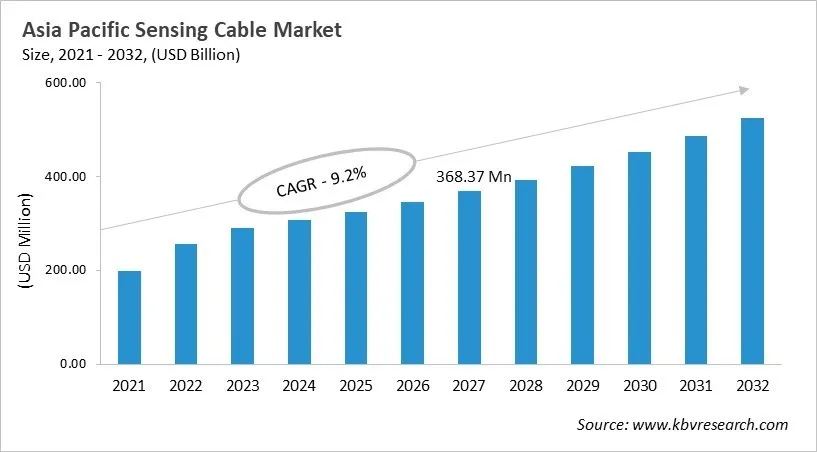
Over the past twenty years, the Asia Pacific sensing cable market has grown quickly. This is because of large-scale infrastructure development, industrial growth, and the need for real-time monitoring across power, transportation, energy, and telecommunications networks. Rapid urbanization in countries like China, India, Japan, South Korea, and ASEAN nations has made assets more complicated, so old ways of checking them aren't enough anymore. Because of this, fiber-optic sensing technologies like Distributed Temperature Sensing (DTS), Distributed Acoustic Sensing (DAS), Distributed Strain Sensing (DSS), and Fiber Bragg Grating (FBG) systems are now widely used. Government-led projects that focus on smart grids, infrastructure that can withstand disasters, and digital transformation have sped up deployment even more, especially for monitoring power grids, pipelines, tunnels, railways, and industrial facilities.
Asia Pacific is now one of the fastest-growing and most competitive sensing cable markets in the world. This is because of strong regulations, the need to reduce disaster risk, and investments in smart infrastructure. Top companies strengthen their presence by making things in specific areas, coming up with new technologies for those areas, and teaming up with utilities, transportation authorities, and government agencies. Sensing accuracy, durability, system integration, and cost-effectiveness all play a role in competition. Global cable companies compete with strong regional and specialized sensing providers. The move toward integrated monitoring ecosystems, predictive maintenance, and infrastructure that is good for the environment is still shaping the market and long-term growth in the area.
Based on End-Use Industry, the market is segmented into Oil and Gas, Power and Utilities, Civil Infrastructure and Construction, Industrial Manufacturing and Process, Defense and Security and Data Centers and Commercial Buildings. Among various China Sensing Cable Market by End-Use Industry; The Oil and Gas market achieved a market size of USD $52.3 Million in 2024 and is expected to grow at a CAGR of 5.1 % during the forecast period. The Industrial Manufacturing and Process market is predicted to experience a CAGR of 7% throughout the forecast period from (2025 - 2032).
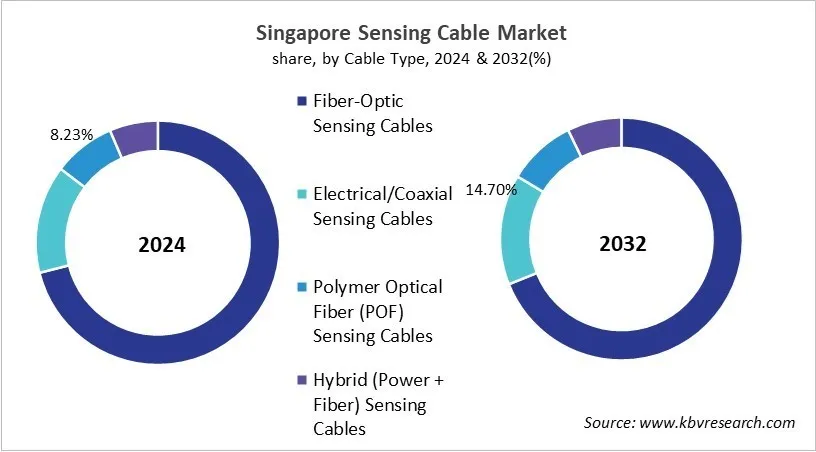
Based on Cable Type, the market is segmented into Fiber-Optic Sensing Cables, Electrical/Coaxial Sensing Cables, Polymer Optical Fiber (POF) Sensing Cables and Hybrid (Power + Fiber) Sensing Cables. With a compound annual growth rate (CAGR) of 9% over the projection period, the Fiber-Optic Sensing Cables Market, dominate the Singapore Sensing Cable Market by Cable Type in 2024 and would be a prominent market until 2032.The Polymer Optical Fiber (POF) Sensing Cables market is expected to witness a CAGR of 10.9% during (2025 - 2032).
Free Valuable Insights: The Sensing Cable Market is Predicted to reach USD 1.68 Billion by 2032, at a CAGR of 6.6%
China has the biggest and most important sensing cable market in the Asia Pacific region. This is because it has a lot of factories, is building a lot of infrastructure, and is always investing in modernizing its factories. Strong demand comes from many different industries, including industrial automation, energy, utilities, transportation, and petrochemicals. Government-led initiatives to promote Industry 4.0 and smart-factory adoption also help. The need for real-time monitoring with advanced fiber-optic and temperature-sensing cables is growing even faster because of new pipelines, high-speed rail, power grids, and renewable energy assets. Market trends show that sensing cables are being used more and more for leak detection, monitoring the health of structures, fire safety, and installations that are good for the environment. Global technology leaders and cost-competitive domestic manufacturers are in a fierce competition over reliability, following the rules, and integrating systems.

By Application
By End-Use Industry
By Sensing Technology
By Cable Type
By Country
Our team of dedicated experts can provide you with attractive expansion opportunities for your business.




 Unique Offerings