The Asia Pacific Self-Healing Networks Market is expected to reach $947.84 million by 2029 and would witness market growth of 31.7% CAGR during the forecast period (2025-2032).
The China market dominated the Asia Pacific Self-Healing Networks Market by Country in 2024, and would continue to be a dominant market till 2032; thereby, achieving a market value of $618.5 million by 2032. The Japan market is registering a CAGR of 30.7% during (2025 - 2032). Additionally, The India market would showcase a CAGR of 32.5% during (2025 - 2032). The China and Japan led the Asia Pacific Self-Healing Networks Market by Country with a market share of 31.9% and 17.2% in 2024. The Singapore market is expected to witness a CAGR of 33.8% during throughout the forecast period.
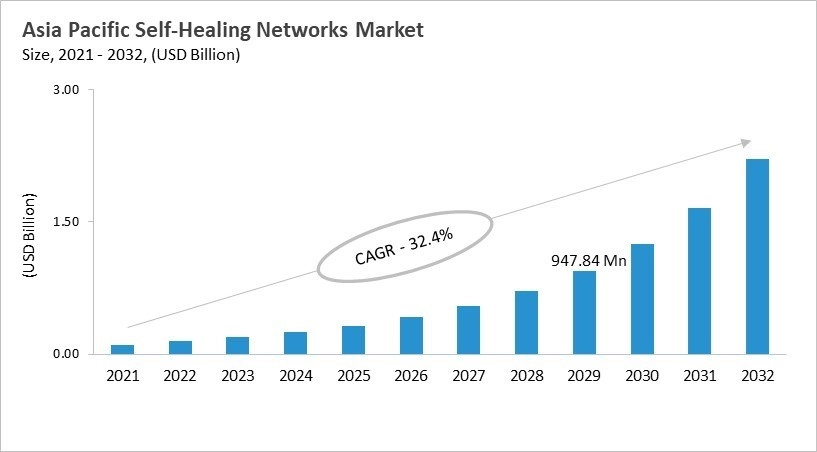
The Asia Pacific region has become a major center for the use of self-healing networks. This is because of the rapid growth of digital infrastructure, the widespread use of 5G, and government-supported smart connectivity projects. Countries like China, Japan, South Korea, India, Singapore, and Australia are putting resilient and autonomous networks at the top of their lists to handle more data traffic, industrial automation, and digital public services. These networks have changed over time from early automation projects and IP-based architectures to AI-driven network operations that allow for predictive maintenance, root-cause analysis, and closed-loop remediation. OEMs like Cisco, Huawei, Nokia, and Ericsson have added self-healing features to network management platforms. This makes service more reliable and reduces downtime for telecom, enterprise, cloud, and industrial networks.
Some important trends in the market are the merging of self-healing networks with 5G and cloud-native architectures, which will help mission-critical applications communicate with ultra-reliable low-latency connections. Businesses and government-backed smart city projects are using these technologies more and more to keep things running smoothly, reduce downtime, and make networks more resilient. To boost adoption and meet local needs, top vendors focus on new technologies, research and development in their own regions, working together with other companies, and following open standards. In the competitive landscape, global OEMs dominate large-scale deployments, while regional providers offer customized solutions. AI capabilities, automation maturity, and support for complex 5G and cloud-native environments are becoming more important for market differentiation.
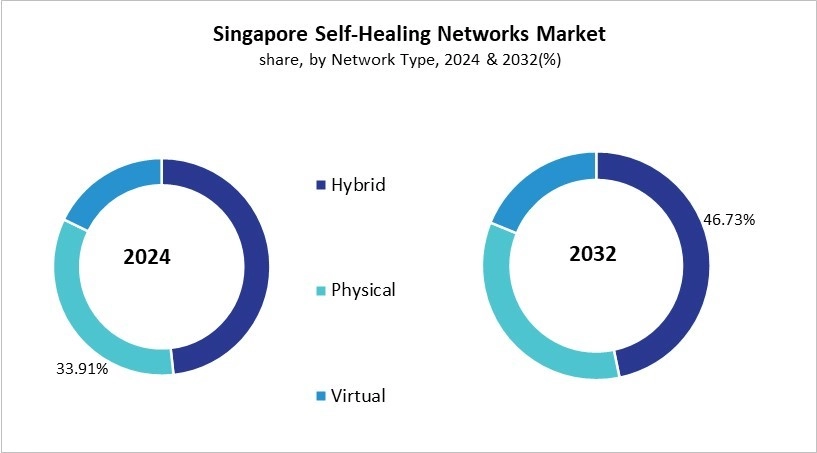
Based on Network Type, the market is segmented into Hybrid, Physical and Virtual. The Hybrid market segment dominated the Singapore Self-Healing Networks Market by Network Type is expected to grow at a CAGR of 33.3 % during the forecast period thereby continuing its dominance until 2032. Also, The Virtual market is anticipated to grow as a CAGR of 34.8 % during the forecast period during (2025 - 2032).
Based on Industry Vertical, the market is segmented into IT & ITES, Telecommunications, BFSI, Healthcare, Retail, Education and Other Industry Vertical. Among various China Self-Healing Networks Market by Industry Vertical; The IT & ITES market achieved a market size of USD $19.3 Million in 2024 and is expected to grow at a CAGR of 27 % during the forecast period. The Education market is predicted to experience a CAGR of 31.5% throughout the forecast period from (2025 - 2032).
Free Valuable Insights: Self-Healing Networks Market is Predicted to reach USD 8.46 billion by 2032, at a CAGR of 30.9%
China is one of the most advanced and largest markets for self-healing networks in the Asia Pacific. This is because of the widespread use of 5G standalone, cloud growth, and smart city projects. Operators like China Mobile need automated fault detection, root cause analysis, and recovery because it is hard to keep ultra-dense networks running with as little downtime as possible. Market trends show that AI-driven, closed-loop automation is being widely used across network layers. This makes it possible to optimize in real time and improve resilience all the time. Self-healing features are being added to more and more enterprise and industrial networks. These features help mission-critical applications while also making networks more energy efficient. In the competition, operators and equipment makers work together. Huawei is at the forefront of developing autonomous network technologies, and companies try to stand out by focusing on scalability, AI accuracy, and the reliability of their networks across the country.

By Enterprise Type
By Offering
By Network Type
By Application
By Industry Vertical
By Country
Our team of dedicated experts can provide you with attractive expansion opportunities for your business.



 Unique Offerings