The Asia Pacific Retail Audience Measurement Solutions Market would witness market growth of 19.7% CAGR during the forecast period (2025-2032).
The China market dominated the Asia Pacific Retail Audience Measurement Solutions Market by Country in 2024, and would continue to be a dominant market till 2032; thereby, achieving a market value of $1,495.3 million by 2032. The Japan market is showcasing a CAGR of 18.9% during (2025 - 2032). Additionally, The India market would exhibit a CAGR of 20.3% during (2025 - 2032). The China and India led the Asia Pacific Retail Audience Measurement Solutions Market by Country with a market share of 29.4% and 19.4% in 2024.The Malaysia market is expected to witness a CAGR of 22.4% during throughout the forecast period.
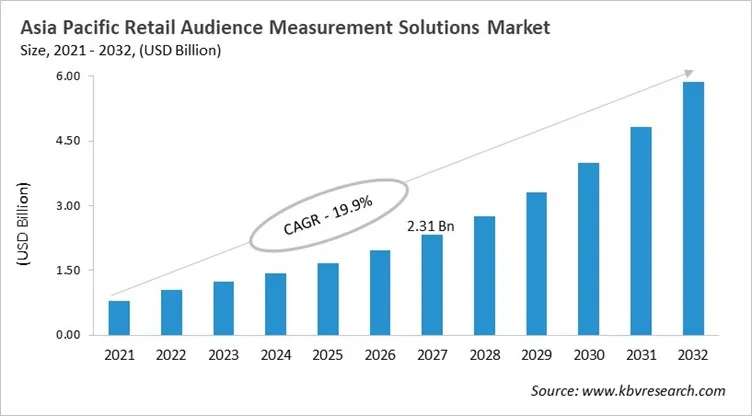
The APAC retail audience measurement market has changed quickly from simple footfall tracking to more advanced AI-driven analytics. This is because of the growth of modern retail, omnichannel strategies, and smart-store infrastructure. Retailers now use computer vision, IoT sensors, and cloud platforms to get real-time information about how customers move around the store, how they interact with shelves, and how well the store is doing. AI-based shelf analytics, cloud-native scaling, and data monetization through retail media networks are just a few of the trends that are changing how physical store engagement is measured and made money. Privacy concerns and different rules in different places have sped up the use of on-device AI, anonymization, and edge analytics. As a result, the area has become a connected retail ecosystem where data about customers helps with operational efficiency, personalizing customer experience, and increasing the value of commercial media.
Trax and SAP are two examples of regional experts that drive competition in APAC. They both have their own strategies that work well with each other. Trax is the leader in real-time shelf execution analytics that use computer vision. Their main goal is to make it easy to use and give CPG and retail teams useful information. Meanwhile, SAP uses its growing retail cloud stack to help with omnichannel operations, data integration, personalization, and big changes to businesses. There are also smart retail vendors that focus on the Internet of Things (IoT), cloud-native analytics providers, and local system integrators that make sure deployments meet national compliance standards. As digital transformation speeds up across APAC, the focus is now on creating platforms that can support both operational optimization and revenue generation based on audience data.
Based on End Use, the market is segmented into Supermarkets & Hypermarkets, Specialty Stores, Convenience Stores, Department Stores, and Other End Use. Among various China Retail Audience Measurement Solutions Market by End Use; The Supermarkets & Hypermarkets market achieved a market size of USD $160.9 Million in 2024 and is expected to grow at a CAGR of 16.8 % during the forecast period. The Department Stores market is predicted to experience a CAGR of 18.4% throughout the forecast period from (2025 - 2032).
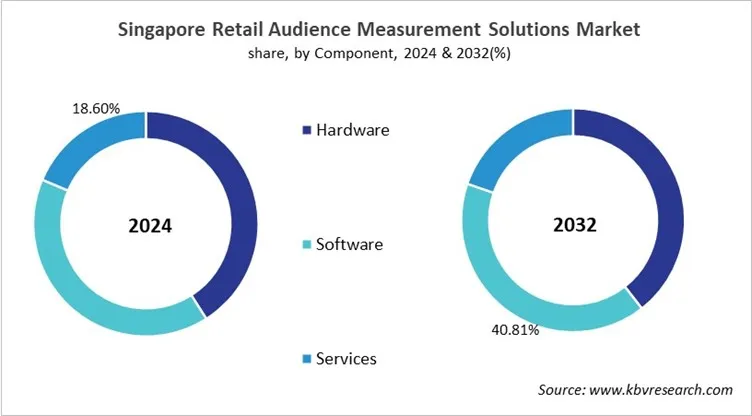
Based on Component, the market is segmented into Hardware, Software, and Services. The report also covers geographical segmentation of Retail Audience Measurement Solutions market. With a compound annual growth rate (CAGR) of 21.1% over the projection period, the Hardware Market, dominate the Singapore Retail Audience Measurement Solutions Market by Component in 2024 and would be a prominent market until 2032.The Software market is expected to witness a CAGR of 21.7% during (2025 - 2032).
Free Valuable Insights: The Retail Audience Measurement Solutions Market is Predicted to reach USD 18.90 Billion by 2032, at a CAGR of 19.1%
As part of China's larger smart-retail and digital transformation strategy, retail audience measurement is speeding up. This is because cities are growing quickly and there are a lot of physical stores. Big OEMs like Hikvision and Dahua are moving beyond security cameras into smart retail analytics, which includes things like counting people, analyzing queues, and heat mapping in unified video platforms. Deep-learning AI counting solutions are making things more accurate and cutting down on false detections. This helps retailers better understand foot traffic patterns and run their businesses more efficiently. Government smart city projects are making it easier for people to use video systems for both security and business intelligence. Retailers are using data insights to improve their marketing, store layouts, staffing, and conversion rates. In the competitive landscape, domestic giants with strong infrastructure integration are in charge. At the same time, new AI specialists are bringing new ideas to the table with their work on integrating with POS systems and digital signage. As AI-driven analytics become more important to retail decision-making, China's market is growing up quickly.

By Application
By End Use
By Component
By Country
Our team of dedicated experts can provide you with attractive expansion opportunities for your business.



 Unique Offerings