The Asia Pacific Post-Quantum Cryptography Market would witness market growth of 40.3% CAGR during the forecast period (2025-2032).
The China market dominated the Asia Pacific Post-Quantum Cryptography Market by Country in 2024, and would continue to be a dominant market till 2032; thereby, achieving a market value of $1,141.9 million by 2032. The Japan market is showcasing a CAGR of 39.4% during (2025 - 2032). Additionally, The India market would register a CAGR of 41.3% during (2025 - 2032). The China and Japan led the Asia Pacific Post-Quantum Cryptography Market by Country with a market share of 34.4% and 18.4% in 2024.The Malaysia market is expected to witness a CAGR of 44.6% during throughout the forecast period.
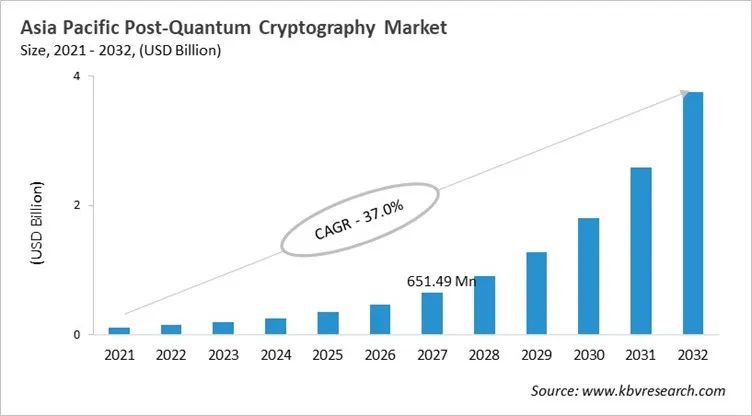
The Asia Pacific post-quantum cryptography (PQC) market is changing quickly as governments and tech leaders deal with new cybersecurity threats that come with the quantum era. Japan, Singapore, Australia, South Korea, China, and India are some of the countries that have started national quantum strategies that put quantum-resistant encryption at the top of the list for protecting important infrastructure and digital assets. Japan and Singapore, two early movers, have made quantum-safe communications and cryptographic frameworks better through strong government programs. Australia, South Korea, India, and China all add to the regional momentum with their work in quantum research, telecom security, and long-term data protection policies. Global OEMs help this change by making cloud, authentication, and hybrid cryptographic systems that are ready for PQC. Policy leadership and technological capacity make Asia Pacific a quickly growing PQC ecosystem.
Strong government-driven adoption mandates, quick integration of PQC into telecom networks, cloud platforms, and enterprise systems, and widespread use of hybrid cryptography during transition phases are some of the most important trends. Telecom companies test PQC-enabled security for 5G, IoT, and edge use cases. Cloud providers, on the other hand, use PQC in all of their regional data centers. Hybrid models help businesses deal with old systems while lowering quantum risk. When governments, OEMs, telecom companies, and research institutions work together, it speeds up innovation and commercialization. Competition is still changing and working together, and public policy, digitalization, and OEM expansion are all helping to shape PQC adoption in the area.
Based on Type, the market is segmented into Lattice-Based Cryptography, Code-Based Cryptography, Hash-Based Cryptography, Multivariate Cryptography and Other Type. Among various China Post-Quantum Cryptography Market by Type; The Lattice-Based Cryptography market achieved a market size of USD $41.7 Million in 2024 and is expected to grow at a CAGR of 37.5 % during the forecast period. The Multivariate Cryptography market is predicted to experience a CAGR of 40% throughout the forecast period from (2025 - 2032).
Free Valuable Insights: The Post-Quantum Cryptography Market is Predicted to reach USD 13.94 Billion by 2032, at a CAGR of 39.6%
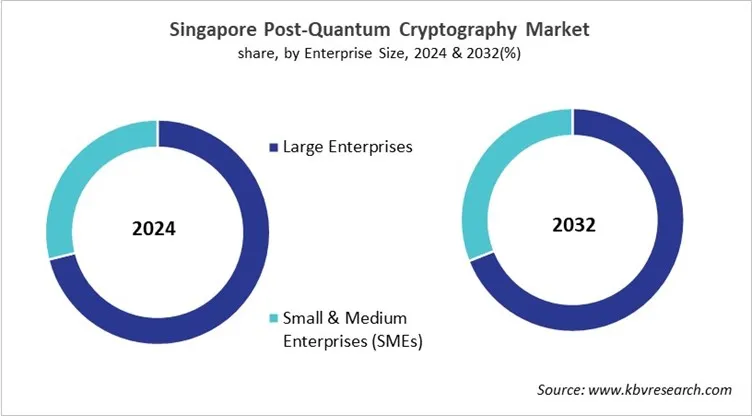
Based on Enterprise Size, the market is segmented into Large Enterprises and Small & Medium Enterprises (SMEs)t. The Large Enterprises market segment dominated the Singapore Post-Quantum Cryptography Market by Enterprise Size is expected to grow at a CAGR of 42.3 % during the forecast period thereby continuing its dominance until 2032. Also, The Small & Medium Enterprises (SMEs) market is anticipated to grow as a CAGR of 44.1 % during the forecast period during (2025 - 2032).
China is quickly adopting post-quantum cryptography (PQC) thanks to strong government support, a focus on national security, and the widespread use of digital technology in finance, telecommunications, and public services. The State Cryptography Administration and MIIT have told companies to start testing quantum-resistant algorithms as soon as possible. The telecom and banking industries are leading the way with pilot projects. A strong focus on being self-sufficient with technology drives the development of lattice- and code-based cryptography in China, with help from institutions like the Chinese Academy of Sciences. A lot of money is being put into quantum communication infrastructure, which makes it more important to protect classical networks. Hybrid cryptographic deployments, PQC-enabled hardware modules, and secure chips are all trends in the market. Telecom companies are trying out PQC in 5G and 6G networks that will come out in the future. In general, domestic vendors are the most important players in China's PQC ecosystem, but they only follow some global standards for interoperability.

By Services
By Type
By Enterprise Size
By Vertical
By Solution
By Country
Our team of dedicated experts can provide you with attractive expansion opportunities for your business.








 Unique Offerings