The Asia Pacific Population Health Management Market would witness market growth of 22.7% CAGR during the forecast period (2025-2032).
The China market dominated the Asia Pacific Population Health Management Market by Country in 2024, and would continue to be a dominant market till 2032; thereby, achieving a market value of $22,378.8 million by 2032. The Japan market is registering a CAGR of 22% during (2025 - 2032). Additionally, The India market would showcase a CAGR of 23.5% during (2025 - 2032). The China and Japan led the Asia Pacific Population Health Management Market by Country with a market share of 27.9% and 20.2% in 2024.The Singapore market is expected to witness a CAGR of 24.5% during throughout the forecast period.
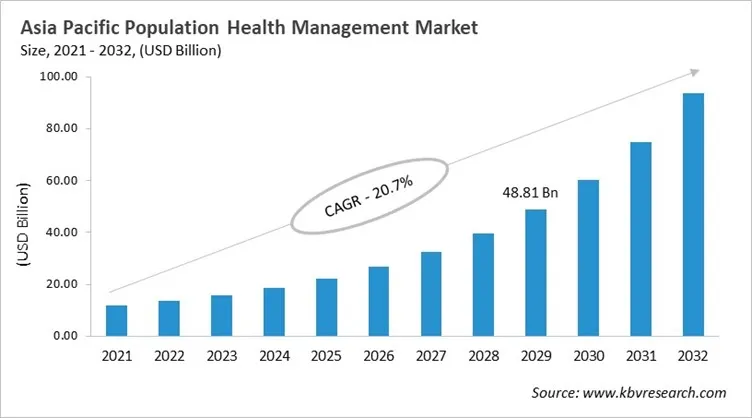
Population health management (PHM) in Asia-Pacific has advanced from fragmented pilots to system-level adoption, driven by demographic pressures, rising chronic disease burdens, and government-led reforms emphasizing primary care and preventive models. The region’s health systems are shifting from hospital-centric care to “hospital-to-home” pathways, supported by digital policies, funding incentives, and investments in remote monitoring, predictive analytics, and AI-enabled decision support. Strategic public–private partnerships and ecosystem collaborations are central, aligning policy goals with vendor capabilities to scale PHM platforms, strengthen resilience, and improve cost-effectiveness across diverse healthcare settings.
Competition in the Asia-Pacific PHM market reflects a mix of global OEMs, local health IT firms, insurers, and public initiatives. Large global players leverage scale, technology breadth, and strong provider relationships to secure national and hospital-level deployments, while regional vendors succeed by offering lower-cost, culturally adapted, and rapidly customizable solutions. Success increasingly depends on partnerships, localized technology, and outcome-based contracting models. Vendors that combine analytics, AI integration, workforce training, and financing models with service delivery are best positioned to demonstrate measurable results, gaining competitive advantage in a rapidly growing and heterogeneous market.
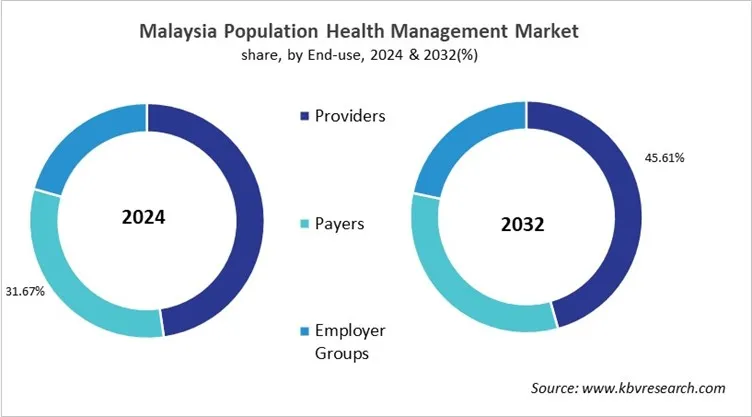
With a compound annual growth rate (CAGR) of 25% over the projection period, the Providers Market, dominate the Malaysia Population Health Management Market by End-use in 2024 and would be a prominent market until 2032. The Employer Groups market is expected to witness a CAGR of 26.5% during (2025 - 2032).
Free Valuable Insights: The Global Population Health Management Market is Predict to reach USD 392.09 Billion by 2032, at a CAGR of 21.6%
The Cloud-based market segment dominated the Japan Population Health Management Market by Delivery Mode is expected to grow at a CAGR of 22.2 % during the forecast period thereby continuing its dominance until 2032. Also, The On-Premise market is anticipated to grow as a CAGR of 21.5 % during the forecast period during (2025 - 2032).
China’s population health management market is witnessing rapid growth driven by healthcare reforms, an aging population, and the rising burden of chronic diseases. Government initiatives such as the Healthy China 2030 plan emphasize preventive care, digital health adoption, and value-based care models, supported by EHRs, telemedicine, and big data analytics. Advancements in AI, mobile health, and wearable devices are enabling personalized care and greater patient engagement. However, challenges around data privacy and rural-urban healthcare disparities persist, while collaborations among authorities, providers, and technology players continue to shape the competitive landscape.

By Product
By Delivery Mode
By End-use
By Country
Our team of dedicated experts can provide you with attractive expansion opportunities for your business.





 Unique Offerings