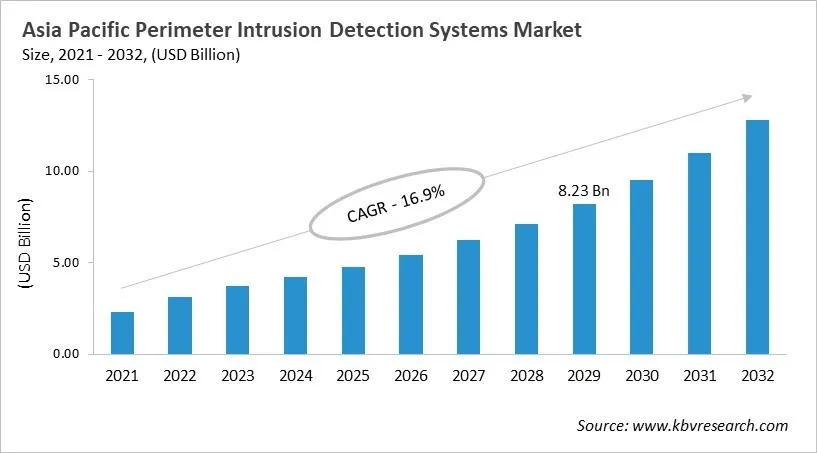
The Asia Pacific Perimeter Intrusion Detection Systems Market is expected to reach $8.23 billion by 2029 and would witness market growth of 15.1% CAGR during the forecast period (2025-2032).
The China market dominated the Asia Pacific Perimeter Intrusion Detection Systems Market by Country in 2024, and would continue to be a dominant market till 2032; thereby, achieving a market value of $3,781.6 million by 2032, growing at a CAGR of 13.3 % during the forecast period. The Japan market is registering a CAGR of 14.1% during (2025 - 2032). Additionally, The India market would showcase a CAGR of 15.8% during (2025 - 2032). The China and India led the Asia Pacific Perimeter Intrusion Detection Systems Market by Country with a market share of 33.5% and 17.6% in 2024. The Malaysia market is expected to witness a CAGR of 18% during throughout the forecast period.
Perimeter Intrusion Detection Systems (PIDS) have become an important part of physical security in the Asia-Pacific region because cities are growing quickly, infrastructure is being built on a large scale, and people are worried about safety. From simple physical barriers and manual surveillance, the market has changed to more advanced electronic systems that use sensors to detect and warn people in real time. Governments and infrastructure operators are putting more and more emphasis on layered security models. PIDS are the first line of defense for airports, ports, rail networks, utilities, and industrial facilities. OEMs have responded by adding strong technologies like fiber-optic sensing, fence-mounted sensors, PIR, and radar systems that are meant to work well in a wide range of difficult and varied environmental conditions that are common in the area.
The Asia-Pacific PIDS market is now known for its ability to integrate technologies, grow, and fit in with goals for public safety. Video surveillance, access control, and centralized monitoring platforms are often built into modern systems to help people be more aware of what's going on and cut down on false alarms. OEMs are interested in modular, interoperable solutions that can be used for big and growing infrastructure projects, like smart city projects. Global and regional players are competing with each other on how accurate their detection is, how reliable their systems are in different environments, and how well they can work together. Vendors that work closely with government agencies and infrastructure authorities and offer solutions that are ready for the future and meet local standards are in a strong competitive position throughout the region.
Based on Offering, the market is segmented into Hardware, Software and Services. With a compound annual growth rate (CAGR) of 12.8% over the projection period, the Hardware Market, dominate the China Perimeter Intrusion Detection Systems Market by Offering in 2024 and would be a prominent market until 2032. The Services market is expected to witness a CAGR of 14.1% during (2025 - 2032).
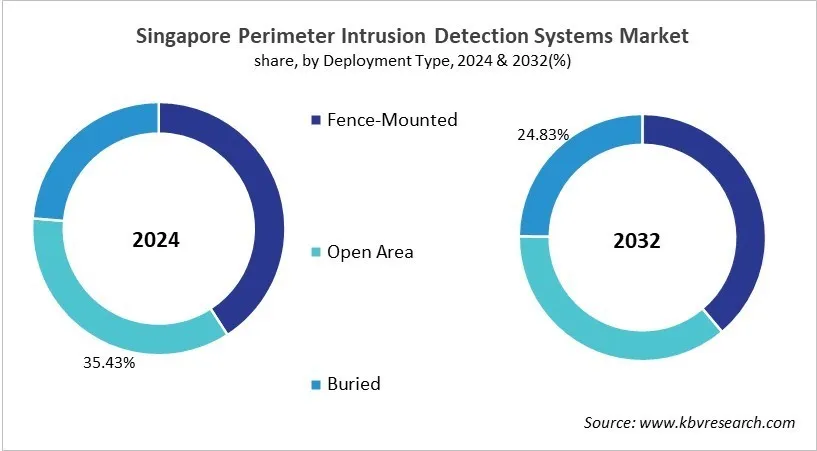
Based on Deployment Type, the market is segmented into Fence-Mounted, Open Area and Buried. The Fence-Mounted market segment dominated the Singapore Perimeter Intrusion Detection Systems Market by Deployment Type is expected to grow at a CAGR of 16.3 % during the forecast period thereby continuing its dominance until 2032. Also, The Buried market is anticipated to grow as a CAGR of 17.8 % during the forecast period during (2025 - 2032).
Free Valuable Insights: The Perimeter Intrusion Detection Systems Market is Predicted to reach USD 47.21 Billion by 2032, at a CAGR of 14.2%
The market for China's perimeter intrusion detection systems (PIDS) is growing because of the country's rapid urbanization, the growth of smart city projects, and the need for better perimeter security for both public and private property. The Ministry of Public Security leads strong national security and public safety mandates that support the widespread use of intrusion detection solutions around borders, transportation networks, industrial zones, and high-value manufacturing facilities. A major trend in the market is the integration of PIDS with video surveillance and AI-based analytics. This makes it possible to use multiple sensors that cut down on false alarms and make threat detection more accurate. Transportation infrastructure, like airports, ports, and metro stations, is still a big area for adoption, along with industrial and logistics facilities. The competitive landscape is mostly made up of domestic OEMs that offer complete, integrated solutions. International companies, on the other hand, mostly work together to develop specialized technologies.

By Offering
By Deployment Type
By End-User Verticals
By Country
Our team of dedicated experts can provide you with attractive expansion opportunities for your business.



 Unique Offerings