The Asia Pacific Passive Optical Component Market would witness market growth of 13.8% CAGR during the forecast period (2025-2032).
The China market dominated the Asia Pacific Passive Optical Component Market by Country in 2024, and would continue to be a dominant market till 2032; thereby, achieving a market value of $16,075.5 million by 2032. The Japan market is registering a CAGR of 12.7% during (2025 - 2032). Additionally, The India market would showcase a CAGR of 14.5% during (2025 - 2032). The China and India led the Asia Pacific Passive Optical Component Market by Country with a market share of 42% and 17.6% in 2024. The Singapore market is expected to witness a CAGR of 16.1% during throughout the forecast period.
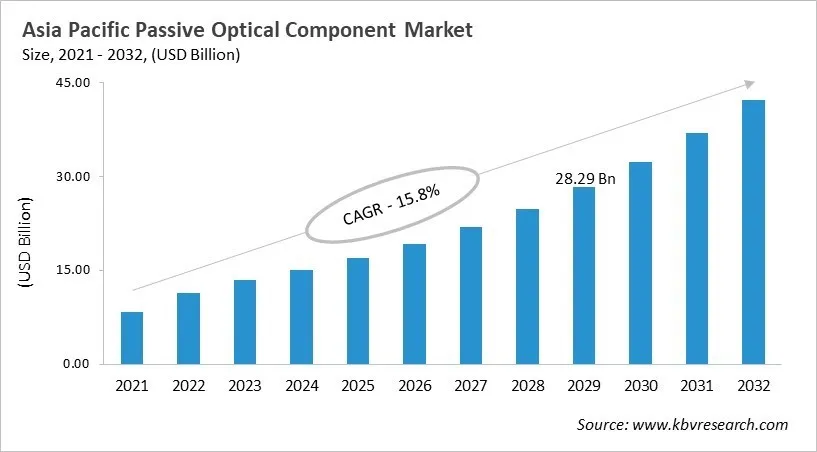
The Asia Pacific Passive Optical Component Market has grown quickly because of strong government efforts to improve digital infrastructure, early use of fiber technologies, and strong leadership from OEMs. Japan, South Korea, and Singapore got things going in the 1980s and 1990s. Then, China, India, and Southeast Asian countries sped things up with programs like China's "Broadband China" and India's BharatNet. This growth increased the need for important passive optical parts like splitters, connectors, WDM filters, and fiber enclosures. At the same time, hyperscale data centers, cloud computing, and 4G/5G networks all grew, making the sector even more important. Asia Pacific is now the world's largest consumer and producer of passive optical solutions.
Some of the most important trends in the market are faster fiber-optic rollouts, the rapid growth of data centers and cloud platforms, and a strong focus on optical innovation and advanced material technologies. To stay ahead of the competition, top companies like Huawei, ZTE, FiberHome, Fujikura, and Sumitomo Electric focus on research and development, vertical integration, partnerships with operators, and taking part in government-led broadband projects. The market in this area is very competitive and technologically advanced for passive optical components. It is known for its high level of technological innovation, cost efficiency based on scale, and strategic partnerships.
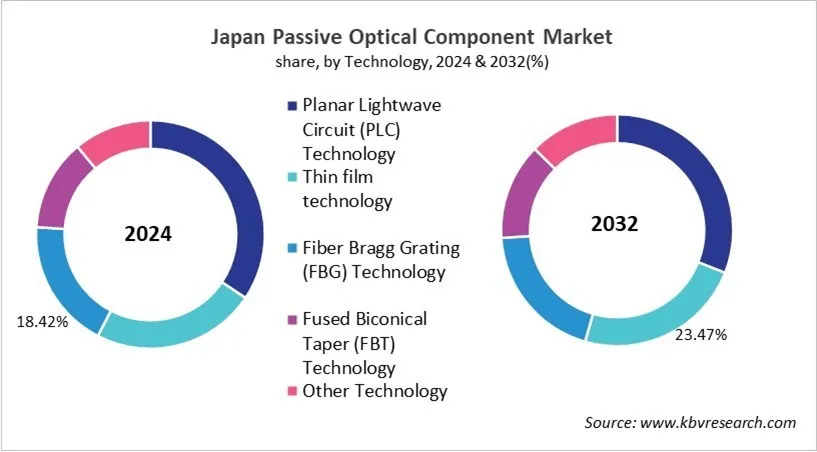
Based on Technology, the market is segmented into Planar Lightwave Circuit (PLC) Technology, Thin film technology, Fiber Bragg Grating (FBG) Technology, Fused Biconical Taper (FBT) Technology and Other Technology. The Planar Lightwave Circuit (PLC) Technology market segment dominated the Japan Passive Optical Component Market by Technology is expected to grow at a CAGR of 11.2 % during the forecast period thereby continuing its dominance until 2032. Also, The Fused Biconical Taper (FBT) Technology market is anticipated to grow as a CAGR of 13.3 % during the forecast period during (2025 - 2032).
Based on Application, the market is segmented into Telecommunications, Fiber to the Home (FTTH), Data Centers, Cable Television (CATV), Enterprise Networks, Industrial Networking and Other Application. Among various Singapore Passive Optical Component Market by Application; The Telecommunications market achieved a market size of USD $228.7 Million in 2024 and is expected to grow at a CAGR of 14.5 % during the forecast period. The Enterprise Networks market is predicted to experience a CAGR of 16.8% throughout the forecast period from (2025 - 2032).
Free Valuable Insights: The Passive Optical Component Market is Predicted to reach USD 140.37 Billion by 2032, at a CAGR of 13.3%
China has the biggest and most advanced passive optical component market in the Asia Pacific. This is because of strong government programs like MIIT's "Broadband China," huge investments in telecom infrastructure, and strong domestic manufacturing capabilities. The demand for WDM filters, PLC splitters, connectors, and high-capacity optical cables has grown because of the quick deployment of fiber, the growth of 5G networks, and the rise of cloud computing, hyperscale data centers, and digital-platform ecosystems. Major players in the US market, like Huawei, FiberHome, ZTE, and YOFC, dominate because of their size, low costs, and technical know-how. Global OEMs, on the other hand, focus on high-end markets. High-density fiber management, silicon-photonics-based devices, and advanced passive optical distribution for FTTH and AI-driven data centers are all examples of market trends. China stays at the top of the world in optical-component technology because of strong competition and constant innovation toward small, powerful, and affordable solutions.

By Technology
By Component Type
By Application
By Country
Our team of dedicated experts can provide you with attractive expansion opportunities for your business.




 Unique Offerings