The Asia Pacific Passenger Information System Market would witness market growth of 14.3% CAGR during the forecast period (2025-2032).
The China market dominated the Asia Pacific Passenger Information System Market by Country in 2024, and would continue to be a dominant market till 2032; thereby, achieving a market value of $7,856.4 million by 2032. The Japan market is registering a CAGR of 13.3% during (2025 - 2032). Additionally, The India market would showcase a CAGR of 14.9% during (2025 - 2032). The China and Japan led the Asia Pacific Passenger Information System Market by Country with a market share of 33.9% and 15.2% in 2024.The Singapore market is expected to witness a CAGR of 16.4% during throughout the forecast period.
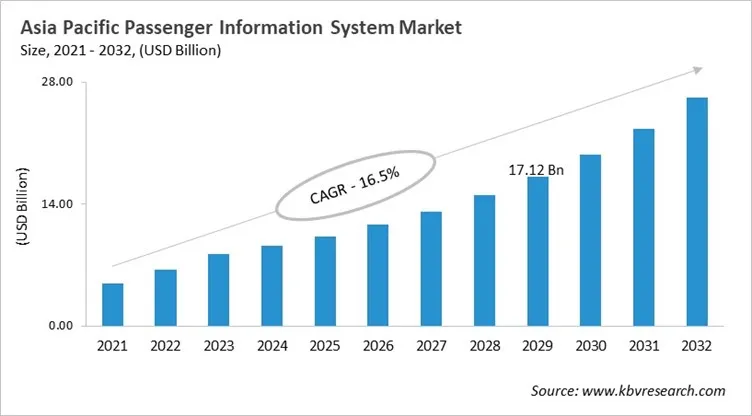
Passenger Information Systems (PIS) in the Asia-Pacific region have become an important part of making public transportation more modern. Japan, South Korea, Singapore, and Australia were some of the first countries to adopt these technologies. They used electronic displays and automated announcements to make the system more reliable and easier for commuters to use. Later, the rapid growth of cities in India, China, and Southeast Asia led to a need for network-wide, real-time PIS solutions. Increasingly, governments saw PIS as necessary for safety, mobility, and efficiency. Combining GPS, central control platforms, and telecom networks made it possible to get updates in real time. Smart city programs in the 2010s sped up the use of rail, metro, and bus systems even more. Because of this, PIS became a key part of smart transport systems all over the area.
The Asia-Pacific PIS market is currently focused on cloud-based architectures, displays that connect to the Internet of Things (IoT), and mobile-first ways of delivering information. Unified multimodal platforms now combine data from metro, bus, suburban rail, and micromobility to make trips easier. High-definition digital screens, smart audio systems, and support for multiple languages make it easier for passengers to get around and enjoy their trip. Mobile apps and AI-powered analytics let you track things in real time, get alerts about problems, and see what's likely to happen in the future. Top OEMs are interested in integrated digital mobility platforms, localization, and long-term partnerships with governments. Local manufacturing and working together with other businesses in the area help keep costs down and make things more personal. Competition is still fierce because of public tenders, the ability to integrate digital services, and lifecycle service offerings.
Based on Type, the market is segmented into Display Systems, Mobile Applications, Announcement Systems, Video Surveillance System, Infotainment System, Emergency Communication Systems and Other Type. Among various China Passenger Information System Market by Type; The Display Systems market achieved a market size of USD $879.6 Million in 2024 and is expected to grow at a CAGR of 10.7 % during the forecast period. The Emergency Communication Systems market is predicted to experience a CAGR of 14.7% throughout the forecast period from (2025 - 2032).
Free Valuable Insights: The Passenger Information System Market is Predicted to reach USD 87.05 Billion by 2032, at a CAGR of 13.7%
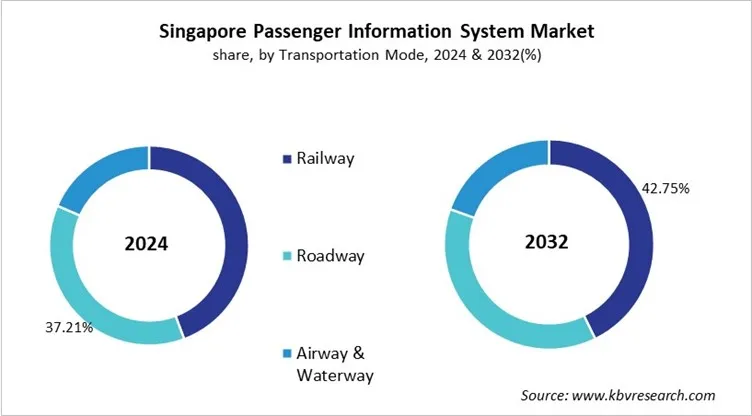
Based on Transportation Mode, the market is segmented into Railway, Roadway and Airway & Waterway. The Railway market segment dominated the Singapore Passenger Information System Market by Transportation Mode is expected to grow at a CAGR of 15.9 % during the forecast period thereby continuing its dominance until 2032. Also, The Airway & Waterway market is anticipated to grow as a CAGR of 17.3 % during the forecast period during (2025 - 2032).
China has one of the biggest and most active Passenger Information System (PIS) markets because it has a lot of public transportation and cities are growing quickly. The country's extensive high-speed rail, metro, and bus systems create a lot of demand for real-time passenger information from millions of people who use them every day. Long-term PIS adoption is supported by a lot of money going into infrastructure and the government's focus on sustainable, integrated transport. Digital mobility platforms, mobile ticketing, contactless payments, and real-time journey updates are all trends in the market. Smart city projects push for more centralized control and the combining of information from different modes of transportation. The government is mostly in charge of the competition, which includes city transit authorities and tech companies that work in the country. Vendors must follow the rules and work with old systems while also providing solutions that can grow and work in different areas. Overall, China's size and drive to modernize make it a PIS market that is growing quickly but is also hard to understand.

By Location
By Component
By Transportation Mode
By Type
By Country
Our team of dedicated experts can provide you with attractive expansion opportunities for your business.







 Unique Offerings